At a second-hand bookstore - for a mere € 15 - I found a beautiful hardcover edition of W.B. Seabrook's 1929 book 'The Magic Island', published by The Literary Guild Of America in 1929, in New York. It is illustrated with (politically very incorrect!) quasi-expressionist drawings by Alexander King, and with photographs by the author. Some of these are reproduced below (click to enlarge).
Seabrook was an exceptional figure: he was a Great War veteran, a journalist and a traveller, a friend to both the Surrealists and to the notorious sorcerer Aleister Crowley, an alcoholic and a sadist. He had supposedly eaten human flesh ("like good, fully developed veal"). The Surrealist photographer Man Ray was inspired by Seabrook's sadist practices to create pornographicphotographs such as "The Fantasies of Mr. Seabrook", "Lee Miller and William Seabrook" and "Homage to D. A. F. Sade", all with Lee Miller as a protagonist. In 1933 Seabrook was voluntarily committed in order to cure his alcoholism, and he documented the experience in his 1935 book "Asylum". Despite the treatment, Seabrook remained an alcoholic. He committed suicide by a drug overdose on September 20, 1945.
The illustrator, Alexander King, was a rake also, described "as a thief, morphine addict, failing playwright and painter, a man of iconoclastic observations and caustic humor who began his career as a painter of human figures, focused primarily on the face. Then he became an art thief, stealing fifty prints from the Metropolitan Museum." King, who claimed to have been married five times, published anecdotes on his life in a series of humorous books, such as May This House Be Safe from Tigers, Mine Enemy Grows Older, I Should Have Kissed Her More, andIs There Life After Birth. King was a frequent guest on on TV talkshows from roughly the mid-1950s until his death in 1965.
Georges Bataille's Surrealist journal Documents published an appreciative article on Seabrook's 'The Magic Island', written by Michel Leiris and Bataille himself. Even if Seabrook's reputation amongst anthropologists is quite bad (his account of Voodoo is often regarded as crypto-racist), Leiris credited Seabrook with being a "conscientious observer and the first man of the white race initiated into the mysteries of voodoo" and praised him for his "humane attitude" toward his subject. Bataille was especially appreciative of the final paragraph quoted below - it echoes Bataille's philosophical attempt to harness the forces of a dis-enchanted sacred to revitalize Western society.
From 'The Magic Island':
"And now the literary-traditional white stranger who spied from hiding in the forest, had such a one lurked near by, would have seen all the wildest tales of Voodoo fiction justified: in the red light of torches which made the moon turn pale, leaping, screaming, writhing black bodies, blood-maddened, sex-maddened, god-maddened, drunken, whirled and danced their dark saturnalia, heads thrown weirdly back as if their necks were broken, white teeth and eyeballs gleaming, while couples seizing one another from time to time fled from the circle, as if pursued by furies, into the forest to share and slake their ecstasy.
Thus also my unspying eyes beheld this scene in actuality, but I did not experience the revulsion which literary tradition prescribes. It was savage and abandoned, but it seemed to me magnificent and not devoid of a certain beauty. Something inside myself awoke and responded to it. These, of course, were very individual emotional reactions, perhaps deplorable in a supposedly civilized person. But I believe that the thing itself - their thing, I mean - is rationally defensible. Of what use is any life without its emotional moments or hours of ecstasy? They were reaching collective ecstasy by paths which were not intrinsically peculiar to their jungle ancestors, but which have been followed by many peoples, some highly civilized, from the earliest ages, and will be followed to the end of time or until we all become mechanical, soulless robots. It is not necessary to look backward to the Dionysian orgies, the bacchanalia, the rites of Adonis, or frenzied David dancing before the Ark of the Covenant. What, after all, were they doing here in these final scenes, when formal ritual had ended, that was so different from things which occur in our own fashionable and expensive night clubs, except that they were doing it with the sanction of their gods and were doing it more succesfully? Savage rhythm, alcohol, and sex excitement - yet there was an essential difference, for here was a mysterious something superadded. Lasciviousness became lust, which is a cleaner thing, and neurotic excitement became authentic ecstasy, the 'divine frenzy' of the ancients.
There us nothing quite as stupid and pathetic as an orgy that doesn't quite come off. Perhaps there is a deep mystical truth in the saying attributed to a much-misunderstood voice, 'Whatever ye do, do it in my name.' Perhaps if we mixed a little true sacrificial blood in our synthetic cocktails and flavored them prayerfully with holy fire, our night clubs would be more orgiastically succesful and become sacred as temples were in the days of Priapus and Aphrodite."
Do not visit the exhibition 'Vodou, art and mysticism from Haiti' at the Tropenmuseum in Amsterdam. I did, on November 8th 2008, and still I sleep uneasily.
Do not visit that exhibition when it moves to the Museum of World Culture in Göteborg, Sweden. The exhibition starts innocently enough, presenting Vodou's most acceptable, folkloric face. It starts politically correct enough, appealing to the emancipatory meaning of Enlightenment in presenting the Haitian religion as a weapon in the struggle against French and American colonial domination. It starts nicely enough, in an Apollonian mode, presenting the Lwa - Vodou's spirits - as the contemporary equivalents of the gods of ancient Greece, exotic and slightly naive, weird but safe. But then you turn a corner, and through a dimly lit passageway you are led to two darkened rooms which reveal a world which has nothing to do with our solid, daylight-filled and clear-headed world. You are led into the ominous world of the secret societies known as Bizango. There, your nerves will start to fray, as did mine.
"The people designated by [the name Bizango] are sorcerers who (...) have joined secret societies whose members, united by the crimes they have committed together, give each other help. The [Bizango] derive material benefits from membership - wealth and all its trappings - a fine house, luxurious cars and a trip to France - though these considerations are secondary to the satisfaction of returning evil for evil, and of 'eating people' during nocturnal expeditions. (...)
Countless stories can be heard about [the Bizango] really belong to the province of the fairy tale, but it seems likely that certain people sometimes do band together, in secret, to practice sorcery or to use the popular belief in sorcerer societies to sow terror around them. Proof that the matter is not wholly a question of superstition is to be found in the passports of the [Bizango], confiscated in humfo [voodoo temples] or handed over to curés by repentant voodooists.
The most sinister fantasies of a kind sure to capture popular imagination have been centered on the 'red sects'. Hideous or grotesque aspect, weird dress, obscene and bloody ceremonies, gratuitous cruelty, weird dress, obscene and bloody ceremonies, gratuitous cruelty - there is no conceivable trait that is not attributed to them provided it is sufficiently repulsive and odious. (...) "
And please do not visit it in Bremen's Überseemuseum, in Germany, as the three rooms in the exhibition dedicated to the Bizango societies contain many frightening artifacts, especially paquets, statues and mirrors (see them on this excellent Flickr slideshow).
The paquets ('parcels') are a special kind of talisman, made of wallets or bottles (sometimes big onion-shaped bottles) wrapped in cloth or silk studded with sequins and adorned with frills. Some of the Bizango paquets on displays had human skulls as stoppers. These paquets, which contain the flesh of a sacrificed 'curly cock' mixed with vegetable substances, have the power of 'heating' or exciting the Lwa; but they also have the power of raising goosebumps on the skin of the museum's visitors.
There is a veritable army statues on display. They are life-size, made of black and red cloth filled up with unknown materials, and adorned with ropes, metal chains and little oxidation-stained mirrors. The statues represent the spirits which rule the Bizango sects, and especially the trinity of Kaifou, Gran Bwa and Simityè (Crossroads, Great Forest and Cemetery). Their eyes - most white, others red, some reflecting - rest heavily on the visitor to the exhibition. They rest all the more heavily when the realization dawns on the visitor that human skulls are sown into the head of these statues; thereafter, their eyes seem to be neither seeing nor dead, neither living nor blind.
But the mirrors on display are the most disconcerting of all exhibits. They are ornate, 19th century mirrors, stained by oxidation, weathered by the passage of time. Their gilded frames are elaborated with rusty chains and sinister woodcuts of snakes and daemons. At the top of a huge circular mirror, a primitive Lucifer winks to the visitor. These mirrors are used to call forth the spirits of Bizango; their reflective surface forms the permeable boundary between this world and a nightmarish Otherworld. As philosopher Maurice Merleau-Ponty noted, mirrors "...change things into spectacle and spectacle into things; myself into another and another into myself...". I trembled at seeing myself in these mirrors, sensing they dissolved the boundaries between self and Bizango.
In his ethnography of Vodou, Métraux writes that - when seen up close - the religion of Haiti does not have the morbid and hallucinatory character which books have given it. That black legend, writes Métraux "..belongs to the colonial period when it was the fruit of hatred and fear. Man is never cruel and unjust with impunity: the anxiety which grows in the minds of those who abuse power often takes the form of imaginary terrors and demented obsessions. He treated him like a beast of burden but dreaded the occult power which he imputed to him. And the greater the subjugation of the Black, the more he inspired fear; that ubiquitous fear which shows in the records of the period and which solidified in that obsession with poison which, throughout the eighteenth century, was the cause of so many atrocities. Perhaps certain slaves did avenge themselves on their tyrants in this way - such a thing is possible and even probable - but the fear which reigned in the plantations had its source in deeper recesses of the soul: it was the witchcraft of remote and mysterious Africa which troubled the sleep of the people in 'the big house'."
The exhibition 'Vodou, art and mysticism from Haiti' proves that Voodoo - or the Bizango cult in any case - does have a hallucinatory and morbid character. The sleep of the people in 'the big house' was not troubled for nothing.
In Greek antiquity, Aristotle observed that "enthousiastic" melodies (associated, as their name indicates, with possession) used the (ancient Greek) Phrygian mode exclusively. The Phrygian mode was said to originate in Phrygia, a kingdom in what is now modern-day Turkey. Also, the aulos was regarded as the instrument specific to Dionysian ecstasies. It was a flute-like wind instrument, which also was seen as coming from the Phrygian kingdom. The music of Dionysian ecstasy was regarded as coming from Phrygia.
Gilbert Rouget in "Music and Trance": "It was indeed from Phrygia (or Thrace, but in any case from Asia Minor) that the Dionysus cult spread (...), or, as the Greeks themselves believed, that it originated. We are therefore justified in saying that, although Dionysian music was Phrygian in instrumentation and mode, it was not because the musical characteristics of this instrumentation and mode in and of themselves (that is to say, their particular timbre or set of intervals) were thought to have any remarkable effect on triggering trance, but rather because they were the clearest sign of Dionysus' identity. This would in any case concur with the general logic of possession. For in fact what is possession other that the invasion of the field of consciousness by the other, that is, someone who has come from elsewhere? Insofar as he is the other, Dionysus is at the same time an elsewhere. This is how he was thought to be, and how his music was experienced. In Dahomey, people of Gun or Fon origin speak Nago when they are possessed by a vodun of Nago origin. Elsewhere, people who ordinarily speak a given African language talk in Arabic if the spirit possessing them is thought to be of Arab origin. When she was possessed by Beelzebub, Jeanne des Agnes spoke, it is said, in Hebrew (...). What is true of speech could also be true of that other language, music."
Rouget's analysis puts in mind Michael Taussig's 1986 ethnography "Shamanism, Colonialism and the Wild Man. A Study in Terror and Healing". In the book, white colonists visiting Indian shamans to be cured of the sorcery believe that the 'wildest' Indians, those Indians who live in the most geographically remote region, have the most powerful healing capabilities. The Indians on the other hand visit markets in Colonial towns to buy 'exotic' Western European grimoires. Here too, the magically powerful Other originates from the mysterious "elsewhere".
II
So what about the music of Mark Stewart, whom Mark K-Punk described as a man possessed, as "a shell and a conduit which other voices, outside forces, (...) occupy.". K-Punk dic not examine too closely which voices, which forces Mark Stewart channels: Stewart's loa was cursorily described as "...rage and utopian longings...". This raises the question: where, for Mark Stewart's, is the "elsewhere" that haunts him?
Even if the sources of inspiration for his music are diverse, Mark Stewart's first "elsewhere" is no doubt Jamaica: possessed by the dubby or duppy ghost, the Caribbean island's music has thoroughly invaded his field of consciousness.
"Dub arose from doubling—the common Jamaican practice of reconfiguring or "versioning" a prerecorded track into any number of new songs. Dub calls the apparent "authenticity" of roots reggae into question because dub destroys the holistic integrity of singer and song. It proclaims a primary postmodern law: there is no original, no first ground, no homeland. By mutating its repetitions of previously used material, dub adds something new and distinctly uncanny, vaporizing into a kind of doppelgänger music. Despite the crisp attack of its drums and the heaviness of its bass, it swoops through empty space, spectral and disembodied. Like ganja, dub opens the "inner door." John Corbett even links the etymology of the word "dub" with duppie (Jamaican patois for ghost). Burning Spear entitled the dub version of his great Marcus Garvey album Garvey's Ghost, and Joe Gibbs responded to Lee Perry's production of Bob Marley's "Duppie Conqueror" with the cut "Ghost Capturer." Perry described dub as "the ghost in me coming out." Dub music not only drums up the ghost in the machine, but gives the ghost room to dance." (sourced here).
It should be noted though that Rastafarianism - unlike many Afro-Caribbean religions such as Vodou - is not a possession cult. As far as I am aware, there are no rituals in Rastafarianism in which, during trance, the subject is thought to have acquired a different personality: that of a god, a deity, genius or ancestor who takes possession of the subject, substitutes itself for him, and acts in that subject's place. Furthermore, alcohol, which has an important role in many Afro-Caribbean possession rituals, is tabooed under Rastafarian food laws (I-Tal).
"[Rasta] has little in common with Haitian voodoo, Cuban santeria or the other Africanised remixes of Catholicism. Instead of a panoply of spirits, Rasta has just the one God, the stern patriarch of the Old Testament - not someone with whom you can cut deals, as you can with voodoo's loa. If anything, Rasta is Afro-Protestant, sharing with mainland America's fundamentalists an emphasis on close reading of the scriptures and a millenarian belief in an End of Time whereupon the righteous get transported to the promised land." ("Tangets #2. Back To The Roots", by Simon Reynolds, Wire, September 2000).
Nevertheless, in Rastafarianism communion or 'communial trances' do play a role. "Rasta mystical experience emphasizes the possibility of the immediate presence of Jah within the "dread," or "God-fearer." God's presence brought on an understanding of the fundamental unity of all humanity, expressed in the pronoun "I&I" (which can mean I, we, or even you, with Jah present). Discerning the will of God is an almost Talmudic process, achieved through night-long "reasoning" sessions, part theological debate, part prayer meeting and meditation, which lead to an "overstanding" (rather than understanding) of the truth through union with Jah." (sourced here).
“In fact, one of the most common Rastafarian rituals involves reading a chapter of the bible everyday. The version most commonly read is that of King James. The Rastafarians claim, however, that King James distorted the true content of the bible party because of his inability to translate the Amharic Ethiopian text accurately, and also as a deliberate ploy to perpetuate the suppression and oppression of the black race. So, although the bible is read and venerated, the Rastafarians only choose to read those passages which they ‘intuitively’ feel are correct.” (sourced here).
Many tenets of Rastafarianism, such as the I-Tal diet and the wearing of dreadlocks, are the result of an at once inspired and paranoid reading of the Scriptures, the result of a Ganja-entranced communion with Jah.
Employing Rouget's typology of types of mystic trance, we can describe Reasoning as a mystic religious practice in which "... the relation between divinity and subject is seen as an encounter which, depending upon the individual, is experienced as a communion, a revelation, or an illumination." For Rouget, this type of non-identificatory mystical trance is possession without the embodiment of the deity. Other examples of such non-identificatory possession are the (Protestant) Shakers of Saint Vincent in the Antilles, the Dervishes, the Schlustes (a Russian sect of dancers and flagellants) and the Camisards.
III
Mark Stewarts music can be described as a non-identificatory possession, directed not at communion with Jah but at communion with the Thatcherite Great Britain of the 1980s, at communion with the Babylon that Rastamen denounce.
Using his politically militant music his to reveal the Western world as a greedy, proto-fascist, paranoid, surveillance-obsessed society, Mark Stewart's use of Dub is informed by late-1970s Western interpretation of Jamaican culture:
"Reggae fans, black and white, (...) looked to the music for "a solid foundation" (as the Congos sang it), for certainty and truth, militancy and motivation. 'Roots rock rebel' neatly condenses how Jamaican music was seen both by rock and by reggae itself. Reggae was anti-imperialist: Rasta's Pan-Africanism connected with the period's post-colonial struggles (...). Reggae was anti-capitalist (...). And reggae was anti-fascist, (...) bringing radical chic to countless student digs with its poster iconography: Peter Tosh, a Che Guevara with natty dreads and black beret; Medusa-headed spiritual warriors Black Uhuru, Burning Spear, and Culture; Steel Pulse preaching about "Handsworth Revolution"." (from: "Tangents #2: Back to the roots", Simon Reynolds, Wire, September 2000 issue)
Stewart's mid-1980s music also looks forward to the mid-1990s discourse on Dub: "For simplicity's sake, this cluster of ideas can be described as the Afro-Futurist discourse, but it actually has multiple facets: dub as deconstruction (of the song, of the metaphysics of musical presence); the producer as mad scientist, dark magus, shaman, trickster; the 'Macro Dub Infection' notions of dub as post-geographical virus and of dub's sonic instability as an education in 'insecurity'." (ibid.)
Mark Stewart's image as a paranoiac can be compared to Lee Perry's image as a 'mad scientist', a madness which in the 1990s was exalted in terms derived from Deleuze and Guattari's "A Thousand Plateaus". Like Perry, Stewart has been portrayed in the press as being dangerously paranoid, and rumours abound as to "no-shows" at On-U Sound concerts being due to hospitalization. In a 1988 article in NME, the artist was presented as suffering from delusions:
"Sure enough our conversation slid rapidly into the realms of the bizarre. 'Of course I know people who are under surveillance,' he claimed at one point, getting up to close the door, 'I'm under surveillance because my Dad has Grade A security clearance and access to uranium.' You mean you're being watched? 'I'm not under surveillance,' he countered, donning a pair of mirror shades, 'I'm a vegetarian'. Looking straight over my shoulder, he laughed with a sudden, unexpected burst."
Mark Stewart's music interrogates his socio-cultural environment like a Rastaman interrogates the Scriptures: in a state of bleary-eyed Ganja-induced paranoid trance, finding unorthodox meanings occulted behind conventional signs. But where Rastafarians unearth the law of Jah in the Bible, Stewart uncovers the secret workings of Babylon in British society, a society which is nothing more than an cancerous outgrowth of the military-industrial entertainment complex; where Rastafarians find ‘a solid foundation’, Stewart finds semiological quicksand, seeing signs and portents which make him suspect the pavement on which he walks hides concrete bunkers; where Rastafarians expect the End Times to bring a repatriation to the Promised Land of Ethiopia, Mark Stewart anticipates - even desires - a nuclear Rapture.
Like Rastafarian Reasoning, Stewart's music conflates several semiological genres in a musical montage: his work is part political harangue, part invocation of the military-industrial complex and part divination aimed at discovering cryptic/encrypted knowledge by the entranced interpretation of the urban environment. Concealed beneath the city streets Stewart sees a veritable labyrinth of missile silos, blockhouses, ventilation shafts, corridors, and "...cathedral-like vaults with hydraulic platforms resembling Piranesi's prisons, endless concrete galleries leading to vertical shafts and even further galleries (...)" (from here).
The concrete bunkers which Mark Stewart knows beneath the city streets are his second, his true 'elsewhere'.
IV
Here is a trailer for a documentary on Mark Stewart,"ON/OFF: Mark Stewart - from the Pop Group to the Maffia" by Tøni Schifer. The DVD will be released by Monitorpop in october/november 2008.
"...one link between the post-punk trio I wrote about in the July issue (Stewart, Mark E Smith, Ian Curtis) is channeling. In order to get at what is at stake in so-called psychic phenomena (and its relationship to performance and writing), it's necessary to chart a middle course between credulous belief in the supernatural and the tendency to relegate any such discussion to metaphor: being taken over by other voices is a real process, even if there is no spiritual substance. (...) Hence another take on the old 'death of the author' riff: the real author is the one who can break the connection with his lifeworld self, become a shell and a conduit which other voices, outside forces, can temporarily occupy."
K-Punk addresses an issue which is close to the concerns of this blog: that of possession cults in relationship to contemporary artistic practices. Inspired by Current 93's concert at the Roadburn Festival, I wrote a post which implied that Walter Benjamin's Angel of History was dancing in the head of David Tibet.
I would agree with K-Punk that the author can indeed become a conduit for "...other voices, outside forces...". One does not have to accept any supernatural content to accept that more is at stake than mere illusion: the sense of being 'ridden' corresponds to a definite experience. However, in his post, K-Punk does not examine too closely which voices, which forces Mark Stewart channels: Stewart's loa is cursorily described as "...rage and utopian longings...". Perhaps K-Punk doesn't examine these voices and forces more closely for ideological reasons, to avoid giving in to "...the dreary certainties of capitalist realism"? Perhaps K-Punk fears ruining the music's mystery?
I'm reminded of the "incident of the Mexican jumping bean", an interesting episode from the history of Surrealism. The incident "...involved a crisis about the proper methodology for inspecting freshly arrived objects into the Surrealist orbit, a pair of jumping beans. Cailloiswanted to slice them open, to see what made them jump; yet out of principle, as he recounts,Breton refused to do so, for this would have destroyed "the mystery"." (sourced here). Caillois strove for a form of the Marvelous that does not fear knowledge, but, on the contrary, thrives on it.
It shouldn't come as a surprise that I come down on Caillois' side in this debate. We must slice open the Mexican jumping bean to examine the "...other voices, outside forces...". Using the proper methodology, a Marvelous bean stalk will grow from the eviscerated bean.
"It was in (...) 1967 (...), that [Mac Rebennack] transformed, like the Loop Garou of legend who carried his head under his arm, into Dr. John, the Night Tripper. 'The original Dr. John claimed to be a West African prince,' wrote Jeff Hannusch in his notes to the Dr. John Anthology, 'and lived in New Orleans during the mid-1800s. He told fortunes, sold "gris-gris" potions, and held seances and voodoo ceremonies. Rebennack had long held a fascination for voodoo, especially as his sister gave him some books on Haitian voodoo she found at an antique store where she worked. Several musicians Rebennack hung out with (particularly Jessie Hill) shared his interest and occasionally he'd visit Cracker Jack's drug store on South Rampart Street, which sold candles, love potions, good-luck floor wash, and incense.
During the period of promoting his Dr. John persona to the rock press, Rebennack played up the voodoo, played down the R&B. 'I was afraid of voodoo, black magic,' he told Jacoba Atlas for Melody Maker in 1970, her transcription adding to the factionalisation, 'but when I got to the Temple of Innocent Blood dey's all dese people groovin' around happy, no race differences, no hates. Dey wuz all one! And I could feel it all aroun' me. I say, dus is fo' me.'
(...)
With its strange timbres, its deep studio echo, its loose-limbed percussive clatter and throb, its ominous tales of charms and spells and nocturnal rituals, [the music of Dr. John] conjured the secrets of African-American mythology and Louisiana magic, filtering them through phantasmagoric Hollywood and its technologies: old as the swamp, new as plastic, real and fake all at once."
Last Saturday, I was finally able to buy a book of photographs by Pierre Verger: 'Retratos De Bahia' ('Portraits Of Bahia'). It is a very beautiful oblong, clothbound book, printed in Bahia, Brazil, itself in 1980 by publishing house Editora Corrupio. The book contains more than 250 black and white photographs of Bahia and its people by this enigmatic photojournalist, ethnographer gone native, and Candomblé priest.
Pierre Verger (1902-1996) is now best known for his photographs printed in two books by Surrealist dissident Georges Bataille: photos of bloodspattered Voodoo ceremonies, printed in Bataille's 1957 book L'Érotisme and his 1961 art book Les Larmes d'Eros. These photos were taken in 1948 in Haiti, where Verger was living in the Centre d'Art, an institution in Port-au-Prince which supported Haitian folk artists. Photos from the same period can be found in the classic 1958 ethnography "Le Vaudou Haitien" by Bataille's and Verger's close friend, the ethnologist Alfred Métraux. Bataille, who did not know Verger personally, called him "one of the most remarkable - and most famous - photographers of these times".
A remarkable figure indeed: after a career as a globetrotting wartime journalist, photographer and ethnologist, Verger between 1953 and 1956 gradually converted to the faith of the black descendants of slaves in Bahia. He was initiated into Candomblé and in the African Ifa divination cult, where he received the name "Fatumbi" and the title of "Babalaô" (The Father of Secrets), allowing him access to the orally passed-on wisdom of the Yorubá. As an ethnologist, Verger "went native", giving in to the attraction of the Other, losing all critical distance between himself and the subject he studied. 'Going native' is the ethnographer's eroticism.
'Retratos De Bahia' contains no photos of gruesome Voodoo rituals: instead, it is a testament to Verger's love for the vibrant black people of Brazil. The book collects photos of street vendors, Capoeira dancers, people celebrating Carnaval, fishers, musicians, people Candomblé rituals, people sleeping in the street, and so on. Many of these exquisitely beautiful photographs can be found on the excellent website of the Pierre Verger Foundation.
Below, you'll find a YouTube slideshow of photographs by Pierre Verger and his biography as found in 'Retratos De Bahia', amateurishly translated from Portuguese into English by myself.
*
*
Biography
"Pierre Fatumbi Verger, born Pierre Edouard Leopold Verger, on November 4th 1902, in Paris. French photographer, ethnologist,Candomblé priest, he used to explain the facts of his life as a series of accidents.
In the nineteenthirties the first important accident happens: he loses his mother, his last remaining direct relative. Without any identity rooted more deeply with the social context in which he was living, he then decides to abandon that context. With a backpack and a camera he parts to find new experiences and especially to be forgotten by too many others. Thus, he leaves Paris in 1932 and heads for the Pacific Islands.
For fifteen years he travels through different regions of the world, photographing that which took his interest. Bit by bit he collects precious documentation on ancient civilizations which are on the brink of disappearance, or were suffering a profound transformation of their cultural traditions. Examining these materials reveals his talent as a researcher.
This period takes him to the United States, Japan, China, the Philippines, Sudan (now Mali), Togo, Dahomey (now Benin), Nigeria, parts of the Sahara, the Antilles, Mexico, Guatamala, Ecuador, Peru, Bolivia, Argentinia and Brazil. Besides reporting, he is also charged with the photographic laboratory of the Musée D'Etnografie (now Musée de l'Homme), in Paris. While a wartime correspondent in China for Life magazine, he also collects photographic documentation for the Museo Nacional de Lima in Peru.
A second important accident precipitates Verger definitively into research: the discovery of Bahia in 1946.
Drawn to Bahia by reading Jorge Amado's book Jubiabá, he is pleased by the city and especially by the people living here. He installs himself, and lives in an intense way with Bahia's people. He commences to tirelessly research the worship of Orixa deities and the way trafficking slaves has influenced economy and culture.
From then on, between 1949 and 1979 he makes several journeys between Bahia and Africa's west coast, mainly Dahomey and Nigeria. He visits every Yoruba stronghold of the New World. He intensifies his research on its ethnicity, on its influence on Bahian culture and on the ties which are established between them.
The relationship between Verger and black culture bit by bit starts to surpass mere intellectual interest. He involves himself deeply in the Candomblé, is initiated and starts to fulfill religious functions. In Bahia, he is an Ogã priest in the Opô Afonjá temple of Miss Mãe Aninha, and in the Opô Aganjú temple of Balbino, in Lauro de Freitas. In Dahomey, he is initiated as a Babalaô when studying Ifa divination, and receives the name of Fatumbi - which means 'Reborn' in Ifa.
As a Babalaô, he has access to the cultural heritage of the Yorubas, their mythology, their botanical therapies and the liturgy of their possession cults.
Verger creates, as photographic reporter, an important body of historical and ethnographic work. His acute powers of observation, the use of austere equipment, his intellectual humbleness, and his human wisdom - based on simplicity, respect and truth - certainly facilitated his task.
In 1966, the development and the talent of Verger's work is officially recognized by science: at the University of Paris, through the Sorbonne, granted him the title of Doctor, even though Verger abandoned his academic studies 17 years earlier.
Currently living in Bahia, Verger tirelessly works on his documentation, collected during 34 years of research. He focuses on the dissemination of his work, preparing books and articles for journals and conferences, answering the requests that come from various parts of the world.
Pierre Fatumbi Verger is the "free and available" man of which his friend Théodore Monod speaks. True to his calling, his profound work corresponds to loneliness and freedom."
Links
Here is a link to an exhibition in Basel, Switzerland, called 'Black Gods in Exile'.
Last Sunday - April 20th 2008 - I saw Current 93 (David Tibet supported by no less than eleven musicians) live at 013 venue in Tilburg, the Netherlands.
Tibet's performance and its psychological effect on myself, reminded me strongly of the 1958 ethnography 'Voodoo In Haiti' by Alfred Métraux:
"The explanation of mystical trance given by disciples of Voodoo is simple: a loa moves into the head of an individual having first driven out the 'big good angel' (gros bon ange) - one of the two souls that everyone carries within himself. This eviction of the soul is responsible for the tremblings and convulsions which characterize the opening stages of trance. Once the good angel has gone the person possessed experiences a feeling of total emptiness as though he were fainting. His head whirls, the calves of his legs tremble; he now becomes not only the vessel but also the instrument of the god. From now on it is the god's personality and not his own which is expressed in his bearing and words. The play of his features, his gestures and even the tone of his voice all reflect the temperament and the character of the god who has descended upon him.
(...)
The preliminary crisis has a contagious effect, particularly upon people who are nervous or unstable. That is why the sight of a possession often has the effect of provoking others, not only among the hunsi who are ready to be ridden by the gods but also among the spectators who have come as visitors or out of curiosity. (...)
Unlike an hysteric who shows his own misery and desires by means of a symptom - which is an entirely personal form of expression - the man who is ritually possessed must correspond to the traditional conception of some mythical personage."
And by which mythical personage is the man ritually possessed? By Walter Benjamin's angel of history:
"A Klee drawing named “Angelus Novus” shows an angel looking as though he is about to move away from something he is fixedly contemplating. His eyes are staring, his mouth is open, his wings are spread. This is how one pictures the angel of history. His face is turned toward the past. Where we perceive a chain of events, he sees one single catastrophe that keeps piling ruin upon ruin and hurls it in front of his feet. The angel would like to stay, awaken the dead, and make whole what has been smashed. But a storm is blowing from Paradise; it has got caught in his wings with such violence that the angel can no longer close them. The storm irresistibly propels him into the future to which his back is turned, while the pile of debris before him grows skyward. This storm is what we call progress."
Post scriptum
I also met these verynicepeople (not familiar with their music, though).
Given the content of this blog, it won't come as a surprise that the chapter on malefic sorcerers in Alfred Métraux' book 'Voodoo In Haiti' is my favorite:
"Only with the greatest reluctance will the peasants of Haiti go out alone at night. What they fear is not so much an encounter with ghosts or evil spirits but to fall in unexpectedly with a 'column' of criminals of a special kind, called, according to region, zobop, bizango, galipotes, 'hairless pigs' or 'hairless ones', vlabindingues, bossu, macandal or finally voltigeurs.
The people designated by these names who are sorcerers who (...) have joined secret societies whose members, united by the crimes they have committed together, give each other help. The zobop (...) derive material benefits from membership - wealth and all its trappings - a fine house, luxurious cars and a trip to France - though these considerations are secondary to the satisfaction of returning evil for evil, and of 'eating people' during nocturnal expeditions.(...)
Countless stories can be heard about zobop really belong to the province of the fairy tale, but it seems likely that certain people sometimes do band together, in secret, to practice sorcery or to use the popular belief in sorcerer societies to sow terror around them. Proof that the matter is not wholly a question of superstition is to be found in the passports of the zobop, confiscated in humfo [voodoo temples] or handed over to curés by repentant voodooists.
The most sinister fantasies of a kind sure to capture popular imagination have been centered on the 'red sects'. Hideous or grotesque aspect, weird dress, obscene and bloody ceremonies, gratuitous cruelty, weird dress, obscene and bloody ceremonies, gratuitous cruelty - there is no conceivable trait that is not attributed to them provided it is sufficiently repulsive and odious.(...)
According to popular belief zobop do their nocturnal raids in motor-cars. A few years ago there was much talk in Port-au-Prince of a 'tiger car' (auto-tigre) which took people away at night to 'eat' them. This was no innocent folk tale, as a friend of mine was able to witness. He - Monsieur M.B. - was being the driver of the phantom car and was almost lynched by a crowd which surged round him, accusing him of having killed a child."
Reproduced at the top of this post is a photograph from Métraux' book of a zobop passport - a document which juxtaposes signs of officialdom, evil scribblings and a Cobra-like picture of a human-like monster. This malefic, perverse and deeply ambiguous caricature of officialdom makes me shiver.
I find the folk tales of the zobop's murderous phantom car highly intriguing. These folk tales show that the spirits of Voodoo are no longer the gods of an African tribe, but spirits which think and act in a modern, industrialized world.
The tales anticipate the emergence of a horror film subgenre in the late 1970s in which malefic, possessed automobiles terrorize American communities. The most prominent examples of the subgenre is John Carpenter’s Christine (1983) – based on a Stephen King novel of the same name, also published in 1983. The Car (1977), The Hearse (1980) and The Wraith (1986) are lesser-known examples of the subgenre. Two episodes of The Twilight Zone (1960 and 1964) are forerunners of the subgenre, and Steven Spielberg's 1971 film Duel, in which a commuter is terrorized by a malevolent driver of a massive truck, explores similar themes. Throughout the film, the driver of the truck remains anonymous and unseen, suggesting that the murderous driver is an impersonal force of evil rather than a human of flesh and blood.
Voodoo picked up on the fleeting currents of the collective life of the contemporary world long before Hollywood.
Post scriptum
The trailers to some of the aforementioned horror films will be showcased in upcoming posts.
Here is a link to an article discussing cyberpunk and voodoo.
In a 1953 Michel Leiris - Surrealist and ethnographer - published an article on the way Haitian Voodooists represent the loa - the spirits of Voodoo - using depictions of Christian saints. For example, the notorious Baron-Samedi, spirit of death, is represented by Saint Expeditus. In the article, it become clear how in the thought of Michel Leiris ethnographic and Surrealist theoretical and aesthetic frameworks intermingle:
"This hasty investigation of fifteen chromos bought in Port-Au-Prince would tend to show, then, that it is often on the basis of a purely circumstantial detail, what one could almost call a pun using things rather than words (such as, for instance, the lowered visor of the helmet likened to the chin bandage of the dead person), that the correspondence between the loa and the saint is established; for such a connection to be made, there need not be any similarity in the content of the symbol: a superficial, fragmentary, and, in short fortuitous analogy seems to be enough in many cases."
These 'concrete puns' - aren't they the chance meeting of a sewing machine and an umbrella on an operating table?
A diary entry written by Michel Leiris 50 years after the publication in Documents (October 5th 1979, "Journal 1922-1989") explains the reasons for Leiris' review of Seabrook's book in that journal. Leiris was interested in Seabrook's book because Voodoo is a possession cult. Possession, understood by Leiris as "... losing one's head in a trance ...", points towards the concept of the "acephalous" (headless). In this concept several strands of Bataillean thought are brought together. For Bataille, the head’s function is utilitarian, and opposed to collective effervescence. Losing one's head means an ecstatic subversion of egotistic calculation. Possession was presented a method to lose oneself in Dionysian ecstasy, like expenditure, sacrifice, transgression, laughter and tears, ecstasy and madness, vice and revolt, eroticism and death.
Bataille used photographs of Voodoo rituals madde by Pierre Verger, a friend to Métraux, for his books "L'Érotisme" (1957) and "Les Larmes d'Éros" (1961). In the texts accompanying these photographs, Bataille also stressed the Dionysian nature of the Voodoo cult: "What the Voodoo-sacrifier experienced was a kind of ecstasy. An ecstasy which was in a sense comparable to a drunkenness. An ecstasy which was caused by killing birds."
On the contrary, in "Le Vaudou Haitien" (published in 1958, before "Les Larmes d'Éros"), Métraux would debunk the presentation of Voodoo as a Dionysian cult:
"Too often people imagine that a crowd exalted by mystic enthusiasm is the usual setting for Voodoo possession. In fact those who attend ceremonies as spectators only cast an occasional absent-minded glance at the goings-on. They gossip on the edges of the peristyle, smoke cigarettes, or nibble at tablettes (pralines). At no time is the crowd subject to a collective delirium, or even to a degree of excitement propitious to ecstasy. The traditional dances of Voodoo - yanvalou, doba, Dahomey, petro - all carried out with great seriousness, a subtle sense of rhythm and admirable suppleness - are far from being Dionysian. Only at certain ceremonial moments does the degree of excitement reach enthusiasm."
"Le Vaudou Haitien" is replete with such paragraphs, texts which aim to "normalize" Voodoo, that is to present Voodoo as un-heterogeneous as possible.
In his introduction to the English translation of the book, ethnologist Sidney W. Mintz (Wikipedia: "the doyen of Caribbean anthropology") calls the scant attention given in "Le Vaudou Haitien" to theoretical perspectives on Voodoo the major weakness of the book.
On the basis of the back story presented in this series of posts, I think Mintz is missing out on a covert debate between Métraux on the one hand and Bataille and Leiris on the other. In this debate Bataille and Leiris stress the ecstatic, Dionysian aspect of Voodoo, while Métraux stresses the normal, the useful and the productive in Voodoo. I think that there is more at stake than a reaction against sensationalist representations of Voodoo in Western popular culture. This debate points towards the wider question of the usefulness of the Nietzschean distinction between the Dionysian and the Apollonian as a tool for ethnographic analysis.
V
That Métraux stresses the normal, useful and productive aspect of Voodoo, in no way diminishes the beauty of "Voodoo in Haiti". Michel Leiris calls Métraux's concern for describing the world of Voodoo a poetic concern: "...not to be content with describing things but, having grasped them in all their singular reality, to make them come alive in the eyes of the person reading what he had written".
"It's by smell and taste alone," Proust writes, that we can recover "the vast structure of recollection." For Métraux, the taste and smell of Voodoo evoked childhood memories that carried him beyond the normal, the useful and the productive into the magical, exuberant world of fairy tales and myth.
"[The loa] are no longer the gods of an African tribe, but deities which think and act in the industrialized world of today. This is why the are as familiar and as close to us as the Gods of ancient Greece were to the people who worshiped them. The westernization of an African religion has brought to light all the features which it shares with the religions of the ancient world, so that anyone acquainted with the classical universe can easily enter the mysterious world of Voodoo. He feels as through he were among gods who speak his language and behave in a way he can understand.
Voodoo is a paganism of the West. We discover it with joy or horror, according to our temperament or our background. Many of us go to Haiti in search of our classical heritage, and find in Voodoo the charm of fairy tales. Without compelling us to give up our habits and our ties with the present, it takes us into a magic realm"
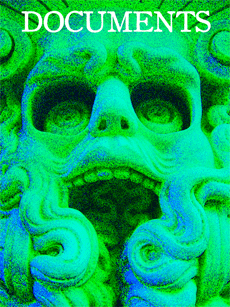
From 1929 to 1931, Métraux' friend Georges Bataille was the driving force behind the journal Documents, the publication which inspired this blog. The journal was the operating table where the encounter between Avant Garde art and ethnography took place: in fact, the famous ethnographer Marcel Mauss contributed a piece on Picasso. Documents also published an appreciative article on W.H. Seabrook's "The Magic Island", written by Bataille's and Metraux's close friend, Michel Leiris. Leiris credited Seabrook with being a "conscientious observer and the first man of the white race initiated into the mysteries of voodoo" and praised him for his "humane attitude" toward his subject.
Seabrook was an exceptional figure: he was a Great War veteran, a journalist and a traveller, a friend to both the Surrealists and to the notorious sorcerer Aleister Crowley, an alcoholic and a sadist. He had supposedly eaten human flesh ("like good, fully developed veal"). The Surrealist photographer Man Ray was inspired by Seabrook's sadist practices to create pornographicphotographs such as "The Fantasies of Mr. Seabrook", "Lee Miller and William Seabrook" and "Homage to D. A. F. Sade", all with Lee Miller as a protagonist.
"The Magic Island" was Seabrook's second book. In keeping with his personality, it was a sensationalistic account of Haitian Voodoo - a literary Mondo Caneavant la lettre. Before publishing his book on Haitian Voodoo, he wrote for publications such as Vanity Fair and Reader’s Digest and published a book on his travels through the Middle East: "Adventures in Arabia: Among the Bedouins, Druses, Whirling Dervishes & Yezidee Devil Worshippers" (1928). "The Magic Island", part of which you can find as an e-book here, inspired the 1932 horror film classic White Zombie.
In 1933 Seabrook was voluntarily committed in order to cure his alcoholism, and he documented the experience in his 1935 book "Asylum". Despite the treatment, Seabrook remained an alcoholic. He committed suicide by a drug overdose on September 20, 1945. Thus died the missing link between the two great heresiarchs of the twentieth century, Aleister Crowley and Georges Bataille.
To be continued...
Post scriptum
Interestingly, the 1928 personal diary of Aleister Crowley contained contact information for Man Ray in Paris (link here). As far as I know, this is the only concrete piece of evidence of a direct and personal contact between the Surrealists and Crowley. The item sold for approximately $45000.
Alfred Métraux' 1958 ethnography "Le Vaudou Haitien" opens with words evoking and dispelling the lurid image of Voodoo:
"Certain exotic words are charged with evocative power. It usually conjures up visions of mysterious deaths, secret rites - or dark saturnalia celebrated by 'blood-maddened, sex-maddened, god-maddened' negroes. The picture of Voodoo which this book will give may seem pale beside such images.
In fact - what is Voodoo? Nothing more than a conglomeration of beliefs and rites of African origin, which, having been closely mixed with Catholic practice, has come to be the religion of the greater part of the peasants and the urban proletariat of the black republic of Haiti. It's devotees have asked what men have always asked of religion: remedy for ills, satisfaction of needs and the hope for survival.
Seen from close, Voodoo has not got the morbid and hallucinatory character which books have given it. A talented but rather fanciful American writer, W.H. Seabrook, has given the most complete account of the black legend of voodoo. But that legend belongs to the past."
The prominent place given to the American William H. Seabrook 1929 book on Haitian Voodoo, "The Magic Island", in the opening sentences of Alfred Métraux's classic ethnography of that religion, become all the more significant if one examines the back story of those sentences.
II
Alfred Métraux (1902-1963) was a close and long-standing friend to the so-called "philosopher of evil", Georges Bataille. They had met in 1922, while studying at the École des Chartes. Bataille and Métraux physically resembled each other, so much so that they were frequently mistaken for brothers. The two shared everything, "...including women in black silk pyjamas, with long gold cigarette-holders and boyish haircuts, moving around in poorly defined and rather ambiguous surroundings" (via this book ). During three to four hour long morning walks along Paris's rue deRennes or the Champs-Élysés, Métraux spoke to Bataille of ethnography. These talks would have a strong influence on the development of Bataille's thought.
Métraux had an impressive international career as an anthropologist. Wikipedia calls Métraux "one of the most significant anthropologists of the twentieth century". The friendship of Bataille and Métraux would "... remain strong even after one became a great scholar and the other a great writer" (via this book).
During World War II, Métraux served in the Morale Division of the US Strategic Bombing Survey in Germany in 1945, and personally witnessed the devastation of war and genocide. This made a deep impression on the anthropologist, and it motivated him to join the UN in mid-1946, when he began working as Chief of the Section on Research in the Department of Social Affairs in New York. In this capacity, he led the UNESCO Marbial Valley (Haiti) anthropological survey from 1948 to 1950; "Le Vaudou Haitien" is the result of that survey. In 1948, the Surrealist and ethnographer Michel Leiris participated in the survey, writing a highly interesting article on Voodooist chromolithographs. Leiris and Métraux had met in 1934.
Alfred Metraux committed suicide on April 12, 1963, and was eulogized by Leiris in a special gathering in his honor at UNESCO House.
'Black in color, with a gaping mouth and projecting teeth and disheveled hair, clad in filthy garments, very smelly, and dwelling in empty, broken-down buildings'
 At a second-hand bookstore - for a mere € 15 - I found a beautiful hardcover edition of W.B. Seabrook's 1929 book 'The Magic Island', published by The Literary Guild Of America in 1929, in New York. It is illustrated with (politically very incorrect!) quasi-expressionist drawings by Alexander King, and with photographs by the author. Some of these are reproduced below (click to enlarge).
 From 'The Magic Island':
 all become mechanical, soulless robots. It is not necessary to look backward to the Dionysian orgies, the bacchanalia, the rites of Adonis, or frenzied David dancing before the Ark of the Covenant. What, after all, were they doing here in these final scenes, when formal ritual had ended, that was so different from things which occur in our own fashionable and expensive night clubs, except that they were doing it with the sanction of their gods and were doing it more succesfully? Savage rhythm, alcohol, and sex excitement - yet there was an essential difference, for here was a mysterious something superadded. Lasciviousness became lust, which is a cleaner thing, and neurotic excitement became authentic ecstasy, the 'divine frenzy' of the ancients.