Showing posts with label Electronica. Show all posts

Friday, December 26, 2008

Aidan Baker and Tim Hecker - Fantasma Parastasie

I

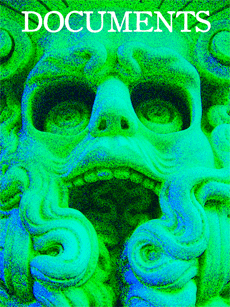
The cover art of Aidan Baker and Tim Hecker's recent musical collaboration 'Fantasma Parastasie' shows a Phantasmagoria.

A Phantasmagoria was a magic lantern show, invented in France in the late 18th century. In these shows, magic lanterns projected frightening images such as skeletons, demons, and ghosts onto walls, smoke, or semi-transparent screens. The projector was mobile, allowing the projected image to move on the screen, and multiple projecting devices allowed for quick switching of different images.

The Phantasmagoria took place on the threshold between science and superstition, between Enlightenment and Romanticism. They employed the technology of Enlightenment, and ostensibly had the purpose of enlightening the audience. Thus Philip Polidor, who first introduced the Phantasmagoria in Paris in 1793 (during the height of the Terror), introduced his spectacle as follows:

"I will not show you ghosts, because there are no such things; but I will produce before you enactments and images, which are imagined to be ghosts, in the dreams of the imagination or in the falsehoods of charlatans. I am neither priest nor magician. I do not wish to deceive you; but I will astonish you." (sourced from this extremely interesting essay)
Phantasmagoria can be called "... an art of total illusion that also contained its own critique." (ibid). But even if Phantasmagoria were justified with appeals to rationalism, the subject matter was inspired by Gothic novels, which were very popular at the time. Étienne-Gaspard Robert, a professor of physics and the most famous creator of Phantasmagoria, created a full-fledged Gothic decor for his his first performance at the Pavillon de L’Echiquier in 1798:

The members of the public having been ushered into the most lugubrious of rooms, at the moment the spectacle is to begin, the lights are suddenly extinguished and one is plunged for an hour and a half into frightful and profound darkness; it’s the nature of the thing; one should not be able to make anything out in the imaginary region of the dead. In an instant, two turnings of a key lock the door: nothing could be more natural than one should be deprived of one’s liberty while seated in the tomb, or in the hereafter of Acheron, among shadows.” (sourced here)

Phantasmagoria were at once a product of the scientific rationalization of nature, and an aesthetic revolt against this rationalization. They were a liminal phenomenon: ambiguous, open, and indeterminate performances of light and darkness on the doorstep between Enlightenment and Romanticism, between the future as technological Telos and the future as Doom.


II

'Fantasma Parastasie' is a shortish (34 minutes) album which documents a collaboration between two Canadian musicians.

The first of these is Tim Hecker, who creates Minimal Techno under the Jetone monicker and glitchy Ambient under his own name. As Jetone, his work is obsessively precise; under his own name, his music has a drifting, billowing, blissed-out quality. In both cases, Hecker's music flaunts its technological, digital, inorganic character.

The second is Aidan Baker, a writer, poet and immensely prolific musician, who is best known for his Doom Metal under the Nadja moniker. Doom Metal is a genre which can be said to be one of the musical inheritors of the legacy of the Gothic novel: drug abuse, cemeteries, melancholia, superstition, Satanism, occultism, pessimism and amor fati are among the themes shared by Doom Metal and the Gothic novel.

So is the Phantasmagoria depicted on the cover art of 'Fantasma Parastasie' an apt metaphor for the album? Is 'Fantasma Parastasie' a Doom Metal album that is also a technological, rationalistic critique of Doom Metal? Does it present music which is an assemblage of technological know-how and of what we fear we might want to believe? Is it an album in which Doom Metal seduces glitchy Ambient to forget - even if only for a moment - its optimistic technological constructions and believe in Doom Metal's sombre pandemonium?

No.

That is because Tim Hecker's Electronica and Aidan Baker's Doom Metal have been integrated rather too well, or rather: because Hecker's Electronica has canceled the Doom Metal content. Where in the Phantasmagoria the technological origin of the illusion was obfuscated, here Electronica's technology has elucidated Doom Metal's malevolent spirits out of existence. In fact, Hecker's music has swallowed up Doom Metal so completely that the two genres cannot attract and repulse each other anymore, they cannot intermingle, alternate, amalgamate, penetrate, receive, expand, converge, diverge, sympathize or antagonize any more. As a result, all ambiguity, openness, and indeterminacy has dried up.


III

The term "fantasma" comes from the Greek phantasia (appearance, imagination), and was taken up in a more technical sense in psycho-analytic theory. Freud took phantasms to be disguises for infantile auto-erotic activity or for the memory of a traumatic event. In his analysis of the structure and function of phantasms, Freud gave particular importance "to the role of hearing: for the noise that impinges on the phantasm may not just be brute sound, but also might be the ‘familial noise’ (bruit familial) which carries the histories or legends or traditions of parents, grandparents and, indeed, the whole tribe. The noise, then, is both interruptive and interpellative and it is a critical component of the phantasm. ‘Phantasms are produced by an unconscious combination of things lived and things heard.’" (sourced here).

Parastasie or Parastasis is a medical term, which refers to a phenomenon familiar to those who watch the medical television drama House. It is a reciprocal relationship among causal mechanisms that can compensate for, or mask defects in, each other; for instance, a syndrome in which a hyperactive organ masks the deficiency of another organ.

Both the fantasma and parastasie are feverish cover-ups, disguises overripe with tension, maskings ready to burst.

Not so Tim Hecker and Aidan Baker's album: too consolidated, too consistent, 'Fantasma Parastasie' lacks grit and is ... polite.

Friday, December 19, 2008

Ambient Burzum

Burzum's 1994 album 'Hvis Lyset Tar Oss' contained the band's first Ambient track, 'Tomhet'. Though the track was at the time compared to Aphex Twin's classic 1994 album 'Ambient Works Volume II', actually the track was closer to the music of 1970s 'Berlin School' Kraut Rock Electronica (Klaus Schulze, Kluster, Tangerine Dream). After the 1996 album 'Filosofem', which contained a 25-minute Ambient track, Burzum released two albums containing only similar Ambient music: the 1997 album 'Dauði Baldrs' and the 1999 album 'Hliðskjálf'. The two Ambient-only albums were recorded and released after Christian 'Varg' Vikernes (the mastermind behind Burzum) was imprisoned for murdering Øystein 'Euronymous' Aarseth.

Before he was murdered by Vikernes, Aarseth functioned as something of a mentor for his assassin-to-be. Aarseth was not only a founding member of the legendary Black Metal band 'Mayhem', but he was also an aficionado of Berlin School Electronica. Aarseth sought out Conrad Schnitzler when visiting Berlin, camped outside the German musician's home, and persuaded him to contribute a track to his band Mayhem's debut album, 'Deathcrush'. In fact, Aarseth felt so honored by Schnitzler's contribution that he made it Deathcrush's opening track. Opening one's debut album with the music of another artist: surely that gesture underlines the immense importance the music of Schnitzler and of the Berlin School had for Aarseth. Surely, it is Aarseth's influence which is responsible for Vikernes creating Ambient in the style of the Berlin School.

Burzum's gradual cross-over from Black Metal to Ambient-only music is said to be due to the fact that Vikernes is not allowed to have the instruments and equipment necessary for Black Metal in his prison cell. Nevertheless, today, bicycling through a wintry forest landscape listening to 'Filosofem', I intuited another reason for Burzum's musical transformation. I sensed Euronymous haunting the album's Ambient track, the 25-minute, pompously titled 'Rundgang Um Die Transzendentale Säule Der Singularität'.

After he was imprisoned, Vikernes could have chosen to remain silent. He did not. Instead, he went on to create music in the style so beloved by his victim, 'Berlin School' Ambient. Did Vikernes become possessed by Aarseth after he murdered him, as Raskolnikov was tormented by the memory of the old pawnbroker and her sister, both of whom he murderded with an axe? Does Euronymous, in a sense, live on in the Ambient music of his murderer?

In any case, to my mind the Ambient tracks present the weakest side of Burzum. This is not only because of my personal distaste for 'Berlin School' Ambient. It has rightly been said that all the great works of literature either establish a genre or wind one down - and the same might well be said of music. Burzum's Black Metal certainly did establish a (sub-)genre, and thus can be said to be a 'major work of music'. The same thing however cannot be said of Burzum's Ambient music. Here, Burzum is a follower rather than a leader. And although many Black Metal bands intersperse their guitar noise with Ambient tracks, the latter tracks tend to be of the Industrial Ambient rather than 'Berlin School' Ambient variety. Brian Williams' Lustmord seems to be a bigger influence than Burzum. Why? The answer is simple: Vikernes' Ambient music is dreary, dreary, dreary - it doesn't quite open up to the cosmic dimensions suggested by the music's titles. Vikernes himself is supposed to have explained his move toward Ambient as a move away from Black Metal, which - as it is a 'late style' of Rock is in fact of Afro-American origin. Indeed, Burzum's Ambient is about as mindnumbing as the ideologies Vikernes converted to in the period he murdered Euronymous.

And yet my intuition points towards another possibility: if it would indeed be true that the fact that Vikernes' abandoning Black Metal for Ambient was the exoteric effect of him being haunted by Euronymous, perhaps the weakness of Burzum's Ambient can be said to be Euronymous' ghostly vengeance upon his murderer. Is Aarseth slowly draining Vikernes?

Monday, December 15, 2008

Skinny Puppy - Last Rights

I've always regarded Canadian Industrial band Skinny Puppy's 1992 album 'Last Rights' as a failure - a bloated album. If the band's 1990 album 'Too Dark Park' already teetered on the edge of the swollen, the 1992 album certainly was overdone. Nivek Ogre's vocals had devolved from anguish into kitsch sentimentality; the music was "... a scribble effacing all lines, a scramble effacing all sounds ..." (Deleuze & Guattari), a "statistical heap" of samples; the album as a whole somehow smacked of puerile Hollywood Gothic.

It was the last Skinny Puppy album I bought. In fact, the album was one of the reasons I abandoned the Industrial aesthetic and crossed over to the nascent IDM scene, a scene which I would abandon for Black and Doom Metal when IDM became too complacent and anodyne. To experience once more something filthy, something guilty! Writing my post on South Korean Black Metal band Pyha's 2008 album 'The Haunted House', made me go back to the Skinny Puppy album.

I must say the sixteen years which have passed since 'Last Rights' was released, have been kind to the album. It is as if time has assembled the scribble, the scramble that I used to hear into a consistency; as if time has simplified, creatively limited, selected the album's overabundance of sounds. The hands of the clock have achieved what the hands of the musicians could not.

By what means has the clock done this?

In 'The Work of Art in the Age of Mechanical Reproduction', Walter Benjamin writes that "Within major historical periods, along with changes in the overall mode of being of the human collective, there are also changes in the manner of its sense perception." Certainly, my manner of sense perception has changed in the last sixteen years.

In part, this change is due to technological advances: the stereo equipment I own is much better than the one I had when the album came out, the acoustic spatiality of my Elac speakers making the disparate elements that constitute the album more clearly discernible. Furthermore, where the production style of 'Last Rights' seemed too rich, in fact downright Hollywoodesque at the time, now - in this age of compression and subsonics and 5.1 surround sound - it sounds quite restrained.

But my manner of sense perception has also been affected by changes in my personal mode of being. The passing years have expanded my musical horizon. Thus, 'Last Rights' has found a place in the procession of musical genres that I have liked. For example, the final track, 'Download', foreshadows the glitch music aesthetic by several years. My appreciation of chaotic music, pomposity and cartoonesque histrionics has grown through listening to Black Metal. And listening to Free Jazz has engendered an interest in (over-)ripe, late-style music in which complexity and chaos go hand in hand. The expansion of my musical repertoire has provided an enriching context for Skinny Puppy's album, and has allowed me when listening to select, capture and extract certain aspects of the album and thereby to effect a certain simplicity. Furthermore, my biographical aging has had an effect on my mode of perception. When I was young, I was more sectarian in my musical tastes than I am now; 'Last Rights' accords better with my current eclecticism than with my former purism. And in all probability, a barely-acknowledged nostalgia to the time when I was twenty-something plays a role also.

Finally, I like it that 'Last Rights' is completely outdated and utterly unfashionable. As noted by Walter Benjamin, the Surrealists had been "...the first to perceive the revolutionary energies that appear in the 'outmoded' - in the first iron constructions, the first factory buildings the earliest photos, objects that have begun to be extinct, grand pianos, the dresses of five years ago, fashionable restaurants when the vogue has begun to ebb from them. The relation of these things to revolution - no one can have a more exact concept of it than these authors. No one before these visionaries and augurs perceived how destitution - not only social but architectonic, the poverty of interiors, enslaved and enslaving objects - can be suddenly transformed into revolutionary nihilism."

'Last Rights': a dress of five years ago, slightly dusty, taken from its cupboard to contemplate for a few brief moments, and then put back.


Post scriptum

Here is the video for 'Killing Game'.


And here a (crappy-looking) live performance of 'Love in Vein'.

Thursday, August 16, 2007

Edgard Varèse - Poème Électronique (1958)

Here is a Dutch short documentary about Edgard Varèse's electronic music piece 'Poème Électronique'. The Dutch-language titles, translated into English, read:

"The Electronic Poem

Philips has developed automated equipment, which heralds a new art with unlimited possibilities, which is the electronic interplay of light, color, image, word and music in space.

The 'electronic poem', put together by the architect Le Corbusier, his co-worker Yean Xenakis and the musician Edgard Varèse, shows how our increasingly mechanized society strives for a future new harmony.

The show consists of the following parts:
creation
mind and matter
from darkness to dawn
gods created by human hands
how time forges civilization
harmony
to all mankind".


Tuesday, July 24, 2007

Three From Front 242 - circa 1983

Front 242 - "Operating Tracks" - from the "Geography" album


Front 242 - " U Men" - from the "Geography" album


Front 242 - "Controversy Between" - from the "Endless Riddance" album

Tuesday, June 19, 2007

Mixed Up In The Hague - a YouTube Gallery

In the nineteen nineties, the squatter scene in the Dutch city of The Hague had a very active musical life, centering on electronic dance music. Focused at first on relentless, industrialized techno (Unit Moebius, Ra-x, Rude 66), in the middle of the decade electrofunk and italodisco came to the forefront. A central figure in the electro-scene was Ferenc E. van der Sluijs, better known als I-F (which stands for Inter-Ferenc).

I-F did not only put out two utterly brilliant albums of electro ("Fucking Consumer" in 1997 and "The Man From Pack" in 1999, both albums strongly influenced by John Carpenter's electronic horror film soundtracks) but also created one of the best DJ-mix-albums ever: "Mixed Up In The Hague Vol. 1". The mix consists mainly of electro and italodisco from 1980 to 1985, as well as a few contemporary nostalgic electro tunes. It was recently rereleased in a very limited edition, and is available from Boomkat, amongst others.

Below you find YouTube videos for some of the tracks featured on the "Mixed Up In The Hague Vol 1. - all great fun!

Georgio Moroder - The Chase


Jonzun Crew - Space Is The Place


Charlie - Spacer Woman (a link only because the embedding function is disabled; it is one of the best though!)


Q - Voice of Q


Vangelis - Blade Runner (end credits)


Kraftwerk - Tour De France


Klein & MBO - Dirty Talk (again only a link).


Sun La Shan - Catch


A Number of Names - Sharevari


Postscripta
  • Did I aggravate any disco-hating metalheads?
  • Here is a link to I-F's internet radio station.

Sunday, January 14, 2007

Gas - Zauberberg

"Zauberberg" by Gas - an alias of Wolfgang Voigt - is a seminal album, one of my all-time favorites.

Like The Third Eye Foundation and Svarte Greiner after him, Gas approaches very Continental-European darkly romantic themes from an unusual angle, in his case from a techno background (Voigt's other projects are much more dancefloor-oriented than Gas). The easiest way to describe his music is as a union between the foggy, throbbing minimal techno of the Berlin Chain Reaction record label on the one hand and dark late-romantic classical music on the other.

It is more revealing however to point to the many intersections between the trajectories that this particular album and the work of German painter Anselm Kiefer trace through the landscape of German culture:
  • the scale of Gas's music is huge, as big as a primeval forest, as massive as the dimensions of Kiefer's works;
  • many of Kiefer's paintings and "Zauberberg" share the theme of the Wald, so deeply rooted in German history;
  • both artists have been inspired by Richard Wagner - Voigt using Wagner's sound world as raw material, Kiefer exploring Wagner's mythical world;
  • 'Gas' - the sinister nom de plume Voigt employs - and much of Kiefer's work points towards the German Third Reich. Both artist's work generated intense debate over it's relationship to German nationalism;
  • the atmosphere prevalent in both artist's work is one of immense desolation, of ominous tragedies, of foreboding, of brooding over some loss;
  • both artists thematize the materiality of their art, Gas through the use of vinyl hiss (together with Coil's 'Music To Play In The Dark' one of the early instances of clicks and cuts) and Kiefer's through the thickness with which he applies paint to his canvasses.
Vinyl hiss, crackle and pop are for me the most beautiful aspects of the album ... they are the sound of the death of grammophone records, the carbon black vinyl slowly rotting, eaten by time ... the carbon which blackens the transparent PVC of which records are made, can be made of charred wood ...

On "Zauberberg" the hiss, crackle and pop, the sound of decripit vinyl, is also the sound of the Wald, the ancestral forest, slowly eaten by fire ... a magnificent conflagration in the darkness.

Wednesday, December 27, 2006

Svarte Greiner - Knive

A review of 'Knive', the debut album of Svarte Greiner - an incarnation in musical form of Erik K. Skodvin, half of the Norwegian ambient duo Deaf Center.

Svarte Greiner's debut album reminds me strongly of a certain part of Rainer Maria Rilke's strange 1910 faux-autobiography 'The Notebooks of Malte Laurids Brigge'. In this part of the novel, the author as a child is rummaging around in the dusty, rarely-visited attic of the Danish country manor of his aristocratic forebears. He finds a lot of disused clothes and uniforms, some decades old, and dresses up in them, using them for playacting, as costumes, like an actor would. Then, the child finds a mask, dons it, and descends towards the empty guest room to see himself in an antique mirror, a mirror so ancient it has acquired a personality. Inadvertently, the child knocks over a table with all kinds of knick-knacks, which fall and break into pieces, aggravating the child. Then, he sees himself masked and in disguise in the mirror and the mirror uses that reflection to avenge the broken things: the mirror reflects "... an image, no, a reality, a strange, incomprehensibly monstrous reality, which suffuses me against my will: because now the mirror was the stronger one, and I was the mirror". On seeing this ghostlike apparition, the child almost faints and flees the room in terror*.

Why are these images called forth so strongly by Svarte Greiner's music?

First of all: 'The Notebooks of Malte Laurids Brigge' is a very continental-European novel, and likewise 'Knive' is a very European album, notwithstanding the fact that American bands Earth and Angelo Badalamenti are namechecked as influences. Though the influence of both Earth and Badalementi can indeed be recognized in the music, Svarte Greiner doesn't have that quintessentially American epic sweep, that vastness in space that they have: Svarte Greiner's proper dimension is time, that most European of dimensions, that dimension which plays such an important role in 'The Notebooks of Malte Laurids Brigge'. In the dimension of time, Svarte Greiner is vast too.

Svarte Greiner repeatedly mentions liking horror films, and the horror films he reminds me of are not American slasher films, not David Cronenberg's biomechanical horror, not Romero's zombie films, but European cinéfantastique films like Harry Kümel's 'Les Lèvres Rouges', Lucile Hadzihalilovic's 'Innocence', Georges Franju's 'Les Yeux Sans Visage' and Borowczyk's and Robbe-Grillet's erotic horror films.

Musically, Svarte Greiners closest agnate is The Third Eye Foundation - the same type of continental-European phantasmagorical pseudo-soundtracks, albeit without the drum and bass rhythms - in fact, Matt Elliott is so continental-European in style that it cannot come as a surprise that he has moved from the UK to France**? Like The Third Eye Foundation, Svarte Greiner comes at darkly romantic themes from an oblique angle, from the angle of ambient electronica rather than from the more obvious angle of gothic music or black metal.

Second, like that of Rilke, Svarte Greiner's style is late-romantic, sensitive and introspective. "The Notebooks of Malte Laurids Brigge" is described by the author as "Introspective and retrospective, mystical and sensitive, and much concerned with loneliness, fear, suffering, and death." The same might be said of Svarte Greiner's music: the atmosphere of 'Knive' is dreamily mournful, romantically minor-key, with sensitive cello and string instruments, with mystical Dead-Can-Dance's-Lisa-Gerrard-style singing. Svarte Greiner's mix tapes (here, here and here) are something of a revelation also: highly introspective and retrospective landscapes of ambient music, jazz, modern composition and improvised music.

Third, it is the way Svarte Greiner uses found sounds and field recordings. The album is replete with beautifully sinister sounds of wind, rain, wood creaking (á la Nurse With Wound's Salt Marie Celeste), digging, sawing, rusty metal scraping rusty metal, footsteps through the underbrush, someone yawning, the call of crows and other black birds, antique vinyl hiss, crackle and pop, the grammophone needle running out of the last groove... Svarte Greiner uses these sounds, which he must have purposefully sought out and found in an attic of the ear, for dramatic effect, much as young Malte Laurids Brigge used the clothes found in the attic for playacting. For example, in the last track, titled "Final Sleep", the conjunction of the song title with the sound of digging evokes horror film burials or exhumations ... Svarte Greiner or the listener transforming into grave robber John Gray, played by Boris Karloff in Robert Wise's 1945 film 'The Body Snatcher'. Found sound hasn't been used this well since C-Schulz & Hajsch eponymous album.

"Music is closer to us, then; it streams toward us; we stand in its way, but then it goes right through us. It is almost like a higher air, we draw it into the lungs of spirit and it gives us a greater blood in the secret circulation" - Rainer Maria Rilke


*Strange that K-Punk has no yet mentioned this most hauntological novel of all European literature.
** Post script: check out this YouTube link to a video made for Matt Elliott, the sad and haunting 'Kursk'.