Showing posts with label Spider. Show all posts

Monday, November 24, 2008

La Taranta (pt. 3)

Ernesto De Martino's fascinating 1961 ethnography of Apulian Tarantism, 'The Land of Remorse: A Study of Southern Italian Tarantism' is strongly influenced by the idealist humanism of Italian philosopher Benedetto Croce.

Because of its optimist, positivist, rational, humanitarian, decent nature, one can read De Martino's ethnography in the way proposed by Roland Barthes in 'The Pleasure of Text': "The more decent, well-spoken, innocent and saccharine a story is told, the easier it is to invert it, the easier it is to blacken it, the easier it is to read it against the grain".

Reading of De Martino's ethnography against the grain is certainly easy- one can destabilize the book's idealism when it is creatively misread in a way informed by Lovecraftian paranoia and the Cthulhu mythos!

Just consider the following quotations from the chapter on the medieval origins of Tarantism:

"First of all, there is the problem of the phenomenon's origins, the period and historical climate in which tarantism came into being, with its own forms, on the ruins of the orgiastic cults and the mystery religions. In this regard, it is impossible for us to trace any useful indication of the symbolism of the taranta in the Phisiologus and medieval bestiaries, or in the prayers, spells and recipes collected by Pradel in Griechische und Süditalienische Gebete, Beschwörungen und Rezepte des Mittelalters. The same must be said for Arab writers. (...) Furthermore, in the De Venenis by Cristoforo Degli Onesti, a Florentine who taught medicine in Padua from 1379 to 1386, there is a chapter which treats De morsu tarantulae. Although this chapter appears in the index of the manuscript preserved in the National Library of Paris, [it] is missing from the text (...)".

Why is the chapter on the bite of the tarantula missing from De Venenis? Did De Martino check all Arab writers - or did he omit to mention that he found some blasphemous indications in the work of the mad one? Why did the authorities really close up the miraculous well at St. Paul's Chapel in Corso Garibaldi in Galatina in July 1959, the well to which those afflicted by Tarantism flocked every year? Doesn't the fact that Tarantism only runs in certain family point towards an Innsmouth-like atavism? And what about the 'Sanpoalari' - Southern Italian snake charmers and traveling healers? To which secrets are they privy? And why doesn't the spider which is held responsible for tarantism correspond to any arachnid of modern zoology? Is there any connection between tarantism and the spider-god Atlach-Nacha? Does the yearly cycle of Tarantism in any way correspond to the astronomical cycle of the planet Cykranosh (or Saturn, as we know it today), the planet from which this demonic deity is said to come? Do the caverns deep beneath Mount Voormithadreth, where the god resides, lead to the Apulian Monte Gargano, or even further south? What about the giant, bloated purple spiders of Leng, which are thought to be the children and servitors of Atlach-Nacha? Wasn't Tarantism mentioned in Unaussprechlichen Kulten by Von Junzt? Or was it Ludwig Prinn's De Vermis Mysteriis?


Post scriptum

Only after writing this post, I read the passages in Reza Negarestani's Cyclonopedia on Hidden Writing.

Saturday, November 22, 2008

La Taranta (pt. 2)

I stumbled on the documentary featured in the previous post when reading Ernesto De Martino's classic 1961 ethnography La Terra Del Rimorso (The Land of Remorse: A Study of Southern Italian Tarantism). The book is the result of ethnographic research into Tarantism, conducted by an interdisciplinary team of historians, psychiatrists, medics, anthropologists and social workers. The fieldwork took place in Apulia, the state that forms the heel in Italy's boot, in the summer of 1959.

What is Tarantism? It is an affliction which the Apulians ascribe to the bite of the Tarantula spider, and which reoccurs in regularly repeating yearly cycles in those bitten. The symptoms include "...falling to the ground, a feeling of prostration, anguish, a state of psychomotor agitation with a beclouding of the sensory apparatus, difficulty in remaining standing, stomach ache, nausea and vomiting, various paresthesias and muscular pains, a heightening of sexual desire...".

The research team found out that - even though the symptoms vaguely resembled those of spider poisoning - Tarantism could be reduced neither to the bite of an actual spider nor to other causes, such as sunstrokes or psychic illness. On the contrary, in the course of the investigations Tarantism acquired the meaning of a mythical-ritual symbol, culturally conditioned in its functioning and efficacy.

The spatial and temporal distribution of 'spider's bites' made it highly unlikely that actual spiders were responsible for the phenomenon. There was an overwhelming prevalence of pubescent female participation in Tarantism, and the phenomenon afflicted certain families only. Once bitten, the victim would be affected in the summer for several years, the phenomenon obeying a strict calender. Furthermore, certain locations associated with specific Saints - such as the town of Galatina, of which the St. Paul church is featured in the film - provided immunity from the spiders' bite.

The spider which was held responsible for tarantism was a mythical creature which did not correspond to any arachnid of modern zoology. Instead, the Taranta assembled the characteristics of several different species of spider into a mythical whole. Different colors were attributed to the spiders - principally red, green and black - and the 'bite' of each respective spider caused different behaviour in the victim. Those bit by red spiders displayed martial, heroic behaviour; those bit by green spiders displayed eroticized behaviour; and those bitten by black spiders were fascinated by funerary paraphernalia. Furthermore, each color spider had its own repertoire of musical figures and dances: for example, those bitten by a green spider would only dance to a Tarantella tune associated with the green spider. Finally, the victims of the spider's bite were fascinated by pieces of cloth with the appropriate color. Thus, during the course of an exorcism different Tarantella tunes were played and different colors of clothes were given to the victim in order to determine which spider possesses her. Only the appropriate Tarantella tune, the appropriate color and the appropriate dance would cure the victim - at least for the time being, until the affliction re-occured a year later. Music serves at once as diagnosis and therapy.

Rather than the result of the bite of an actual spider, Tarantism was a mythical-ritual experience which was modeled on the medical symptoms of the actual bite of a poisonous spider. Examining parallels in ethnography and folklore, De Martino found structural similarities between Tarantism and Afro-Mediterranean and Afro-American (Vodou) possession cults. Furthermore, De Martino found antecedents to this religious formation in classical Greek mythology and rituals.

De Martino interprets Tarantism primarily as a form of psychological therapy. For his, the Tarantella is an exorcism, as a ritual eviction of the spider which possesses the victim. The spider symbolizes a traumatic event in the biography of the victim (specifically frustrated eros), and it is the memory of that traumatic effect which causes the affliction of Tarantism with its attendent symptoms. This memory is cast out my music, color and dance - the Tarantella. For De Martino, the symbol of the Taranta is a "mythical-ritual horizon of evocation, release and resolution of unresolved psychic conflicts (...). As a cultural model, the symbol offers a mythical-ritual order for settling these conflicts and reintegrating individuals into the group. The symbol of the taranta lends a figure to the formless, rhythm and melody to menacing silence, and color to the colorless in an assiduous quest of articulated and distinct passions, where a horizonless excitation alternates with a depression that isolates and closes off."

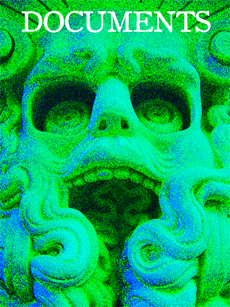
(A short aside on formlessness. That De Martino associates the spider with formlessness certainly struck a chord with me: for Georges Bataille, the spider was an almost formless creature, an invertebrate that is not like anything: "To declare (...) that the universe is not like anything, and is simply formless, is tantamount to saying that the universe is something like a spider or spittle." (Documents 7, 1929). The relation between Bataille's thought and formlessness is the polar opposite of the relationship between De Martino's thought and formlessness.)


Gilbert Rouget, whose 1985 ethnography "Music and Trance. A theory of the relations between music and possession" was featured before on this blog, was highly critical of De Martino's interpretation of Tarantism. Rouget writes that De Martino's analysis makes one lose sight of the most obvious aspect of Tarantism: the identification of the afflicted with the spider. Rouget: "One of the dance figures of the tarantulees - the best known - consists, as we know, in imitating the spider's movements: back to the ground, body arched to a great or lesser degree, the tarantulee moves about like a spider on all fours. One can see this very clearly in D. Carpitella's film, and the sight is striking." (Rouget is mistakingly referring to La Taranta as Carpitella's film: Carpitella merely recorded the music). Rouget reproaches De Martino for making himself an heir to a Christian tradition which abjects possession and possessing divinities and thereby misinterpreting Tarantism. Rouget: "Despite appearances, the divinity responsible for the possession is not the one that is excorcised. On the contrary, it is the divinity concerned who, by allowing the possessing person to identify with him or her, provides the means of ecxorcising the illness - real or imagined - from which the person is suffering."

Whatever the case may be, De Martino's book is highly interesting for those who are interested in possession - whether for scientific reasons or because possession can function as a model for countercultural practices. In De Martino's book, possession is not the exotic practice of an exotic people in an exotic land: La Terra Del Rimorso presents ethnographic and historiographic material on a possession cult which takes place in Europe itself. What's more, Tarantism has its roots in the very soil from which Western civilization sprang: in classical Greece. We were already possessed in the cradle.


Post scriptum

Here is an indepth review of De Martino's book (link).

Thursday, November 20, 2008

La Taranta (pt. 1)

The two YouTube videos embedded below together form the 1962 documentary La Taranta, which investigates a Southern Italian possession cult: Tarantism. The film, directed by Gianfranco Mingozzi, documents this fascinating peasant religious formation in which the victims of the bite of the mythical Tarantula require a ritual exorcism of frenetic dance, music and colors.

Even if you do not speak Italian, do watch the film, for it is convulsively beautiful. In my mind, its 19 minutes assemble Luis Buñuel's 1933 documentary on the grinding poverty of Spanish peasants Las Hurdes, Herk Harvey's 1962 existential horror film Carnival of Souls and Jean Rouch's 1955 documentary on the Hauka possession cult Les Maitres Fous. The documentary was filmed in a black and white which is so funereal it is almost Xasthuresque, and its music - the famous Tarantella - is haunting. In short: my highest recommendations!


*


The next post will provide indepth material on Tarantism!


Post scriptum

Some readers of this blog might be familiar with Mingozzi's name from the 1974 nunsploitation film Flavia, la Monaca Musulmana.

Friday, November 23, 2007

Robert Frost - Design

An anonymous commentator to my posts on Striborg's album "Ghostwoodlands" (here and here) pointed me towards Robert Frost's poem "Design". I've reproduced it below.


Design

I found a dimpled spider, fat and white,
On a white heal-all, holding up a moth
Like a white piece of rigid satin cloth--
Assorted characters of death and blight
Mixed ready to begin the morning right,
Like the ingredients of a witches' broth--
A snow-drop spider, a flower like a froth,
And dead wings carried like a paper kite.

What had that flower to do with being white,
The wayside blue and innocent heal-all?
What brought the kindred spider to that height,
Then steered the white moth thither in the night?
What but design of darkness to appall?--
If design govern in a thing so small.

Friday, October 26, 2007

Striborg - Ghostwoodlands

Michel Paul Guy de Chabanon, a French 18th century musician, musicologist and man of letters "...had an interest in spiders and played the violin for them to see what music they liked..." (quote sourced form Claude Lévi-Strauss's "Look, listen, read").

Alas, Lévi-Strauss's book does not tell us what music spiders did like.

For Georges Bataille, the spider was an almost formless creature, an invertebrate that is not like anything: "To declare (...) that the universe is not like anything, and is simply formless, is tantamount to saying that the universe is something like a spider or spittle" (Documents 7, 1929).

Certainly, Bataille's perspective on the spider is anthropocentric. Nonetheless, though highly sensitive to vibration, spiders have no ears. For that reason alone, the music spiders like would sound formless to us, unlike any music hitherto made by man, the audio equivalent of spittle.

Translating the music spiders like to human music is impossible. As Lévi-Strauss notes, translation "... is impossible in music, for lacking words it possesses as many languages as composers, and, ultimately, as compositions. Musical languages are, relative to each other, untranslatable, though conceivably they could be transformable - even if this has not, or has hardly been attempted".

In my imagination, if the music spiders like could be transformed to human terms, it might sound something like Tasmanian Black Metal band Striborg's latest album, the predatory and poisonous "Ghostwoodlands".

Friday, December 22, 2006

Blut aus Nord

Continuing the French theme of the last few posts, a review of French Black Metal band Blut Aus Nord's recent cd MoRT ...

A few posts ago, I proposed the idea that Black Metal has drunk deep from occidentalist wells - the term occidentalism referring to Buruma's and Margalit's hastily put together but interesting enough booklet on the western origins of antiwestern thought. In this post, I'll explore this idea a little further.

One of the characteristics of occidentalist thought is that it contrasts wild and rural landscapes with urban landscapes. The urban landscape is portrayed as an inversion of the values of the wild and rural landscapes. The urban landscape is associated with capitalist greed, soulless rationalism, vice, dishonesty, superficiality: the city is both a whore and an automaton. The rural landscape on the other hand is unselfish, spiritual, soulful, deep, pure and true. This vision of nature versus nurture has roots going al the way back to Tacitus' Germania and had some of it's ugliest proponents in the German nazi era.

In Black Metal, rural and wild landscapes, especially those of Norway, are highly significant. The cd cover art of Emperor's "In the Nightside Eclipse" features pictures of Norwegian landscape (one of a fjord and one of a ruined castle) and the lyrics of that album repeatedly portrays the lyrics' narrator in natural surroundings: "Beyond the great vast forest / Surrounded by majestic mountains / Dark rivers float like tears of sorrow / Frost submerge the holy ring of fire" or "As the Darkness creeps over the Northern mountains of Norway and the silence reach the woods, I awake and rise... Into the night I wander, (...) Under the moon, under the trees. Into the Infinity of Darkness beyond the light of a new day, into the frozen nature chilly, beyond the warmth of the dying sun. Hear the whispering of the wind, the Shadows calling... (...) I gaze into the moon which makes my mind pure as crystal lakes, my eyes cold as the darkest winter nights, by yet there is a flame inside". Many Black Metal bands subscribe to deep ecological or ecofascist beliefs: misanthropic, biocentric ideologies that put nature before man.Burzum's Varg Vikernes occidentalism is apparent when he states in a rather disgusting interview "Ironically, the only thing that can save mankind is a stream of pandemics, natural disasters and other human catastrophes, wiping out most of us. In fact, I think the catastrophe is inevitable - unless something drastic happens very soon, - and to be honest I even welcome it. The sooner this world order collapses the better. We don't even need to do anything for it to collapse in chaos. The best and only thing we can do is to get away from the tidal wave, and make sure the best amongst us survive, along with our Pagan culture. We can physically move away from the modern world and all its moral, physical, emotional, mental and spiritual decay and depravity".

Given that Black Metal despises the city, it is all the more surprising and original that Blut Aurs Nord presents urban Black Metal. Just visit Blut Aus Nord's unusual and interesting website (not completely up to date as their most recent cd is not yet included in the discography) and you will see why this strand of the Black Metal web is an urban strand: the site lets the visitor stray through a mazelike, somewhat futuristic but derelict city, vaguely Blade Runner-ish, with Piranesi-like subterranean vaults and Gothic churches, and sombre high rise buildings. Click on the oriental glyphs and be led astray in a decaying urban world, the Paris of a nightmarish future, light years from nature.

Blut Aus Nord's recent cd (MoRT, 'Metamorphosis of Realistic Theories) continues this urban atmosphere. No 'natural, spiritual simplicity' here, but academic intellectualism and philosophical concepts. No blastbeats and 'simple, authentic, rural' folk music but industrialized, complex, almost-IDM-like rhythms and mention of Webern, Ligeti and Stockhausen as sources of inspiration. And aren't academia and industry the epitomes of urban existence?

The way Blut As Nord uses guitars deserves special mention. In an interview with a German website, band member Vindsvall states "We have moved far away from every theory of harmony. This was the perfect way to work more modulations into the guitar sound. If one plays the guitar fast, one has no possibility to hear the last vibration of the sound. But there exactly began our work: we used these last vibrations, gave them a new tone". In an interview with a French website, band member Vindsval tells that they wanted to use the guitar like a piano, "with eight fingers on the neck to obtain the same variations on the different parts played simultaneously by each of the hands", and have started to work with a touch guitar to optimize such techniques. "This broadens enormously the possibilities on the harmonic level, and when you do away with the frets you even multiply those possibilities".

All this makes for a discordant, seasick, murky, disturbing, haunting album, an album of writing tentacles, as formless as a spider, an album that does not sound like it is composed but like it is emanated, emanated like a Victorian trance medium emanates a cloud of ectoplasm, an album that is " (...) part of the human body, external to it, unstable, sometimes soft, occasionally hard, from time to time vaporous, variable in volume, visible only in semi-darkness, making an impression on photographic emulsion, presents to the sense of touch a humid and slippery sensation, leaving in the hand a residue which, when dry, has under microscopic examination the appearance of epithelial cells, without odour or definite taste, in other respects fleeting and transient, whether projected or otherwise, of uncertain temperature, fond of music" (from the DaCosta Dictionary's entry on ectoplasm).

Wednesday, November 15, 2006

Spider's web II

A few posts back, I wrote that Black Metal is a culture, a spider's web of significance where ideological and aesthetic strands are closely interwoven and mutually dependent on each other.

Nonetheless, vast differences in ideological perspective are apparent within the Black Metal genre, often related to the local culture of the place of origin of the band in question. Thus, Eastern European bands (Drudkh, Hate Forest) often have a strongly nationalistic orientation, an orientation which for example is not so apparent in Californian Black Metal bands (Weakling, Leviathan, Xasthur) and "orthodox evil" French Black Metal bands (Blut aus Nord, Deathspell Omega, Haemoth). The ideology of some more artistically inclined Black Metal artists is more likely to be extremely liberal (tending towards anarchism) than highly intolerant.

The ideological orientation of Black Metal bands is interwoven with their aesthetic orientation: if a Black Metal album features a lot of folk, the chances are that the ideological orientation of the band is nationalistic, intolerant and paganistic. Folk music in Black Metal signifies the Volk, the national heritage (a completely different meaning than Folk music has in Free Folk, or for Bob Dylan for example). Misanthropy, which is an important theme in Californian Black Metal, is tied to a very specific Californian Black Metal sound: Black Metal with strange song structures, bizarre parts, and an accent on mood and ambience - as if hatred of Man goes hand in hand with the destabilization of 'normal' song structure.

Without doubt, the ideological and aethetic differences are causally linked to the different uses of Black Metal in these specific local cultures.

I can of course only guess what uses Black Metal has in Lebanese society (check this interview with Ayat, or the information "Dark Ritualistic/Barbaric Black Metal" band Kafan on FMP), but one can be sure that they are very different from the uses of the genre in the Ukraine or San Fransisco - if only because the political and religious situation is vastly different. Even the name of Kafan points towards the importance of the local context of the band in question: "Kafan" is the shroud of the dead Muslim. And also Ayat's statements that "Every prejudice westerners might have regarding Arabs is correct" and the stress on the irreligious nature of the music provide insight into this Black Metal scene's relationship to local society and culture.

And what to think of Iranian Black Metal? Wikipedia suggests that these bands are rather nationalistic, but I can only imagine what it must be like to make music of Satanic origin in a fundamentalist country. And Iranian Black Metal cannot derive meaning only from it's relation to local culture, but must also derive meaning from the relation of that local culture to the wider world, and specifically to the West - origin of Black Metal, focus of hatred for Shi'ite Fundamentalists.

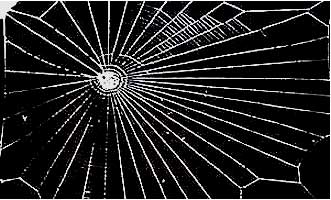
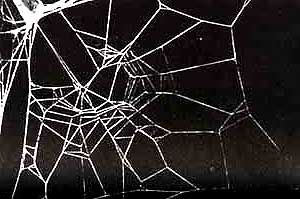
"However, Black Metal culture is not woven as neatly as spider's webs usually are... Perhaps they're more like the webs of spiders on drugs: chaotic, tangled ... it is an eccentric, centrifugal genre after all".

Saturday, November 11, 2006

Spider's web

A few posts back, I received a comment from Martin, posing the question whether Black Metal is fueled by a certain ideology, or rather by the appeal of a certain imagery/aesthetics.

Almost having finished his "Available Light. Anthropological Reflections on Philosophical Topics", I'd like to use Clifford Geertz's definition of culture for a reply to that question:

"The concept of culture I espouse. . . is essentially a semiotic one. Believing, with Max Weber, that man is an animal suspended in webs of significance he himself has spun, I take culture to be those webs, and the analysis of it to be therefore not an experimental science in search of law but an interpretative one in search of meaning. It is explication I am after. . . . " (Geertz in "The Interpretation of Cultures").

Black Metal is a culture, a spider's web of significance where ideological and aesthetic strands are closely interwoven and mutually dependent on each other. Take away either the ideological (i.e. politico-moral) strands or the aesthetic strands and the whole web will shift, destabilize, maybe even threaten to collapse or in any case reform into a completely different shape.

However, Black Metal culture is not woven as neatly as spider's webs usually are... Perhaps they're more like the webs of spiders on drugs: chaotic, tangled ... it is an eccentric, centrifugal genre after all.