Showing posts with label Clifford Geertz. Show all posts

Thursday, May 21, 2009

Euronymous's Epistles (pt 5)

I am the knife and the wound it deals,
I am the slap and the cheek,
I am the wheel and the broken limbs,
hangman and victim both!

I am the vampire at my own veins,
one of the great lost horde
doomed for the rest of my time, and beyond,
'to laugh - and smile no more'.


From "Self-tormentor" by Charles Baudelaire


I

The letters which Chagrynn sent me, mention several times 'Dead' Per Yngve Ohlin's acts of auto-mutilation. Read in chronological order, the letters tell a story of an escalating infliction of harm to the body.

From the first letter: "And if the gig is very good, Dead will cut himself up and bleed on the audience."

From the second letter: "About Dead, he IS insane. I think those rumours you heard are a bit untrue, he doesn't day ha's [sic] been dead 3 times, but he believes that he's the incarnation of Vlad (Dracula). He cut himself up pretty extreme at a gig we did, and if he gets too drunk he also cuts, but not only himself, unfortunately. At new years eve he almost cut up his artery, but he don't remember anything himself. I do. We had to put handcuffs on him."

The third letter contains a handwritten postscriptum which reads: "P.S. Very important: Dead is probably going to cut himself totally to pieces at one of the gigs (at least), so it's great if you found out where the nearest hospitals are, in case he's dying. Thanks!"

Surprisingly, the final letter, which recounts how Øystein "Euronymous" Aarseth found Ohlin's body after his suicide on April 8th 1991, makes no mention of automutilation.


II

The wikipedia entry on self-injury states: "Self-harm is listed in the Diagnostic and Statistical Manual of Mental Disorders (DSM-IV-TR) as a symptom of borderline personality disorder and depressive disorders. It is sometimes associated with mental illness, a history of trauma and abuse including emotional abuse, sexual abuse, eating disorders, or mental traits such as low self-esteem or perfectionism, but a statistical analysis is difficult, as many self-injurers conceal their injuries. (...) A common belief regarding self-injury is that it is an attention-seeking behaviour; however, in most cases, this is inaccurate. Many self-injurers are very self-conscious of their wounds and scars and feel guilty about their behavior leading them to go to great lengths to conceal their behavior from others. They may offer alternative explanations for their injuries, or conceal their scars with clothing. Self-injury in such individuals is not associated with suicidal or para-suicidal behavior. The person who self-injures is not usually seeking to end his or her own life; it has been suggested instead that he or she is using self-injury as a coping mechanism to relieve emotional pain or discomfort."

The wikipedia entry shows that Ohlin was an atypical self-injurer in two respects. First, rather than hiding his wounds, Ohlin flaunted his self-injury, cutting himself in front of audiences during Black Metal concerts. Second, Ohlin's self-injury cannot be disassociated from his suicide.


III

While it seems obvious that there must have been a link between Ohlin's psychological problems and his practice of self-injury, the fact that Ohlin cut himself ostentatiously as part of a Black Metal concert points to the fact that his auto-mutilation was enmeshed with Black Metal culture. Thus, Ohlin's self-injury was not a private practice, but one that was eminently social.

Ohlin cut himself to bleed on his audience. Lacerating the surface of his body, Ohlin opened a channel of communication between himself and the assembled crowd. To paraphrase The Three Degrees: "Blood is the Message". If, in religious ritual, one sacrifices in order to communicate with the gods, Ohlin made libations of his blood to communicate with those who attended the concerts.

The relationship between the quality of the Black Metal concert and Ohlin's public acts of self-injury is particularly interesting: "And if the gig is very good, Dead will cut himself up and bleed on the audience." Evidently, the communal enthusiasm of a succesful Black Metal concert engendered in Ohlin this frightful desire to spill his own blood. This allows me to interpret Ohlin's bloodspilling as part of a cycle of gift exchange between the musician and his audience. When Mayhem's musicians gave themselves over to their Black Metal, the audience reciprocated with a frenzied movement, shaking their heads until their minds were a blur; and when Ohlin, in his turn, accepted the audience's gift of enthusiasm, he gave back his own blood. Blood, a heterogeneous and revolting fluid, charged by Black Metal with hatred and disgust, signalled that the world of self-interest and self-preservation had been abandoned by the artist and challenged the audience to do likewise.

Exceeding the expression of an individual mental disorder, Ohlin's public acts of self-injury can be designated as acts of sacrifice.

IV

Prima facie, Ohlin's self-injury cannot be disassociated from his suicide.

However, Ohlin's suicide note read "Excuse all the blood". This apology implies that it would have been preferable if the blood had been absent. Thus, the suicide note stands in striking contrast to Ohlin's ostentatious spilling of blood. A further contrast between Ohlin's acts of self-injury and his suicide is that while the acts of self-injury were public performances, his suicide was a private act, which took place in a situation of complete social isolation.

From an interview with Jan Axel "Hellhammer" von Blomberg, Mayhem's drummer:

“In the beginning of the ’90s we rented an old deserted house in the forest. We needed a place for rehearsals, so we ended up in that house. It would take twenty minutes to get to the nearest shop, and we had to go by train to the nearest town. People who walked by our house, fastened their steps. They were afraid of us. And teachers from the nearby schools told children: “Do not come up to this house. The house is haunted!” Everybody hated us, but we enjoyed it. Euronymous was busy with his label and spent all the days typing something. I played drums and Dead would lock in his room being permanently depressed. So that was the way we lived: each of us was in his own world. Euronymous and Dead didn’t get along well. Dead didn’t trust Euronymous. The verbal fights turned to real bloody beatings. I got tired of their quarrels and moved to my grandmother’s, coming back merely to rehears. One day I decided to go to Oslo with my friends. Before the departure I met Dead. He was grim and depressed: “Look, I bought a big knife. It’s very sharp.” Those were the last words I heard from him.

Euronymous was leaving with me that day. He went to town on his label’s business. Some days later, when Euronymous came back, the house looked deserted. The front door was locked and there was no key in our secret place. Euronymous went round the house and noticed that the window to Dead’s room was opened. He got to the house and saw Dead lying on the floor: a part of his head was blown away by the gun’s shot. Euronymous hitchhiked a car to the nearest town to buy a film for camera. Then he returned and made a shot of Dead’s corpse. I was surprised at having noticed that the knife laid on the gun. It should lay under it... May be Euronymous never went to town that day... When Euronymous called me, he was not talkative. “Dead went back home,” he said. “Back to Sweden?” I wondered. “No, he’s blown his head.”

Friday, May 01, 2009

Deathlike Silence and Sodomy

"Because the cry of Sodom and Gomorrah is great, and because their sin is very grievous..." (Genesis 18:20)

In trying to understand the enigma that is the Norwegian Black Metal scene in the late eighties and early nineties, an important strategy is researching and analyzing the web of significance spun around the music. "The concept of culture I espouse. . . is essentially a semiotic one. Believing, with Max Weber, that man is an animal suspended in webs of significance he himself has spun, I take culture to be those webs, and the analysis of it to be therefore not an experimental science in search of law but an interpretative one in search of meaning. It is explication I am after. . . . " (Clifford Geertz in "The Interpretation of Cultures").

The German Thrash Metal band Sodom forms an important strand of Black Metal's web of significance, because that band was a very important influence on Øystein "Euronymous" Aarseth, the mastermind of Black Metal band Mayhem. Sodom is mentioned in almost every interview with Aarseth.

Aarseth's independent record label 'Deathlike Silence Productions' was named after a song by Sodom, the opening song from their 1986 debut album 'Obsessed By Cruelty'. The lyrics - full of spelling errors and unintentionally funny - are reproduced from the band's web site below. There you will also find a YouTube video of the song. In this interview, Aarseth described the album as an underrated "Masterpiece of Black Stinking Metal".

As an aside, 'Deathlike Silence Productions' must be one of the most poetical names in the music industry.Why? Because 'silence' is a word which is not a word, it is (as Bataille said in Inner Experience) the abolition of the sound that the word is. "Among all words, it is the most perverse, or the most poetic: it is the token of its own death." For this reason, the word 'deathlike' is the perfect adjective for the word 'silence'.

Sodom is relevant to Mayhem for another reason: the name of the German Thrash Metal band refers to the eponymous biblical city which was destroyed by "brimstone and fire from the Lord out of heaven" (Genesis 19:24-25). In Christian thought, the sin for which God meted out punishment to the inhabitants of Sodom was anal intercourse. Sodomy is a term used predominantly to describe male-on-male, but also male-on-female, anal intercourse.

Aarseth was an ardent proponent of anal intercourse, which he called 'Sodomy', because he regarded it as an "evil" act. It may be useful to compare and contrat Aarseth's view of sodomy with that of the Divine Marquis. From Pierre Klossowski's Sade My Neighbour: "For Sade, the sodomist act is the supreme form of transgression of norms (which suggests their paradoxical maintainance); at the same time it must be the way to transgress the different cases of perversion and thus to constitute the principle of affinity among the perversions. For, like a callipygian test, this act suppresses the specific borders between the sexes and according to Sade constitutes the key sign for all perversions. Having interpreted morally this act as a testimony of atheism and a declaration of war on the norms inherited from monotheism, Sade then projects perversion into the domain of thought. There integral monstrosity forms a sort of space for minds that communicate with another by the mutual understanding of this key sign."

Did anal intercourse in Aarseth's view suppress the specific borders between the sexes? None of the primary biographical sources on Aarseth provide any clarity on this point. Nevertheless, it is striking that even if homosexuality is a taboo generally left untransgressed in Metal culture, Aarseth never specified that he was referring only to male-on-female anal intercourse. In the oeuvre of Swedish Black Metal band Marduk - whose Morgan "Evil" Steinmeyer Håkansson maintained close ties with Aarseth - sodomy had connotations of homo-erotic sadism ('Christraping Black Metal').

"War and Sodomy" was a kind of battle cry for Aarseth. So closely was this rallying cry for sodomites associated with Aarseth's Black Metal aesthetic, that it became the title of the bootleg recording of a Mayhem concert in Zeitz, Germany, on November 24th 1990 (though the album cover mentions that it was recorded in East Germany, the concert in fact took place a month and two weeks after German reunification). That he used "War and Sodomy" as a battle cry in so many interviews, may well point to the fact that for Aarseth too the sodomic act was the supreme form of transgression of norms, as the key sign for all perversions. (Interestingly, war is an important theme for Sodom, but they approach the theme from an anti-war perspective - other than Aarseth).

Sodomy has become an important trope in Black Metal. A quick search on Black Metal audio blog Dunkelheit turns up no less than seventeen bands which use sodomy as a sign of evil: "Black Metal Sodomy", "In The Dark And Sodomy", "Sado Terrorism (Or the Nuklear Sodomy)", "Genocide Sodomy", "Sacred Sodomy", "Angel of Sodomy", "Sodomy of Holy Children", "War, Whiskey, Sodomy", not to mention the tasteful "Cadaveric Leather Sodomy". It does not go too far to conclude that Black Metal aficionados communicate with another by the mutual understanding of the key sign which is sodomy.

However, there is one crucial difference between Sade's view of sodomy and that of Aarseth. Aarseth, being a theistic Satanist, could not have seen sodomy as a testimony of atheism. In fact, Aarseth opposed atheism: "I believe in a horned devil, a personified Satan. In my opinion all the other forms of Satanism are bullshit. I hate that some people think up idiotic ways of making eternal peace in the world and dare to call it Satanism, like so many do. Satanism comes from religious Christianity, and there it shall stay. I'm a religious person and I will fight those who misuse His name. People are not supposed to believe in themselves and be individualists. They are supposed to OBEY, to be the SLAVES of religion." (sourced here). Even if Aarseth waged war on Christianity, and even if sodomy was a weapon in that war, paradoxically for Aarseth sodomy also was an affirmation of the norms inherited from Christianity.


Sodom - Deathlike Silence


A twilight was in my mind
Fulfilled of suspended bare foreboding
Great erhaulted forms of life
Touched me by my nightmare
Feel the inflamed impression in my soul
Appeared that I get blessed

Deathlike silence
Deathlike silence

Trustful eyes look up to me
Bring they harm in my exsist
Terrible things revelated the curse
A petual attemp to blasphemic cruelty
Revelated me to that what i am
I hear it, feel it the weird...

Deathlike silence
Deathlike silence

Grasp the sneep tamed snake
Drink fertite poison without ingure
Men spotless and pure heart
True secret as grave
Master of earth and all on it

No reason to vespair
Ready to fo though hell
Always known the fate
Morbid addication to pain

Talk to me in a prophetic sound
I am choosen to saw the true
That have rage as no earthly calamity
Looking for the centre of labyrinth
But its known in my unconscious mind
Escape to myself coined of envy

Deathlike silence
Deathlike silence

No reason to bespair
Ready to go through hell
Always know the fate
Morbid addication to pain

Deathlike silence
Deathlike silence

Fortify at a namn abness of deep
Intinite space of human existence
Broken is my lords foul work
Burst rebellious shouts of deads
All accurse by...

Deathlike silence
Deathlike silence

Sunday, December 16, 2007

Metal Folk Culture

The following citation, from a 1953 issue of American Anthropologist, reminded me strongly of the Sunn 0))) phenomenon - though it also would do nicely on Transpontine's excellent "History Is Made At Night" blog:

"The symbiotic relationship between folk (i.e., "peasant" (...)) and non-folk (i.e. "gentry") here postulated as the key concept of folk culture implies that the direction of culture flow is not alone outward and downward, from city to country and from upper to lower classes. Rather, we are facing a circular phenomenon in which folk culture draws on and is continually replenished by contact with the products of intellectual and scientific strata, but in which folk culture continually, though perhaps in a lesser degree, contributes to these non-folk societies.

The dance is illustrative of this process. In the 17th and 18th centuries the Western European dance masters introduced folk dances to social dancing, adapting them to the needs of the courts. English country square dances played a role in the development of the French
quadrille, which was then introduced back into London. These folk dances then became the forms around which composers, then and now, created important works. Folk dances, now become court dances, spread from Spain and France to Latin America, and the process began anew whereby little by little they became the property of the folk. The current American rage for square dancing also reflects this process: after a suitable time the folk entertainment of yesteryear becomes the pastime of the artistic avant-garde".

G.F. Foster, "What is folk culture?" American Anthropologist, Vol. 55, No. 2, 1953, pp. 159-173; quoted in Clifford Geertz "The Religion Of Java" (The University Of Chicago Press, 1960).


PS: I bought the shirt!

Tuesday, November 27, 2007

Clifford Geertz - The Religion Of Java (pt. 2)

In Clifford Geertz's classic 1960 ethnography "The Religion Of Java" there is a fascinating chapter on malefic magical rites. In these rites the sorceror - the dukun - performs a blackened version of the communal ritual feast, the slametan. Below is an extensive quote from the chapter, which I'm sure you will enjoy.


"There are several different types of sorcery, all of which bear a family resemblance to the next (...). The general term for sorcery is sikir or sihir, and the three most virulent varieties are tenung, djènggès and santèt.

The symptoms of tenung sorcery are such as vomiting blood, violent sickness in the stomach, or a raging fever, without any traceable cause. The dukun's performance (...) consists of a kind of Black-Mass mock slametan. The dukun sits chanting spells in the center of a half circle of sadjèns - food offerings for evil spirits - pleading for the destruction of his victim. The sadjèns consist of unbroken pieces of incense and opium mostly, although various other things of which sétans are especially fond, such as mirrors, may be added. If one intends to kill the victim rather than merely sicken him, one must break the incense into small bits and wrap it in a white muslin tied in three places as though it were a corpse, and one can chant a little tahil (the chanting one does at funerals) if he wishes.

In djènggès a similar rite is performed, except that objects such as nails, hair, broken glass, and pieces of iron and needles are added to the sadjèns. The dukun spells his spell and concentrates upon his evil intent and by so doing is able to persuade the spirits to induce the objects into the stomach of the victim, who will hear a sudden explosion all around him and then fall dreadfully sick. Sometimes a long piece of wire may be employed which is induced into the victim's arm or leg, thereby paralyzing him (...).

The term santèt is also sometimes used for inducing foreign objects into the stomach of the victim, but, strictly speaking, it refers to the kind of sorcery in which the dukun must actually approach the victim and rub pepper grains (or something of the sort) against him while repeating a spell soundlessly in his mind. The victim than contracts incurable diarrhoea".


The malefic dukun is the subject of several horror films from the region, such as the 2007 Malaysian film "Dukun". Below is Dukun's trailer:

*

*

Another nice example is the Indonesian 1979 film "Dukun Ilmu Hitam" from which you'll find a clip below. The entire film can be found (broken into 5 minute pieces) on YouTube.

*

*

Wednesday, November 14, 2007

Three From Belgium (pt. 2)

Belgian director Fabrice Du Welz 2004 debut film "Calvaire" is a horror film which I can highly recommend.

Set in the rural region of the Belgian Ardennes, a region of extensive forests and rolling hill country, the film explores the class-based fear city people have of the rural poor, a fear which animated horror films like The Texas Chain Saw Massacre, The Hills Have Eyes, Deliverance, Mother's Day and Motel Hell.

In the film, Laurent Lucas plays Marc Stevens, a showman who performs his inauthentic show in homes for the elderly, causing the hearts of nurses (Brigitte Lahaie!) and grannies alike to beat faster. Driving through the Ardennes, he loses his way and his car breaks down, deep in the woods. He finds shelter at an isolated Auberge run by the widower Bartel (Jackie Berroyer). Bartel, once something of an performer himself, is lonely and still grieving over the loss of his wife, and is overjoyed to give some hospitality to a fellow artist. Over-joyed ... and his joy derails completely when Marc Stevens tries to continue his journey to his next venue. And Stevens hasn't even met the equally friendly villagers!


In "Calvaire" the "urbanoid" fear is explored from several distinct angles: from the perspective of a macabre comedy, from the viewpoint of a self-aware but otherwise straight-up horror film, and from that of an extremely violent European art-house film in the style of Gaspard Noé. In a sense, it is the filmic equivalent of a Geertzian "thick description" of the urbanoid fear in horror film: by exploring the urbanoid fear in the context of several different film genres encapsulated in one film, the viewer is enabled to experience different dimensions of "urbanoia" as a socio-cultural phenomenon.

Skirting but never crossing the line between an intelligent, self-referential film and a film that is too smart for it's own good, Calvaire is a powerful experience, with excellent camera-work, beautiful color schemes, strong performances and a warped, absurd sense of humor.

Sunday, November 04, 2007

Clifford Geertz - The Religion Of Java

Saturday, I started reading Clifford Geertz's classic 1960 ethnography "The Religion Of Java". The book describes the religious life of the three main social classes of an east central Javanese town: farmers, tradesmen and aristocrats. The book starts with the religious life of the farmers and contains a fascinating chapter about the farmers' spirit beliefs: memedis (frightening spirits), lelembuts (possessing spirits), tujuls (familiar spirits), demits (place spirits) and danjangs (guardian spirits). These spirits represent disorder, the uncivilized, the nonhuman.

Some of these spirits "... show signs as having been derived from European sources: the djrangkong, who is a man 'with his flesh off,' i.e. a skeleton; or the wedon, a spiritual being covered with a white sheet like our ghosts. The memedi who kept adding salt to an informant's food for three months, the disembodied pair of hands at which the same man threw a plate of hot peppers, and the ghost whose shadow remained on the wall even after the light had been turned off may also owe something to our cultural tradition". Ever since reading Michael Taussig's "Mimesis And Alterity" such syncretic ghosts have held a special fascination for me. These deterritorialized spirits are after-images not only of the living humans they once were, but they are also after-images of European colonists: they are excessively mimetic.

The chapter contains folk tales about these spirits, one of which I'll reproduce here for your enjoyment. The story concerns tujuls, spirits which reside in the Hindu ruins on Java and require a devil's pact to do one's bidding, an oath that the sorcerer will deliver a magically killed human sacrifice for the spirit each year. Rich misers are often suspected of having tujuls.

"One of the most famous tujul owners in the Modjokuto area is an old hadji [someone who has made the pilgrimage to Mecca, Valter] who lives in a village a few miles to the east of town. The richest man out that way, he is also the most miserly. He acquired his tujuls through the usual pact - promising to deliver four dead people to the spirits each year. He seeks his victims everywhere - he even looked for them in Mecca. The odd thing is that, even though he had been doing this for years, it was only discovered in 1951 by another man - something of a dealer in the occult himself - who developed countermagic against the hadji. He gathered together thirty-three students an taught them special magical techniques for defeating tujuls. One Friday night the students attacked the tujuls of the hadji, but the latter called in reinforcements from among the spirits at the various ruins. The attacking students wore black spectacles in order to see the spirits and used flashlights as weapons, for where there is light there can be no spirits of any kind. The tujuls threw a tjakra (a magical ring-shaped weapon, used by Krishna in the Mahabharata) at the students but did not kill them, and, though the struggle was hard, the four victims were not taken. Now, it is said, every Friday night the struggle continues. People who see the students fighting think that they are mad because they strike the empty air. The first battle took place in the hadji's front yard, but now the war seems to move about from place to place."

A fascinating folk tale - and from a Bataillan point of view it is interesting that misers (i.e. persons who are opposed to expenditure and gift-giving) are the persons who own the tujuls. Are the tujuls (who represent disorder, the uncivilized, the nonhuman) the monstrous externalizations of the expenditure they rule out? Or are tujuls to be seen (á la Taussig) as a critique of capitalism by Javanese farmers in terms of their own cultural idiom?

I see the sacrificial victims as proxies of the sorcerer himself. In Maussian terms, sacrifice is a gift of the self to the Gods which obliges them to reciprocate with supernatural blessings. But instead of giving himself the sorcerer cheats the gift exchange cycle by giving the life of others instead of his own. But in the long run, he cannot escape giving himself: he must reciprocate the gifts of the tujuls with his own life. And the fact that he has deferred giving himself by giving the life of others instead, has a supernatural effect on his own death: Tujul owners die an exceedingly slow and painful death.

I'll finish this post with some clips from two Indonesian horror films which feature spirits such as those described by Geertz.


Leák - 1981


Pengabdi Setan - 1982


Post scriptum

Here is "The Religion of Java" at Google Books (link).

Saturday, November 11, 2006

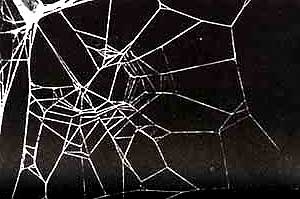
Spider's web

A few posts back, I received a comment from Martin, posing the question whether Black Metal is fueled by a certain ideology, or rather by the appeal of a certain imagery/aesthetics.

Almost having finished his "Available Light. Anthropological Reflections on Philosophical Topics", I'd like to use Clifford Geertz's definition of culture for a reply to that question:

"The concept of culture I espouse. . . is essentially a semiotic one. Believing, with Max Weber, that man is an animal suspended in webs of significance he himself has spun, I take culture to be those webs, and the analysis of it to be therefore not an experimental science in search of law but an interpretative one in search of meaning. It is explication I am after. . . . " (Geertz in "The Interpretation of Cultures").

Black Metal is a culture, a spider's web of significance where ideological and aesthetic strands are closely interwoven and mutually dependent on each other. Take away either the ideological (i.e. politico-moral) strands or the aesthetic strands and the whole web will shift, destabilize, maybe even threaten to collapse or in any case reform into a completely different shape.

However, Black Metal culture is not woven as neatly as spider's webs usually are... Perhaps they're more like the webs of spiders on drugs: chaotic, tangled ... it is an eccentric, centrifugal genre after all.

Friday, November 03, 2006

Rest in peace, Clifford Geertz

Clifford Geertz has died - just as I was reading his collection of essays "Available Light. Anthropological Reflections on Philosophical Topics"!

Geertz's book "Negara. The Theatre State in Nineteenth Century Bali" was one of the books that got me through the difficult years of my cultural anthropology MA, one of the few books that managed to be beautiful and scientific at the same time. Of course, I also loved his famous "The Interpretation of Cultures", and can wholeheartedly recommend both books to anyone with the slightest interest in the cultural life of that strangest of animals, homo sapiens. "Available Light" is also a wonderful read: the essays that are included in the collection, on diversity of cultures, breathe that optimism of the pre-George Bush, pre-9/11 era that is so sorely missed today.

In "Available Light" Geertz described anthropologists: 'We have, with no little success, sought to keep the world off balance; pulling out rugs, upsetting tea tables, setting of firecrackers. It has been the office of others to reassure; ours to unsettle. Australopithecenes, Tricksters, Clicks, Megaliths - we hawk the anomalous, peddle the strange. Merchants of astonishment'.

I hope this blog can live up to that ideal. Rest in peace, wise trickster.