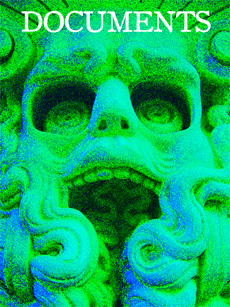
Reading David Gordon White's book on medieval South Asian Tantra and listening to Caïna's brilliant Post Black Metal album Temporary Antennae, images from the two works merged in my mind.
White's book describes medieval South Asian Tantra as a cult in which fierce bird-headed, flying goddesses - Yoginis - were placated by offerings of raw meat, alcohol and semen. Caïna's album presents us with a vision of England's hidden reverse in which the pastoral landscape is crawling with all sorts of beetles and larvae.
This imagery spilled over and into each other to produce a Dream Land in which Black Metal fans sacrifice raw meat, vodka, pills and semen to many-armed, insect-headed goddesses residing in picturesque English village cemeteries; a Dream Land in which ornate Gothic Revival architecture is merged with that of medieval Indian temples, decorated with sculptures of Christian saints in all conceivable states of undress and sexual positions; a Dream Land in which corpse-painted Siddhas fly over Ben Nevis, the Venomous Mountain; a Dream Land in which M.R. James leads a nocturnal double life as an immortal practitioner of left-handed Tantra in dark ant-nest-like catacombs beneath King's College, Cambridge; a Dream Land in which hosts of child-eating female deities, whose hateful cries sound like a downtuned cold black insect buzz, haunt Tintern Abbey; a Dream Land in which Satan's claw is the mandible of a huge stag beetle; a Dream Land in which not Euronymous but Jhonn Balance was Mayhem's sacrificial King.
From the larva of the short, Coil-like opening number, 'Temporary Antennae' pupates in a chrysalis of Lurker of Chalice-influenced Black Metal before emerging metamorphized into a many-colored yet sinister butterfly.
The opening track, 'Manuscript Found In Unmarked Grave, 1919', starts with echoing bells and percussion lost in a roaring drone and ends with a distorted voice (reminiscent of Jhonn Balance's voice on Musick To Play In The Dark 2) reading part of a poem. The poem is 'Grief', and it can be found at the end of the 1908 novel The House on the Borderland by William Hope Hodgson, a British writer of fantastic stories who was killed by an artillery shell at Ypres in April 1918.
When the voice has died down, a fierce, primitive-sounding guitar erupts: 'Ten Went Upriver'. This track shows clearly the influence on Caina of the work of US Black Metal musician Wrest (Leviathan, Lurker of Chalice): the rawness bleeds into blackened sheets of shoegazer sound, melancholic ambient keyboards, and acoustic guitar.
With an intro that brings to mind Justin Broadrick's Jesu, the slowpaced, despondent, distorted psychedelia of the album's third track owes more to the Doom Metal of bands such as Warhorse than to Burzum and his kindred. The song ends with a long sample of the song “Willow Waly” sung by Isla Cameron imitating the voice of an eleven year old girl in Jack Clayton's classic 1961 film The Innocents.
The eerie faux-folk song from the film heralds a turn towards a more dreamy, folk-like music, influenced by Current 93, Death in June, early (1980–1982) The Cure and later (1991-1992) Swans. In these songs Caina proves that is he capable of more than merely following Wrest's 'freezing moon', creating a sound that departs even further than Lurker of Chalice from the orthodoxies of Black Metal. Musically, Lurker of Chalice relates to Caïna as Bauhaus relates to The Cure. But the meaning of the structural relationship extend beyond the strictly musical sphere. Where Wrest revels in extravagant nocturnal theatricality, artifice and aesthetics, Caïna chooses autobiography, personal experience, sensitivity, authenticity. Where Wrest attempts to overstrain the listener by means of a violent gloominess and unresolvable musical matter, Caïna is unafraid of creating harmonies. While Wrest runs the risk of becoming Camp, Caïna risks becoming sentimental to the point of weepiness. Though from a theoretical viewpoint I do not privilege the one approach above the other, Caïna's is more audacious in the context of Black Metal culture.
All in all I find Caïna's Temporary Antennae one of the most interesting - and perhaps the most interesting - Black Metal albums I bought in 2008. I've played it so often these last few weeks that if I'd bought it on vinyl the record would have turned a very pale shade of grey by now. Highly recommended!
Willows And Whippoorwills
Here is an excellent interview with Andrew Curtis-Brignell, the man behind Caïna.
"The Hindu Mantramahodadhi of Mahidhara, a 1558 c.e. work, describes a rite in which the practitioner worships the Goddess while sitting on a corpse with flowers sprinkled with the practitioners own semen."
The quote put one of the most scandalous and disgusting episodes of George Bataille's oeuvre in my mind: he masturbated naked, in the night, before his mother's corpse, which lay on her bed, alone, stretched out between two candles for her vigil. Both scenes evince the same disturbing assemblage of necrophilia, aesthetics and religious devotion to a motherfigure.
Thus, the quote from White's book prompted some internet research.
In another book by White, 'Tantra In Practice', he describes the Mantramahodadhias a Sanskrit text that prescribes the mantras of different deities and ritual practices connected with them. "Mahidara wrote the work with the intention of gathering all significant information on the topic in a single book. Because of the clarity of its presentation, theMantramahodadhi - along with the Nauka (The Boat) , the author's commentary written to enable practitioners to cross the "Great Ocean of Mantras" - has enjoyed great popularity in all parts of India up to the present day." Indeed, the Mantramahodadhi can easily be orderered through the internet (here, for example). Sadly, I could not find the book on Google Books or Project Gutenberg.
"The Vamacharins [followers of the left-hand ritual] ... and amongst these especially that branch called Kaula or Kulina, adopt a ritual of the grossest impurities. Their object is, by reverencing Devi, who is one with S'iva, to obtain supernatural powers in this life, and to be identified after death with S'iva and his consort. 'According to the immediate object of the worshipper,' Professor Wilson says, ' is the particular form of worship ; but all the forms require the use of some or all of the five letters M viz., Mansa, Matsya, Madya, Maithuna, and Mudra i. e., flesh, fish, wine, women, and certain mystical gesticulations. Suitable mantras (or formulas) are also indispensable, according to the end proposed, consisting of various unmeaning monosyllabic combinations of letters, of great imaginary efficacy. Where the object of the ceremony is to acquire an interview with, and control over, impure spirits, a dead body is necessary. The adept is also to be alone, at midnight, in a cemetery or place where bodies are burned or buried, or criminals executed ; seated on the corpse, he is to perform the usual offerings, and if he does so without fear, the Bhutas, the Yoginis, and other male or female goblins, become his slaves.
In this, and many of the observances practised, solitude is enjoined ; but all the principal ceremonies comprehend the worship of S'akti, and require for that purpose the presence of a female as the living representative and type of the goddess. This worship is mostly celebrated in a mixed society, the men of which represent Bhairava (or S'iva as the Terrific), and the women, Bhairavi (S'akti or Devi as the Terrific). The S'akti is personated by a naked female, to whom meat and wine are offered, and then distributed amongst the assistants ; the recitation of various Mantras and texts, and the performance of the Mudra, or gesticulations with the fingers, accompanying the different stages of the ceremony ; and it is terminated with the most scandalous orgies amongst the votaries.'
The same author adds that, "in justice to the doctrines of the sect, it is to be observed, that these practices, if instituted merely for sensual gratification, are held to be as illicit and reprehensible as in any other branch of the Hindu faith"; but full assent must be given to his remark which follows a text quoted by him in support of this view, for he says: " It is only to be added that if the promulgators of these doctrines were sincere, which is far from impossible, they must have been filled with a strange frenzy, and have been strangely ignorant of human nature."
Filled with a strange frenzy! But are they really so 'strangely ignorant of human nature'?
In a tale of Tantric sorcery, the hero comes to a cremation ground in the dead of night, where he secretly beholds a wandering mendicant seated upon a corpse and uttering mantras:
Suddenly, the corpse beneath the mendicant began making a 'put-put' noise, as flames belched from its mouth and mustard seeds shot out of its navel. Thereupon the mendicant, taking those mustard seeds and standing up, slapped the corpse with the palm of his hand. The corpse, which was inhabited by a gigantic [vampire spirit], rose up, and the mendicant then climbed up on it's shoulder. Thus mounted, the [vampire] began to move quickly away. ... [Then, having completed some bussiness in a Durga temple], the mendicant went out, and again striking him with his hand, caused the [vampire] to rise up with the sound of 'put-put'. And climbing up on the shoulder of him whose mouth was spewing flames of fire, he flew up, and went across the sky.
Using textual, sculptural, archeological and ethnographic evidence, White examines that element which distinguishes Tantra from other religious traditions: a form of eroticized ritual practice that emerged in India in the eighth century CE. In this ritual practice, Yoginis where worshiped: avi-cephalic or zoo-cephalic flying goddesses, at once divine and demonic, at once benign and dangerous. To these female divinities, sacrifices were made of meat, of alcohol, but most of all of semen. These oblations would be reciprocated by the Yoginis, who allowed the worshiper to drink their sexual fluids and menstrual blood. Drinking this 'flow of liquid gnosis' made the worshiper part of a clan family (kula), whose lines extend from the god Bhairava down to the human initiate. What is more, drinking the Yogini's sexual fluids and menstrual blood transformed the very being of the worshiper, and conferred supernatural powers, most particularly the power of flight and bodily immortality.
Between the tenth and the twelfth century CE, this medieval Tantric practice was gradually gentrified, in order to make it acceptable to Hindu "mainstream". This gentrification involved the subordination of the female goddesses to the male Tantric practitioner. Furthermore, Tantric practice became less and less corporeal, knowledge taking precedence over eroticized praxis and ritual taking precedence over sacrifice. In this process, the Yoginis came to be regarded not as sctual goddesses but as (symbols of) chakras, wheels of energy which were believed to exist in subtle bodies of man: the fierce goddesses were rendered powerless by internalizing and semanticizing them.
Nevertheless, it seems likely that practitioners of corporeal tantric rites continued to observe the heterodox rites in semi-secrecy, dissimulating their nocturnal identities. Dissimulating gave medieval South Asian elites an opportunity to experiment with a multiple religious identity.
White's book is magnificent, assembling a wealth of scholarly knowledge into a coherent - and to this reader, convincing - whole.
Nevertheless, I feel that White's book would have been even for interesting for the general reader if he had taken care to explicitly relate his empirical findings to theoretical concerns. The exchange of fluids between the Yoginis and their consorts could have been connected to Durkheimian and Maussian themes such as sacrifice, gift exchange and the idea of 'the sacred as the social'. As is, I feel White's reading of medieval Tantra must implicitly be informed by these themes, but the book would have gained in strength if they had been made explicit. Furthermore, the analysis of the strategies of dissimulation could have become stronger if they had been connected to ethnographic thought on secrecy and the social; I'm thinking of some of the essays in Michael Taussig's 2006 book Walter Benjamin's Grave.
I sympathize with White's disdain for New Age Tantra: 'New Age Tantra is to medieval Tantra what finger painting is to fine art, a remarkably unimaginative "series of yogic exercises applied to the sexual act ... a coitus reservatus par excellence ... a sad attempt to mechanize the mysteries of sexual love."' However, in some of his derogatory remarks I felt that he was loathing the right thing for the wrong reasons: the problem with New Age Tantra is not that it is inauthentic, Americanized. I'll quote Michel Leiris once more: “As far as I am concerned, I love everything that presents this dimension of mixing, everything mixed blood, from sarcophagi dating from Roman times with faces of splendidly made-up women painted in the most realistic way to Fuegeans wearing European pants found in shipwrecks, not forgetting Alexandrine philosophy and the unmatchable elegance of Harlem negroes along the way.” The problem with New Age Tantra shows reluctance before excesses of joy, lacks audacity, asks for deliverance and salvation, is anaemic and impoverished. New Age Tantra - like Hindu elites between the tenth and the twelfth century CE - domesticates the wild Yoginis.
Notwithstanding these minor points, I can recommend White's fascinating book to all who are interested in Tantra, in the history of religions and in the anthropology of the body.
Post scriptum
These are some of the words from White's book which I (not being a native speaker of the English language) had to look up in the dictionary:
soteriology- the theological doctrine of salvation
hypaethral - partly or entirely open to the sky
melopoeia - the art of forming melody
theriomorphic - thought of as having the form of a beast. Used of a deity.
antinomian - opposed to or denying the fixed meaning or universal applicability of moral law
'A fascinating dissertation exists entitled Wargus, Vargr - 'Criminal' 'Wolf': A Linguistic and Legal Historical Investigation by Michael Jacoby, published in Uppsala, Sweden, but written in German. It is a highly detailed, heavily referenced exploration of the Germanic word Warg, or vargr in Norse. The paper begins with a section "The term Warg as a Designation for the Criminal in Ancient Germanic Sources," discussing the connotations for the root word among the various Northern European cultures. It appears in the different language dialects, but always with a negative implication when descriptive of men, conveying the sense of "criminal," "outlaw," "outcast," "thief," "malefactor," "evil being," "the damned one," and indeed, even "Devil."
(...)
Jacoby's research continues with an investigation and examination of the most noteworthy crimes which were strongly connected to the word. These are: grave robbery, treason, theft, and manslaughter. A case can be made that Varg Vikernes fulfilled each one of these specific connotations in some respect. Describing the first of the crimes, there is clause in another ancient Germanic legal text, the Salic law, which states: "If anyone shall have dug up or despoiled an already buried corpse, let him be a varg." Vikernes advocacy of, and participation in, grave desecrations certainly qualifies him for this designation. As regards treason, Varg proudly states a desire to see the current government of Norway overthrown, and he identifies with the man whose name has become synonymous with treason in the international vocabulary, Vidkun Quisling. Vikernes has also often been called a "traitor" by others in the Black Metal scene for killing Øystein Aarseth. Vikernes was found guilty of theft - he stole 150 kilos of explosives and had this stored in his apartment at the time of his arrest. The old Germanic laws do not appear to make a distinction between first-degree murder and manslaughter, and refer only to the latter. Vikernes was convicted of mudering Euronymous, although he insists this was only manslaughter, done in self-defense. It is eerie and uncanny that someone would live up to their name so well, even down to the subtleties of its earliest etymological essence. As he result of his actions, he has truly become and "outlaw" and "outcast" in the eyes of society."
I bought Jacoby's dissertation through the internet - it's front cover and the invitation to the dissertation defense are reproduced nearby. Here is a link to a post I wrote earlier, in which I examine Moynihan and Søderlind's hypothesis on the meaning of the word Vargr for the deeds of Varg Vikernes from an anthropological point of view.
I stumbled on the documentary featured in the previous post when reading Ernesto De Martino's classic 1961 ethnography La Terra Del Rimorso (The Land of Remorse: A Study of Southern Italian Tarantism). The book is the result of ethnographic research into Tarantism, conducted by an interdisciplinary team of historians, psychiatrists, medics, anthropologists and social workers. The fieldwork took place in Apulia, the state that forms the heel in Italy's boot, in the summer of 1959.
What is Tarantism? It is an affliction which the Apulians ascribe to the bite of the Tarantula spider, and which reoccurs in regularly repeating yearly cycles in those bitten. The symptoms include "...falling to the ground, a feeling of prostration, anguish, a state of psychomotor agitation with a beclouding of the sensory apparatus, difficulty in remaining standing, stomach ache, nausea and vomiting, various paresthesias and muscular pains, a heightening of sexual desire...".
The research team found out that - even though the symptoms vaguely resembled those of spider poisoning - Tarantism could be reduced neither to the bite of an actual spider nor to other causes, such as sunstrokes or psychic illness. On the contrary, in the course of the investigations Tarantism acquired the meaning of a mythical-ritual symbol, culturally conditioned in its functioning and efficacy.
The spatial and temporal distribution of 'spider's bites' made it highly unlikely that actual spiders were responsible for the phenomenon. There was an overwhelming prevalence of pubescent female participation in Tarantism, and the phenomenon afflicted certain families only. Once bitten, the victim would be affected in the summer for several years, the phenomenon obeying a strict calender. Furthermore, certain locations associated with specific Saints - such as the town of Galatina, of which the St. Paul church is featured in the film - provided immunity from the spiders' bite.
The spider which was held responsible for tarantism was a mythical creature which did not correspond to any arachnid of modern zoology. Instead, the Taranta assembled the characteristics of several different species of spider into a mythical whole. Different colors were attributed to the spiders - principally red, green and black - and the 'bite' of each respective spider caused different behaviour in the victim. Those bit by red spiders displayed martial, heroic behaviour; those bit by green spiders displayed eroticized behaviour; and those bitten by black spiders were fascinated by funerary paraphernalia. Furthermore, each color spider had its own repertoire of musical figures and dances: for example, those bitten by a green spider would only dance to a Tarantella tune associated with the green spider. Finally, the victims of the spider's bite were fascinated by pieces of cloth with the appropriate color. Thus, during the course of an exorcism different Tarantella tunes were played and different colors of clothes were given to the victim in order to determine which spider possesses her. Only the appropriate Tarantella tune, the appropriate color and the appropriate dance would cure the victim - at least for the time being, until the affliction re-occured a year later. Music serves at once as diagnosis and therapy.
Rather than the result of the bite of an actual spider, Tarantism was a mythical-ritual experience which was modeled on the medical symptoms of the actual bite of a poisonous spider. Examining parallels in ethnography and folklore, De Martino found structural similarities between Tarantism and Afro-Mediterranean and Afro-American (Vodou) possession cults. Furthermore, De Martino found antecedents to this religious formation in classical Greek mythology and rituals.
De Martino interprets Tarantism primarily as a form of psychological therapy. For his, the Tarantella is an exorcism, as a ritual eviction of the spider which possesses the victim. The spider symbolizes a traumatic event in the biography of the victim (specifically frustrated eros), and it is the memory of that traumatic effect which causes the affliction of Tarantism with its attendent symptoms. This memory is cast out my music, color and dance - the Tarantella. For De Martino, the symbol of the Taranta is a "mythical-ritual horizon of evocation, release and resolution of unresolved psychic conflicts (...). As a cultural model, the symbol offers a mythical-ritual order for settling these conflicts and reintegrating individuals into the group.The symbol of the taranta lends a figure to the formless, rhythm and melody to menacing silence, and color to the colorless in an assiduous quest of articulated and distinct passions, where a horizonless excitation alternates with a depression that isolates and closes off."
(A short aside on formlessness. That De Martino associates the spider with formlessness certainly struck a chord with me: for Georges Bataille, the spider was an almost formless creature, an invertebrate that is not like anything: "To declare (...) that the universe is not like anything, and is simply formless, is tantamount to saying that the universe is something like a spider or spittle." (Documents 7, 1929). The relation between Bataille's thought and formlessness is the polar opposite of the relationship between De Martino's thought and formlessness.)
Gilbert Rouget, whose 1985 ethnography "Music and Trance. A theory of the relations between music and possession" was featured before on this blog, was highly critical of De Martino's interpretation of Tarantism. Rouget writes that De Martino's analysis makes one lose sight of the most obvious aspect of Tarantism: the identification of the afflicted with the spider. Rouget: "One of the dance figures of the tarantulees - the best known - consists, as we know, in imitating the spider's movements: back to the ground, body arched to a great or lesser degree, the tarantulee moves about like a spider on all fours. One can see this very clearly in D. Carpitella's film, and the sight is striking." (Rouget is mistakingly referring to La Taranta as Carpitella's film: Carpitella merely recorded the music). Rouget reproaches De Martino for making himself an heir to a Christian tradition which abjects possession and possessing divinities and thereby misinterpreting Tarantism. Rouget: "Despite appearances, the divinity responsible for the possession is not the one that is excorcised. On the contrary, it is the divinity concerned who, by allowing the possessing person to identify with him or her, provides the means of ecxorcising the illness - real or imagined - from which the person is suffering."
Whatever the case may be, De Martino's book is highly interesting for those who are interested in possession - whether for scientific reasons or because possession can function as a model for countercultural practices. In De Martino's book, possession is not the exotic practice of an exotic people in an exotic land: La Terra Del Rimorso presents ethnographic and historiographic material on a possession cult which takes place in Europe itself. What's more, Tarantism has its roots in the very soil from which Western civilization sprang: in classical Greece. We were already possessed in the cradle.
Post scriptum
Here is an indepth review of De Martino's book (link).
The two YouTube videos embedded below together form the 1962 documentary La Taranta, which investigates a Southern Italian possession cult: Tarantism. The film, directed by Gianfranco Mingozzi, documents this fascinating peasant religious formation in which the victims of the bite of the mythical Tarantula require a ritual exorcism of frenetic dance, music and colors.
Even if you do not speak Italian, do watch the film, for it is convulsively beautiful. In my mind, its 19 minutes assemble Luis Buñuel's 1933 documentary on the grinding poverty of Spanish peasants Las Hurdes, Herk Harvey's 1962 existential horror film Carnival of Souls and Jean Rouch's 1955 documentary on the Hauka possession cult Les Maitres Fous. The documentary was filmed in a black and white which is so funereal it is almost Xasthuresque, and its music - the famous Tarantella - is haunting. In short: my highest recommendations!
*
The next post will provide indepth material on Tarantism!
Do not visit the exhibition 'Vodou, art and mysticism from Haiti' at the Tropenmuseum in Amsterdam. I did, on November 8th 2008, and still I sleep uneasily.
Do not visit that exhibition when it moves to the Museum of World Culture in Göteborg, Sweden. The exhibition starts innocently enough, presenting Vodou's most acceptable, folkloric face. It starts politically correct enough, appealing to the emancipatory meaning of Enlightenment in presenting the Haitian religion as a weapon in the struggle against French and American colonial domination. It starts nicely enough, in an Apollonian mode, presenting the Lwa - Vodou's spirits - as the contemporary equivalents of the gods of ancient Greece, exotic and slightly naive, weird but safe. But then you turn a corner, and through a dimly lit passageway you are led to two darkened rooms which reveal a world which has nothing to do with our solid, daylight-filled and clear-headed world. You are led into the ominous world of the secret societies known as Bizango. There, your nerves will start to fray, as did mine.
"The people designated by [the name Bizango] are sorcerers who (...) have joined secret societies whose members, united by the crimes they have committed together, give each other help. The [Bizango] derive material benefits from membership - wealth and all its trappings - a fine house, luxurious cars and a trip to France - though these considerations are secondary to the satisfaction of returning evil for evil, and of 'eating people' during nocturnal expeditions. (...)
Countless stories can be heard about [the Bizango] really belong to the province of the fairy tale, but it seems likely that certain people sometimes do band together, in secret, to practice sorcery or to use the popular belief in sorcerer societies to sow terror around them. Proof that the matter is not wholly a question of superstition is to be found in the passports of the [Bizango], confiscated in humfo [voodoo temples] or handed over to curés by repentant voodooists.
The most sinister fantasies of a kind sure to capture popular imagination have been centered on the 'red sects'. Hideous or grotesque aspect, weird dress, obscene and bloody ceremonies, gratuitous cruelty, weird dress, obscene and bloody ceremonies, gratuitous cruelty - there is no conceivable trait that is not attributed to them provided it is sufficiently repulsive and odious. (...) "
And please do not visit it in Bremen's Überseemuseum, in Germany, as the three rooms in the exhibition dedicated to the Bizango societies contain many frightening artifacts, especially paquets, statues and mirrors (see them on this excellent Flickr slideshow).
The paquets ('parcels') are a special kind of talisman, made of wallets or bottles (sometimes big onion-shaped bottles) wrapped in cloth or silk studded with sequins and adorned with frills. Some of the Bizango paquets on displays had human skulls as stoppers. These paquets, which contain the flesh of a sacrificed 'curly cock' mixed with vegetable substances, have the power of 'heating' or exciting the Lwa; but they also have the power of raising goosebumps on the skin of the museum's visitors.
There is a veritable army statues on display. They are life-size, made of black and red cloth filled up with unknown materials, and adorned with ropes, metal chains and little oxidation-stained mirrors. The statues represent the spirits which rule the Bizango sects, and especially the trinity of Kaifou, Gran Bwa and Simityè (Crossroads, Great Forest and Cemetery). Their eyes - most white, others red, some reflecting - rest heavily on the visitor to the exhibition. They rest all the more heavily when the realization dawns on the visitor that human skulls are sown into the head of these statues; thereafter, their eyes seem to be neither seeing nor dead, neither living nor blind.
But the mirrors on display are the most disconcerting of all exhibits. They are ornate, 19th century mirrors, stained by oxidation, weathered by the passage of time. Their gilded frames are elaborated with rusty chains and sinister woodcuts of snakes and daemons. At the top of a huge circular mirror, a primitive Lucifer winks to the visitor. These mirrors are used to call forth the spirits of Bizango; their reflective surface forms the permeable boundary between this world and a nightmarish Otherworld. As philosopher Maurice Merleau-Ponty noted, mirrors "...change things into spectacle and spectacle into things; myself into another and another into myself...". I trembled at seeing myself in these mirrors, sensing they dissolved the boundaries between self and Bizango.
In his ethnography of Vodou, Métraux writes that - when seen up close - the religion of Haiti does not have the morbid and hallucinatory character which books have given it. That black legend, writes Métraux "..belongs to the colonial period when it was the fruit of hatred and fear. Man is never cruel and unjust with impunity: the anxiety which grows in the minds of those who abuse power often takes the form of imaginary terrors and demented obsessions. He treated him like a beast of burden but dreaded the occult power which he imputed to him. And the greater the subjugation of the Black, the more he inspired fear; that ubiquitous fear which shows in the records of the period and which solidified in that obsession with poison which, throughout the eighteenth century, was the cause of so many atrocities. Perhaps certain slaves did avenge themselves on their tyrants in this way - such a thing is possible and even probable - but the fear which reigned in the plantations had its source in deeper recesses of the soul: it was the witchcraft of remote and mysterious Africa which troubled the sleep of the people in 'the big house'."
The exhibition 'Vodou, art and mysticism from Haiti' proves that Voodoo - or the Bizango cult in any case - does have a hallucinatory and morbid character. The sleep of the people in 'the big house' was not troubled for nothing.
"A witch-doctor does not only divine with his lips, but with his whole body. He dances the questions which are put to him. A witch-doctor's dance contrasts strikingly with the usual ceremonial dance of the Azande. The one is spirited, violent, ecstatic, the other slow, calm, restrained. The one is an individual performance organized only by traditional movements and rhythm, the other a collective performance.
(...)
It is important to notice that witch-doctors not only dance but make their own music with hand-bells and rattles, so that the effect in conjunction with gong and drums is intoxicating, not only to the performers themselves, but also to their audience; and that this intoxication is an appropriate condition for divination. Music, rhythmic movements, facial grimaces, grotesque dress, all lend their aid in creating a proper atmosphere for the manifestation of esoteric powers. The audience follow the display eagerly and move their heads to the music and even repeat the songs in a low voice when they are pleasing themselves rather than adding to the volume of the chorus. It would be a great mistake to suppose there is an atmosphere of awe during the ceremony. On the contrary, everyone is jovial and amused, talking to each other and making jokes. Nevertheless, there is no doubt that the success of the witch-doctor's profession is largely due to the fact that he does not rely entirely upon the settled faith of his audience, but makes belief easier by compelling their surrender to sensory stimuli.
We have to remember, moreover, that the audience is not observing simply a rhythmic performance, but also a ritual enactment of magic. It is something more than a dance, it is a fight, partly direct and partly symbolic, against the powers of evil. The full meaning of a seance as a parade against witchcraft can only be fully grasped when this dancing is understood. An observer who recorded only questions put to the witch-doctors and the replies which they gave would leave out the whole mechanism by which the answers are obtained, and even the answers themselves. A witch-doctor 'dances the questions'.
(...)
Every movement in the dance is as full of meaning as speech. All this jumping and leaping embodies a world of innuendo. A witch-doctor dances in front of one spectator or gazes intently at another, and when people see this they think that he has spotted a witch, and the object of their attention feels uncomfortable. Spectators can never be quite certain about the meaning of the witch-doctors behavior, but they can interpret in a general way from his actions what he is feeling and seeing. Every movement, every gesture, every grimace, expresses the fight they are waging against witchcraft, and it is necessary for the meaning of a dance to be explained by witch-doctors as well as by laymen to appreciate its full symbolism."
These are immensely important paragraphs: as early as 1937 they bind together issues of embodiment, rationality, movement and meaning. Not only does Evans-Pritchard conceive the witch-doctor's dance as a semiological system, he also allows the witch-doctor's dance to enrich our understanding of rationality and meaning. The dance may mimic the questions: but the questions anticipate and the answers mimic the dance. Discourse jumps, leaps and grimaces, becomes sweat-soaked, smelly, intoxicated.
It might seem bizarre to write, as I did in the previous installment of this series of posts, that Mark Stewart was a man possessed by the spirit of the Thatcherite Great Britain of the 1980s, a man communing with the military-industrial entertainment complex, a man in communion with the capitalist, proto-fascist, paranoid, surveillance-obsessed oppressor, a man in unio mystica with Babylon, with the enemy. Bizarre: wasn't Stewart an anti-fascist, anti-colonial, anti-capitalist activist?
But there is an interesting antecedent: the West-African Hauka movement. From Michael Taussig's "Mimesis and Alterity":
"Those involved in this rapidly growing movement, begun among the Songhay people in 1925, would dance and become possessed by the spirit of the French major who had first taken the offensive against him, who imprisoned those who had begun the movement, who slapped them around until they said there was no such thing as Hauka. Thus deified as "the wicked major," his spirit got into the first floor of the Hauka pantheon as one of its most violent spirits. Thus possessed, the Hauka would mimic the white men (and sometimes their wives, too) and acquire strange powers.
(...)
But in addition to the conscious play-acting mimicking of the European, conducted with wit and verve, there is bodily possession - which is what makes the mimicry possible yet generally works at a less than conscious level with special, even disturbing, bodily effects: frothing at the mouth, bulging of the eyes, contorted limb movements, inability to feel pain. Strange "Europeans" indeed. And surely that's the point - they so clearly are and are not Europeans. It's the ability to become possessed, the ability that signifies to Europeans awesome Otherness, if not downright savagery, which allows them to assume the identity of the European and, at the same time, stand clearly and irrevocably eye-bulgingly apart from it."
In the Hauka cult, the Europeans discovered "... the presence of an open dissidence, a society the members of which openly defied the social, political and religious order. It his here that we discover the most original aspect of the Hauka movement: their total refusal of the system put in place by the French." In embodying the enemy the Hauka appropriated his power. In this case, possession was anthropophagy.
Like the Hauka, Stewart embodied the enemy: in his case, the enemy was not the colonial authorities but the grey and hopeless Great Britain of the 1980s, the Babylon that Rastamen denounce, the "wicked major" Margaret Thatcher. And like the Hauka, the fact that Stewart embodied the enemy didn't keep him from refusing all cooperation with the authorities.
II
Reflecting on a specific moment in "Les Maîtres Fous" ("The Mad Masters"), a 1955 ethnographic film by Jean Rouch (1917-2004), Taussig writes:
"A man possessed by a Hauka spirit stoops and breaks an egg over the sculpted figure of the governor (a little statue not unlike the Mbari shrine of the white man) that presides over the day's events of Hauka possession. Cracked on the governor's head, the egg cascades in white and yellow rivulets. Then the film is abruptly cut. We are transported to a big military parade in the colonial city two hours away. The film hurls at us the cascading yellow and white plumes of the white governor's gorgeous hat as he reviews the black troops passing. Those of us watching the film in a university lecture hall in New York City gasp. There is something immensely powerful released at this moment, begging for interpretation."
Mark Stewart's version of William Blake's "Jerusalem" somehow parallels this moment in Rouch's film. Regarded as the high point of Stewart's career, the song was played on a regular basis by John Peel and constantly being asked for by listeners. Stewart's "Jerusalem" is more than a parody of the patriotic 1916 hymn, written by C. Hubert H. Parry: it is also an anthropophagic appropriation of the affective power of Brass band patriotism and militarism for anti-nationalist and anti-militarist purposes. But "Jerusalem" is even more than parody and appropration: the rough, almost Dadaist juxtaposition of incongruent sonic material (Industrial, Dub Reggae, Punk Rock, Brass Band, Song) mimics the tensions present in the British social and cultural life in the 1980s.
But Stewart's "Jerusalem" is yet more than a parody and an appropriation and mimesis: the song wrests Blake's poem "...away from a conformism that is about to overpower it". In "Jerusalem", Mark Stewart is a "...writer of history with the gift of setting alight the sparks of hope in the past, [he] is the one who is convinced of this: that not even the dead will be safe from the enemy, if he is victorious" (Benjamin).
To paraphrase Taussig's analysis of Rouch's film: the deep Industrial Dub of "Jerusalem", with its ability to explore the sonic unconscious, to come close and enlarge, to frame and to montage, creates in this sudden juxtaposition a suffusion of mimetic poetry. Blake's poetry is allowed to flower in the grey Thatcherite Great Britain of the 1980s.
Mark Stewart's "Jerusalem" is to C. Hubert H. Parry "Jerusalem", what the rivulets of egg are to the governor's hat.
Post scriptum
I've posted Rouch's film before, but feel compelled to watch it. Even though I first saw it several years ago the film is still bending my mind into shapes that are "abnormal, non-Euclidean, and loathsomely redolent of spheres and dimensions apart from ours" (Lovecraft). As Wizard Eibon commented on the earlier posting of the film: "a classic masterpiece you can't forget once you've seen it".
In Greek antiquity, Aristotle observed that "enthousiastic" melodies (associated, as their name indicates, with possession) used the (ancient Greek) Phrygian mode exclusively. The Phrygian mode was said to originate in Phrygia, a kingdom in what is now modern-day Turkey. Also, the aulos was regarded as the instrument specific to Dionysian ecstasies. It was a flute-like wind instrument, which also was seen as coming from the Phrygian kingdom. The music of Dionysian ecstasy was regarded as coming from Phrygia.
Gilbert Rouget in "Music and Trance": "It was indeed from Phrygia (or Thrace, but in any case from Asia Minor) that the Dionysus cult spread (...), or, as the Greeks themselves believed, that it originated. We are therefore justified in saying that, although Dionysian music was Phrygian in instrumentation and mode, it was not because the musical characteristics of this instrumentation and mode in and of themselves (that is to say, their particular timbre or set of intervals) were thought to have any remarkable effect on triggering trance, but rather because they were the clearest sign of Dionysus' identity. This would in any case concur with the general logic of possession. For in fact what is possession other that the invasion of the field of consciousness by the other, that is, someone who has come from elsewhere? Insofar as he is the other, Dionysus is at the same time an elsewhere. This is how he was thought to be, and how his music was experienced. In Dahomey, people of Gun or Fon origin speak Nago when they are possessed by a vodun of Nago origin. Elsewhere, people who ordinarily speak a given African language talk in Arabic if the spirit possessing them is thought to be of Arab origin. When she was possessed by Beelzebub, Jeanne des Agnes spoke, it is said, in Hebrew (...). What is true of speech could also be true of that other language, music."
Rouget's analysis puts in mind Michael Taussig's 1986 ethnography "Shamanism, Colonialism and the Wild Man. A Study in Terror and Healing". In the book, white colonists visiting Indian shamans to be cured of the sorcery believe that the 'wildest' Indians, those Indians who live in the most geographically remote region, have the most powerful healing capabilities. The Indians on the other hand visit markets in Colonial towns to buy 'exotic' Western European grimoires. Here too, the magically powerful Other originates from the mysterious "elsewhere".
II
So what about the music of Mark Stewart, whom Mark K-Punk described as a man possessed, as "a shell and a conduit which other voices, outside forces, (...) occupy.". K-Punk dic not examine too closely which voices, which forces Mark Stewart channels: Stewart's loa was cursorily described as "...rage and utopian longings...". This raises the question: where, for Mark Stewart's, is the "elsewhere" that haunts him?
Even if the sources of inspiration for his music are diverse, Mark Stewart's first "elsewhere" is no doubt Jamaica: possessed by the dubby or duppy ghost, the Caribbean island's music has thoroughly invaded his field of consciousness.
"Dub arose from doubling—the common Jamaican practice of reconfiguring or "versioning" a prerecorded track into any number of new songs. Dub calls the apparent "authenticity" of roots reggae into question because dub destroys the holistic integrity of singer and song. It proclaims a primary postmodern law: there is no original, no first ground, no homeland. By mutating its repetitions of previously used material, dub adds something new and distinctly uncanny, vaporizing into a kind of doppelgänger music. Despite the crisp attack of its drums and the heaviness of its bass, it swoops through empty space, spectral and disembodied. Like ganja, dub opens the "inner door." John Corbett even links the etymology of the word "dub" with duppie (Jamaican patois for ghost). Burning Spear entitled the dub version of his great Marcus Garvey album Garvey's Ghost, and Joe Gibbs responded to Lee Perry's production of Bob Marley's "Duppie Conqueror" with the cut "Ghost Capturer." Perry described dub as "the ghost in me coming out." Dub music not only drums up the ghost in the machine, but gives the ghost room to dance." (sourced here).
It should be noted though that Rastafarianism - unlike many Afro-Caribbean religions such as Vodou - is not a possession cult. As far as I am aware, there are no rituals in Rastafarianism in which, during trance, the subject is thought to have acquired a different personality: that of a god, a deity, genius or ancestor who takes possession of the subject, substitutes itself for him, and acts in that subject's place. Furthermore, alcohol, which has an important role in many Afro-Caribbean possession rituals, is tabooed under Rastafarian food laws (I-Tal).
"[Rasta] has little in common with Haitian voodoo, Cuban santeria or the other Africanised remixes of Catholicism. Instead of a panoply of spirits, Rasta has just the one God, the stern patriarch of the Old Testament - not someone with whom you can cut deals, as you can with voodoo's loa. If anything, Rasta is Afro-Protestant, sharing with mainland America's fundamentalists an emphasis on close reading of the scriptures and a millenarian belief in an End of Time whereupon the righteous get transported to the promised land." ("Tangets #2. Back To The Roots", by Simon Reynolds, Wire, September 2000).
Nevertheless, in Rastafarianism communion or 'communial trances' do play a role. "Rasta mystical experience emphasizes the possibility of the immediate presence of Jah within the "dread," or "God-fearer." God's presence brought on an understanding of the fundamental unity of all humanity, expressed in the pronoun "I&I" (which can mean I, we, or even you, with Jah present). Discerning the will of God is an almost Talmudic process, achieved through night-long "reasoning" sessions, part theological debate, part prayer meeting and meditation, which lead to an "overstanding" (rather than understanding) of the truth through union with Jah." (sourced here).
“In fact, one of the most common Rastafarian rituals involves reading a chapter of the bible everyday. The version most commonly read is that of King James. The Rastafarians claim, however, that King James distorted the true content of the bible party because of his inability to translate the Amharic Ethiopian text accurately, and also as a deliberate ploy to perpetuate the suppression and oppression of the black race. So, although the bible is read and venerated, the Rastafarians only choose to read those passages which they ‘intuitively’ feel are correct.” (sourced here).
Many tenets of Rastafarianism, such as the I-Tal diet and the wearing of dreadlocks, are the result of an at once inspired and paranoid reading of the Scriptures, the result of a Ganja-entranced communion with Jah.
Employing Rouget's typology of types of mystic trance, we can describe Reasoning as a mystic religious practice in which "... the relation between divinity and subject is seen as an encounter which, depending upon the individual, is experienced as a communion, a revelation, or an illumination." For Rouget, this type of non-identificatory mystical trance is possession without the embodiment of the deity. Other examples of such non-identificatory possession are the (Protestant) Shakers of Saint Vincent in the Antilles, the Dervishes, the Schlustes (a Russian sect of dancers and flagellants) and the Camisards.
III
Mark Stewarts music can be described as a non-identificatory possession, directed not at communion with Jah but at communion with the Thatcherite Great Britain of the 1980s, at communion with the Babylon that Rastamen denounce.
Using his politically militant music his to reveal the Western world as a greedy, proto-fascist, paranoid, surveillance-obsessed society, Mark Stewart's use of Dub is informed by late-1970s Western interpretation of Jamaican culture:
"Reggae fans, black and white, (...) looked to the music for "a solid foundation" (as the Congos sang it), for certainty and truth, militancy and motivation. 'Roots rock rebel' neatly condenses how Jamaican music was seen both by rock and by reggae itself. Reggae was anti-imperialist: Rasta's Pan-Africanism connected with the period's post-colonial struggles (...). Reggae was anti-capitalist (...). And reggae was anti-fascist, (...) bringing radical chic to countless student digs with its poster iconography: Peter Tosh, a Che Guevara with natty dreads and black beret; Medusa-headed spiritual warriors Black Uhuru, Burning Spear, and Culture; Steel Pulse preaching about "Handsworth Revolution"." (from: "Tangents #2: Back to the roots", Simon Reynolds, Wire, September 2000 issue)
Stewart's mid-1980s music also looks forward to the mid-1990s discourse on Dub: "For simplicity's sake, this cluster of ideas can be described as the Afro-Futurist discourse, but it actually has multiple facets: dub as deconstruction (of the song, of the metaphysics of musical presence); the producer as mad scientist, dark magus, shaman, trickster; the 'Macro Dub Infection' notions of dub as post-geographical virus and of dub's sonic instability as an education in 'insecurity'." (ibid.)
Mark Stewart's image as a paranoiac can be compared to Lee Perry's image as a 'mad scientist', a madness which in the 1990s was exalted in terms derived from Deleuze and Guattari's "A Thousand Plateaus". Like Perry, Stewart has been portrayed in the press as being dangerously paranoid, and rumours abound as to "no-shows" at On-U Sound concerts being due to hospitalization. In a 1988 article in NME, the artist was presented as suffering from delusions:
"Sure enough our conversation slid rapidly into the realms of the bizarre. 'Of course I know people who are under surveillance,' he claimed at one point, getting up to close the door, 'I'm under surveillance because my Dad has Grade A security clearance and access to uranium.' You mean you're being watched? 'I'm not under surveillance,' he countered, donning a pair of mirror shades, 'I'm a vegetarian'. Looking straight over my shoulder, he laughed with a sudden, unexpected burst."
Mark Stewart's music interrogates his socio-cultural environment like a Rastaman interrogates the Scriptures: in a state of bleary-eyed Ganja-induced paranoid trance, finding unorthodox meanings occulted behind conventional signs. But where Rastafarians unearth the law of Jah in the Bible, Stewart uncovers the secret workings of Babylon in British society, a society which is nothing more than an cancerous outgrowth of the military-industrial entertainment complex; where Rastafarians find ‘a solid foundation’, Stewart finds semiological quicksand, seeing signs and portents which make him suspect the pavement on which he walks hides concrete bunkers; where Rastafarians expect the End Times to bring a repatriation to the Promised Land of Ethiopia, Mark Stewart anticipates - even desires - a nuclear Rapture.
Like Rastafarian Reasoning, Stewart's music conflates several semiological genres in a musical montage: his work is part political harangue, part invocation of the military-industrial complex and part divination aimed at discovering cryptic/encrypted knowledge by the entranced interpretation of the urban environment. Concealed beneath the city streets Stewart sees a veritable labyrinth of missile silos, blockhouses, ventilation shafts, corridors, and "...cathedral-like vaults with hydraulic platforms resembling Piranesi's prisons, endless concrete galleries leading to vertical shafts and even further galleries (...)" (from here).
The concrete bunkers which Mark Stewart knows beneath the city streets are his second, his true 'elsewhere'.
IV
Here is a trailer for a documentary on Mark Stewart,"ON/OFF: Mark Stewart - from the Pop Group to the Maffia" by Tøni Schifer. The DVD will be released by Monitorpop in october/november 2008.
Below, you'll find a YouTube video of the 1984 documentary 'Sur les traces du Renard Pâle' (Tracking the Pale Fox) by Belgian ethnographer and filmmaker Luc de Heusch. It is a fascinating documentary about French ethnographic research into the mythology and rituals of the Dogon, a West-African people living in Mali and northern Burkina-Faso.
The central figure of the documentary is the French anthropologist Marcel Griaule (1898 – 1956), who was affiliated with Georges Bataille's brand of Surrealism. He published several articles in Bataille's journal Documents, the publication which inspired this blog.
Griaule is perhaps best known as the leader of the 1931-1933 Dakar-Djibouti expedition, which became famous paradoxically because of one of its most disaffected participants: the Surrealist and ethnographer Michel Leiris, one of Georges Bataille's closest friends. The mission was organized by the Institut D'Ethnologie and financed by the French government and the Rockefeller Foundation. The mission, which took from 1931 to 1933 would "... criss-cross French West Africa, Nigeria, Cameroon, French Equatorial Africa, the Belgian Congo, Anglo-Egyptian Sudan, Abyssinia, Eritrea, and French Somaliland".
During the Dakar-Djibouti expedition, Griaule studied the culture of the Dogon, a West-African people living in Mali and northern Burkina-Faso. Following the expedition, Griaule would study Dogon culture extensively for more than 25 years, becoming famous for a study on the meaning of masks in the complex mythology of the Dogon.
Jean Rouch, whose utterly mindbending documentary Les Maitres Fous was featured earlier on this blog, narrates the story, and interviews Dogon elders and Griaule's closest collaborator, Germaine Dieterlen.
Valenapio, who posted the videos on YouTube, writes: "Note : As always, the translations and subtitles are clumsily home-made. A dogon game is mentionned in this part. I haven't found a transcription of its name : Griaule uses a phonetic sign for it in his book "Jeux Dogons", and the sound "un" or "in", which exists in french, doesn't exist in english. So, you've got an "ein" instead. Oh, well...".
Last Saturday, I was finally able to buy a book of photographs by Pierre Verger: 'Retratos De Bahia' ('Portraits Of Bahia'). It is a very beautiful oblong, clothbound book, printed in Bahia, Brazil, itself in 1980 by publishing house Editora Corrupio. The book contains more than 250 black and white photographs of Bahia and its people by this enigmatic photojournalist, ethnographer gone native, and Candomblé priest.
Pierre Verger (1902-1996) is now best known for his photographs printed in two books by Surrealist dissident Georges Bataille: photos of bloodspattered Voodoo ceremonies, printed in Bataille's 1957 book L'Érotisme and his 1961 art book Les Larmes d'Eros. These photos were taken in 1948 in Haiti, where Verger was living in the Centre d'Art, an institution in Port-au-Prince which supported Haitian folk artists. Photos from the same period can be found in the classic 1958 ethnography "Le Vaudou Haitien" by Bataille's and Verger's close friend, the ethnologist Alfred Métraux. Bataille, who did not know Verger personally, called him "one of the most remarkable - and most famous - photographers of these times".
A remarkable figure indeed: after a career as a globetrotting wartime journalist, photographer and ethnologist, Verger between 1953 and 1956 gradually converted to the faith of the black descendants of slaves in Bahia. He was initiated into Candomblé and in the African Ifa divination cult, where he received the name "Fatumbi" and the title of "Babalaô" (The Father of Secrets), allowing him access to the orally passed-on wisdom of the Yorubá. As an ethnologist, Verger "went native", giving in to the attraction of the Other, losing all critical distance between himself and the subject he studied. 'Going native' is the ethnographer's eroticism.
'Retratos De Bahia' contains no photos of gruesome Voodoo rituals: instead, it is a testament to Verger's love for the vibrant black people of Brazil. The book collects photos of street vendors, Capoeira dancers, people celebrating Carnaval, fishers, musicians, people Candomblé rituals, people sleeping in the street, and so on. Many of these exquisitely beautiful photographs can be found on the excellent website of the Pierre Verger Foundation.
Below, you'll find a YouTube slideshow of photographs by Pierre Verger and his biography as found in 'Retratos De Bahia', amateurishly translated from Portuguese into English by myself.
*
*
Biography
"Pierre Fatumbi Verger, born Pierre Edouard Leopold Verger, on November 4th 1902, in Paris. French photographer, ethnologist,Candomblé priest, he used to explain the facts of his life as a series of accidents.
In the nineteenthirties the first important accident happens: he loses his mother, his last remaining direct relative. Without any identity rooted more deeply with the social context in which he was living, he then decides to abandon that context. With a backpack and a camera he parts to find new experiences and especially to be forgotten by too many others. Thus, he leaves Paris in 1932 and heads for the Pacific Islands.
For fifteen years he travels through different regions of the world, photographing that which took his interest. Bit by bit he collects precious documentation on ancient civilizations which are on the brink of disappearance, or were suffering a profound transformation of their cultural traditions. Examining these materials reveals his talent as a researcher.
This period takes him to the United States, Japan, China, the Philippines, Sudan (now Mali), Togo, Dahomey (now Benin), Nigeria, parts of the Sahara, the Antilles, Mexico, Guatamala, Ecuador, Peru, Bolivia, Argentinia and Brazil. Besides reporting, he is also charged with the photographic laboratory of the Musée D'Etnografie (now Musée de l'Homme), in Paris. While a wartime correspondent in China for Life magazine, he also collects photographic documentation for the Museo Nacional de Lima in Peru.
A second important accident precipitates Verger definitively into research: the discovery of Bahia in 1946.
Drawn to Bahia by reading Jorge Amado's book Jubiabá, he is pleased by the city and especially by the people living here. He installs himself, and lives in an intense way with Bahia's people. He commences to tirelessly research the worship of Orixa deities and the way trafficking slaves has influenced economy and culture.
From then on, between 1949 and 1979 he makes several journeys between Bahia and Africa's west coast, mainly Dahomey and Nigeria. He visits every Yoruba stronghold of the New World. He intensifies his research on its ethnicity, on its influence on Bahian culture and on the ties which are established between them.
The relationship between Verger and black culture bit by bit starts to surpass mere intellectual interest. He involves himself deeply in the Candomblé, is initiated and starts to fulfill religious functions. In Bahia, he is an Ogã priest in the Opô Afonjá temple of Miss Mãe Aninha, and in the Opô Aganjú temple of Balbino, in Lauro de Freitas. In Dahomey, he is initiated as a Babalaô when studying Ifa divination, and receives the name of Fatumbi - which means 'Reborn' in Ifa.
As a Babalaô, he has access to the cultural heritage of the Yorubas, their mythology, their botanical therapies and the liturgy of their possession cults.
Verger creates, as photographic reporter, an important body of historical and ethnographic work. His acute powers of observation, the use of austere equipment, his intellectual humbleness, and his human wisdom - based on simplicity, respect and truth - certainly facilitated his task.
In 1966, the development and the talent of Verger's work is officially recognized by science: at the University of Paris, through the Sorbonne, granted him the title of Doctor, even though Verger abandoned his academic studies 17 years earlier.
Currently living in Bahia, Verger tirelessly works on his documentation, collected during 34 years of research. He focuses on the dissemination of his work, preparing books and articles for journals and conferences, answering the requests that come from various parts of the world.
Pierre Fatumbi Verger is the "free and available" man of which his friend Théodore Monod speaks. True to his calling, his profound work corresponds to loneliness and freedom."
Links
Here is a link to an exhibition in Basel, Switzerland, called 'Black Gods in Exile'.
In my previous post about Michael Taussig's 1986 ethnography "Shamanism, Colonialism and the Wild Man. A Study in Terror and Healing", I wrote that Taussig's description of the montage-like (dis-)order of Indian healing rituals is very reminiscent of Deleuze's and Guattari's concept of the rhizome. It must be stressed though that where Deleuze and Guattari tend towards the obscurantist and the disembodied, Taussig's work remains in close contact with the filth and grime of the physical world.
Below I quote Taussig's description of yagé-intoxicated montage-like (dis-)order in full, as I found it beautiful and inspiring.
"Montage: alterations, cracks, displacements and swerves all evening long - the sudden interruptions, always interruptions to what at first appears the order of the ritual and later takes on little more than an excuse of order, and then dissolves into a battering of wave after wave of interruptedness into illusory order, mocked order, colonial order in the looking glass. Interruptions for shitting, for vomiting, for a cloth to wipe one's face, for going to the kitchen to gather coals for burning copal incense, for getting roots of magical chondur from where nobody can remember where they were last put, for telling and retelling a joke (especially for that), for stopping the song in mid-flight to yell at the dogs to stop barking ... and in the cracks and swerves, a universe opens out.
Montage: the manner of the interruptedness; the sudden scene changing which breaks up any attempt at narrative ordering and which trips up sensationalism. Between the swirling uncertainty of nausea and the abrupt certainty of the joke there lies little if any room for either the sensationalistic or the mysterious.
Montage: suddenly altering situations of the group withing the room and mood-slides associated with these changing situations, scenes, as it were, from the art of trompe-l'oeil, passing in a flash from night to day through ages of time from despair to joy and back again without any guarantee of happy endings.
Montage: flashing back and forth from self to group; not simply self-absorption broken up and scrambled by participation in the group or with one or two members of it, but also through such flashing back and forth from self to group and group to self a sort of playground or testing-ground is set up for comparing hallucinations with the social field from which they spring. Hence the very grounds of representation itself are raked over.
(...)
Montage: the 'interior" scenes of dots and dashes of color and of phantasms, coming and going, death scenes, above all fragments of things - shiny blades of grass quivering under the rain, a tiny feathered segment of intricate pattern (the edge of a bird's wing, perhaps?), the quavering of yagé songs butting into the river's rush - all metamorphosing into memory images as the past gains force in its rush into the present "now-time" of the Jetztzeiten where time stands still as an image in which past and future converge explosively.
Montage: oscillating in and out off oneself; feeling sensations so intensely that you become the stuff sensed. But then you are standing outside the experience and coldly analyzing it as Bertolt Brecht so wanted from his "alienation effects" in his epic theater. Only here, in the theater of yagé nights in the Putumayo foothills, the A-effect, standing outside of one's own defamiliarized experience and analyzing that experience, is inconstant and constantly so, flickering, alternating with absorption in the events and their magic. Perhaps that is the formula for the profoundest possible A-effect, standing within and standing without in quick oscillation."
'Black in color, with a gaping mouth and projecting teeth and disheveled hair, clad in filthy garments, very smelly, and dwelling in empty, broken-down buildings'
 Reading David Gordon White's book on medieval South Asian Tantra and listening to Caïna's brilliant Post Black Metal album Temporary Antennae, images from the two works merged in my mind.