Of all French chanson artists, Death has made the strongest mark on the oeuvre of Barbara. Below the lyrics and a YouTube video for her song "Nantes", one of the most mournful of her sombre repertoire. The subject of the song is the death of her father, whom she had not seen for ten years. In her autobiography, Mémoires interrompus, it is implied that she was raped by her father when she was 10 years old.
Il pleut sur Nantes
Donne-moi la main
Le ciel de Nante
Rend mon cœur chagrin
Un matin comme celui-là
Il y a juste un an déjà
La ville avait ce teint blafard
Lorsque je sortis de la gare
Nantes m'était encore inconnue
Je n'y étais jamais venue
Il avait fallu ce message
Pour que je fasse le voyage:
"Madame soyez au rendez-vous
Vingt-cinq rue de la Grange-au-Loup
Faites vite, il y a peu d'espoir
Il a demandé à vous voir."
A l'heure de sa dernière heure
Après bien des années d'errance
Il me revenait en plein cœur
Son cri déchirait le silence
Depuis qu'il s'en était allé
Longtemps je l'avais espéré
Ce vagabond, ce disparu
Voilà qu'il m'était revenu
Vingt-cinq rue de la Grange-au-Loup
Je m'en souviens du rendez-vous
Et j'ai gravé dans ma mémoire
Cette chambre au fond d'un couloir
Assis près d'une cheminée
J'ai vu quatre hommes se lever
La lumière était froide et blanche
Ils portaient l'habit du dimanche
Je n'ai pas posé de questions
A ces étranges compagnons
J'ai rien dit, mais à leurs regards
J'ai compris qu'il était trop tard
Pourtant j'étais au rendez-vous
Vingt-cinq rue de la Grange-au-Loup
Mais il ne m'a jamais revue
Il avait déjà disparu
Voilà, tu la connais l'histoire
Il était revenu un soir
Et ce fut son dernier voyage
Et ce fut son dernier rivage
Il voulait avant de mourir
Se réchauffer à mon sourire
Mais il mourut à la nuit même
Sans un adieu, sans un "je t'aime"
Au chemin qui longe la mer
Couché dans le jardin des pierres
Je veux que tranquille il repose
Je l'ai couché dessous les roses
Mon père, mon père
Il pleut sur Nantes
Et je me souviens
Le ciel de Nantes
Rend mon cœur chagrin
Showing posts with label Barbara. Show all posts
Showing posts with label Barbara. Show all posts
Thursday, December 28, 2006


Tuesday, December 12, 2006
The Hand of God or the Devil's Hand?
A YouTube video of Barbara's 'Chapeau Bas'...
Another video of Barbara, playing "La Dame Brune" with Georges Moustaki...
Another video of Barbara, playing "La Dame Brune" with Georges Moustaki...
Faces of Paris
 Visiting Paris, it was one of my goals to buy three cd's:
The nexus of the post would have been Pierre Klossowski's 'Sade - My Neighbour', more specifically the chapter of that book on the Divine Marquis' relation to the French revolution, where Klossowski describes regicide as the killing of God by proxy. The post would have linked the three cd's thematically through:
- the violent, sadomarxist, even selfdestructive aspect of existentialism, that philosophical movement of which Barbara was one of the figureheads (didn't Sartre write in his preface to Frantz Fanon's 'The Wretched of the Earth' that ".... by their mad fury, (...) by their ever-present desire to kill us, (...) have [the oppressed] become men"?);
- the violent, regicidal aspect of the may 1968 Paris uprising, where 'Soyons cruels!' was one of the slogans and where De Gaulle was to play the role of sacrificial king; the uprising of which Luc Ferrari's 'Music Promenade' is a music concrete collage of field-recorded sounds; and
- the sadean aspect of Black Metal, which needs no commentary here. "Les Hordes Noires", cruel deicides par excellence, would have been presented as the heirs of the Sadean regicidal revolutionaries.
*The title of Spektr's cd is a paraphrase of Virgilius "Fast flies meanwhile the irreparable hour".
Friday, November 10, 2006
Misanthropic Quasimodo
 I know, I've been a less than active blogger these last few weeks: the days getting shorter, and I was feeling more and more like a cross between senator Thomas Buddenbrooks at the end of Thomas Mann's novel and a misantropic Quasimodo.
Today was a day off and I've spent most of it sleeping, only becoming active after noon. Now, I'm on the sofa, listening to consolingly melancholic French music from the 1960's: Brigitte Fontaine's "Comme à la radio" and "Une soirée avec Barbara" by Barbara - of course.
Brigitte Fontaines record, released in 1969, was the result of the collaboration by the chanteuse with the Art Ensemble of Chigaco and Fontaine's husband Areski Belkacem, a Frenchman of Algerian descent: a caleidoscope of French poetry, American "Black Power" free jazz and North African music. It was one of the first instances of World Music, but it is thankfully completely free from that genre's usual bland UNESCO-style universalist optimism: the chanteuse is too impassioned, too eccentric and too darkly cynical for that. Her lyrics are beautiful, surreal, sombre: "Il fait froid dans le monde / Ca commence à se savoir / Et il y a des incendies qui s'allument dans certains endroits / Parce qu'il fait trop froid " (Freely translated: "The world gets cold / That's becoming clear / And fires are blazing in certain places because it's getting too cold"). Amazingly, Fontaine is still active, collaborating with a variety of artists: Sonic Youth, Gotan Project and Archie Shepp, to name a few.
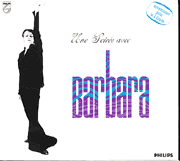
Barbara's record is a live recording of a february 1969 concert in Paris' famous Olympia venue on the Boulevard des Capucins. It is one of my mother's favorite records: she still has the double lp box set issued by Philips, she played so often when I was an infant. I loved it then, I still love it now. The music may be somewhat more conventional than that of Brigitte Fontaine, but it is deeply beautiful and the songs covers much a broader emotional spectrum: from the humorous ("Elle vendaits des petits gateaux") via the amourous ("La dame brune") to the sombre ("Le soleil noir" - "The Black Sun", a haunting, almost hallucinatory evocation of luxurious depression). It is a powerful, truly moving album. She died on november 25th 1997, and was buried two days later in the Jewish area of Bagneux Cemetery.
Subscribe to:
Posts (Atom)