"
Now I see well why with such dark flamesyour eyes sparkled so often.
O eyes!It was as if in one full glanceyou could concentrate your entire power.Yet I did not realize - because mists floated about me,woven by blinding fate -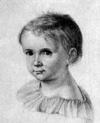 that this beam of light was ready to be sent hometo that place whence all beams come.
You would have told me with your brilliance:we would gladly have stayed near you!But it is refused by Fate.Just look at us, for soon we will be far!What to you are only eyes in these days -
in future nights shall be stars to us".
From this sombre poem about the death of a child, the cd "KTL", a collaboration between Stephen O'Malley and Peter Rehberg, descends. In this post, I'll trace it's genealogy a bit more extensively than has been done in other reviews of the album.
The poem above was written by the romantic poet
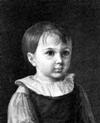
Friedrich Rückert, while grieving over two of his children, who had both died within 16 days at a very tender age: Ernst Rückert (january 4th 1829 – january 16th 1834) and Luise Rückert (june 25th 1830 – december 31st 1833). It is part of a much larger cycle of poems, called "Kindertotenlieder". The cycle contains no less than 425 poems in total, which are reproduced in full
here.From this cycle of poems, the late-romantic composer
Gustav Mahler selected five poems for a symphony - the one above (reproduced in a translation by
Emily Ezust) is one of these five. The poems that Mahler chose for his "
Kindertotenlieder" symphony all deal with the theme of light and darkness. The composer wrote that "[t]hese five songs are intended as one inseparate unit, and in performing them their continuity should not be interfered with". Mahler's wife Alma wrote in her book 'Erinnerungen und Briefe' (1946) that she felt that Mahler tempted fate in setting Rückert's poems to music - and sure enough, fate answered Mahler's call, death taking his oldest daughter Maria in 1907 at the age of 4.
This year, Gisèle Vienne (philosopher, marionetist, director) and
Dennis Cooper (
writer, poet, performance artist, blogger) created a theatre piece named after Mahler's sombre song cycle, a piece which "interrogates the confusion between phantasm and reality in the collective sphere". Cooper calls it "a combination black metal concert/funeral in the dead of winter in the middle of the Austrian woods".
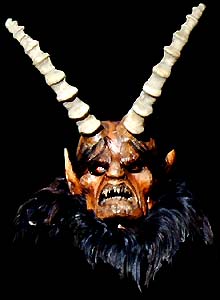
Besides the cycle of Mahler's poems, Vienne and Cooper were inspired by folkloric Yuletide rituals from Austria, in which people don monstrous masks to portray the devils and daemons of the Wild Hunt - masks that would make many a black metal performer proud! These rites too are connected to the death of children. From
Wikipedia: "
In the folklore of Bavaria and Austria, Perchta was said to roam the countryside at midwinter, and to enter homes on Twelfth Night. She would know whether the children and young servants of the household had behaved well and worked hard all year. If they had, they might find a small silver coin next day, in a shoe or pail. If they had not, she would slit their bellies open, remove stomach and guts, and stuff the hole with straw and pebbles". This ancient tradition is apparently still very much alive in Austria, judging by the number of websites dedicated to it: see
here,
here and
here for some examples.
The
premiere of "Kindertotenlieder" will take place on february 28th 2007, on the Festival Les Antipodes, at the Le Quartz gallery in Brest, France.
Here are some dialogues from the play. A photograph from the website is reproduced nearby - note that the dead child (don't worry, it's only a doll) is wearing a Burzum hoodie!

From these funereal forebears, KLT descends, a collaboration between Stephen O'Malley and Peter Rehberg. The music on the cd is apparently not the soundtrack to the theatre piece, though elements may appear in the finished piece.
On the website of the Rehberg's record label Éditions Mego, KTL is called "A six part collision amongst the increasingly fading prescences (sic) between the light and the dark" - echoing the theme of those of Rückert poems (light and darkness) that Mahler selected for his symphony. That very theme is also reflected in the description of the two places the music was recorded, each a place where light and darkness collide: "Pieces were recorded in a resistance fortress in southern France during a thunderstorm. Others in a wintergarden drenched in the sunlight": thunder (light) versus storm (dark), winter (dark) versus sunlight (light).
As the Mego website calls KTL a "threatening new collaboration taking in parallel worlds of Extreme Computer Music and Black Metal", I feared that this release would be marred by the schlock-horror approach of Black Metal, so unapproapriate for the mournful theme of this release. Thus, I think, it is a good thing O'Malley and Rehberg did not follow the musical onomatopeia which is present in Mahlers work (from
Derek Lims essay: "... the most subtle is in Wenn dein Mütterlein, Mahler accompanies the melody with pizzicato cello, imitating in the Bachian sense, the mother's footsteps. Later, pizzicato viola imitates the footsteps of the daughter who once followed the mother's footsteps, but no more"). A modern-day variation on Mahler's musical onomatopeia - such as a sample of a weeping mother or whimpering child - would have spoiled the stark, pristine beauty of KTL with lurid sensationalism.
Thankfully, this is not the case: O'Malley and Rehberg do not take a leaf out of Mahler's late-romantic style, but follow their own musical path. Like Mahler's Kindertotenlieder, the six tracks of the cd "... are intended as one inseparate unit, and in performing them their continuity should not be interfered with".
The first track of the cd, Estranged, opens with an icy-blue shimmering ambient tone - somewhat reminiscent of the ambient sound of the last track of Burzum 's "Hvis Lyset Tar
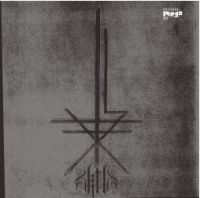
Oss", but even more minimalist. Over this, sound effects are slowly added, O'Malleys guitars putting accents on the electronica. As a whole, the track is somewhat similar to Sunn 0)))'s "A Shaving of the Horn That Speared You" , from
White1. Another musical precursor is Justin Broadrick's
Final project.
Then, on the four movements of "Forest Floor" - the second to sixth tracks on the cd - the music crescendoes into a cold and ferocious metallic (not just metallic as in the musical genre, but metallic as in the element, as in iron, steel, silver) soundscape - an assault of industrialized loops - and then slowly diminuendos into desperate and desolate drones - the musical equivalent of being lost in the alps in a winternight night during a snowstorm.
When the storm has settled, all is covered in snow: "Snow", the coda of KTL ... starting with flakes, blots, squiggles, marks, scribblings, doodles of noise ...
Henri Michaux described fighting with such blots, likening them to 'insatiable desires or knots of force, which are destined never to take form' ... one cannot decide whether their origin is electronic or electric ... and out of these slowly a structure rises up, slow loops, sombre repetitions, sinister slashings of sound: the most mournful of all six tracks.
Breathtaking.

 By making a fool of myself, by abasements (What is abasement?), through shattering, through emptiness, through a total dissipation-derision-purgation, I shall cast out that form of me which was thought to be so well-attached, well-composed, well-coordinated, of the same stamp as the company I keep and as my fellow-men, my oh so worthy fellow men.
 CLOWN, submitting to the assault of laughter, jeers and guffaws the notion that against all evidence I had formed of my importance.