From Derek Walmsley's interview with Kode9 in The Wire 303: "When dubstep was bogged down in too much stodgy bass, Hyperdub switched to crisp, super-light 8-bit electronics. In an era when dance music is generally self-satisfied and commercially bloated, Hyperdub releases short, sharp tracks like acupuncture darts aimed at the pleasure centers. And the self-titled debut by Burial - The Wire's album of the year in 2006 - was an emotionally overwhelming experience in a decade where sincerity is often seen as a sign of weakness. Meanwhile, Kode9's own music has suggested viable escape routes from the electronic dance continuum formulaic deadlock. When most London producers were bragging about bass weight in 2007, like kid comparing their souped-up cars, "Magnetic City" and "Stung" took graceful spins in a hover speeder. More recently, the slithering synths and Latin-inflected rhythms of "Black Sun" and "2 Far Gone" suggest Herbie Hancock sweating out heavy psychedelics, tie askew and forcing his group out of their comfort zone."
From Joseph Stannard's interview with Sunn 0))) in The Wire 302: "The walls of O'Malley's Paris appartment stare back, as he plays me [Sunn 0)))'s new album] Monoliths and Dimensions. (...) The final track on Monoliths, "Alice", begins quietly, gradually gathering itself, recalling the gritty, graceful film scores of Ennio Morricone and Bernard Hermann. There are atmospheric echoes of recent Earth, whose guitarist Dylan Carlson appears elsewhere on the album; so far, so lugubrious. Minutes from the end, however, an unexpected shift occurs. The tolling guitars recede and the listener is guided to a space somewhere between ecstatic harp-adorned reveries of the song's subject, Alice Coltrane, and the bittersweet haze of Miles Davis's "In A Silent Way/It's about that time" and "He Loved Him Madly". Into the space vacated by the song's stunning, climactic trombone solo, O'Malley projects a single word: "Priester". He's referring to Julian Priester, veteran jazz musician, alumnus of Sun Ra's Arkestra, John Coltrane's Africa/Brass ensemble and Herbie Hancock's Mwandishi group, and initiator of two fine examples of spacious electric jazz, 1974's Love, Love and 77's Polarization. That Priester should deliver the final note on an album by this particular duo is surprising; that his musical heritage should prove so influential on their music, doubly so. There has often been a kind of lumbering, monumental grace to Sunn 0)))'s music, but it has seldom produced anything that could so readily be termed soulful, or even beautiful."
Am I the only one reading/hearing a parallel development? I've heard parallels between Dubstep and Sunn 0)))'s music before, and now I'm hearing them again!
From the two interviews, it would appear that both Sunn 0))) and Kode9 are turning away from stark, gloomy meditations on bass weight; and that both are turning to graceful, Herbie Hancock-influenced psychedelic Jazz.
Of course, it could be that the parallel development reflects not so much a convergent evolution of the musics, but the latest fad in the offices of The Wire. Assuming, however, that this is not the case, assuming that there actually are parallels, one wonders: "What does it mean?" Does the development reflect the recent political progress in the United State? Is it primarily an artistic/aesthetic process which is not related to changes in society in any relevant way? Or is it something else entirely?
"When [...] the world of clear and articulate objects is abolished, our perceptual being, cut off from its world, evolves a spatiality without things. This is what happens in the night.
Night is not an object before me; it enwraps me and infiltrates through all my senses, stifling my recollections and almost destroying my personal identity. I am no longer withdrawn into my perceptual look-out from which I watch the outlines of objects moving by at a distance. Night has no outlines; it is itself in contact with me and its unity is the mystical union of the mana. Even shouts or a distant light people it only vaguely, and then it comes to life in its entirety; it is pure depth without foreground or background, without surface and without any distance separating it from me."
If we interpret this text from a Bataillan perspective, Merleau-Ponty's night is a formlessness that is homogenous.
These last few days I've been thinking a lot about this extremely interesting text, and about how it relates to the trope of 'night' in Black Metal, and how that trope relates to the sense perception of Black Metal music itself. I've published this post fully aware that my thoughts on this subject still lack definite shape and form - but than again, in night "the world of clear and articulate objects is abolished".
'Night' is a fairly prominent trope in Black Metal. Just search for the word 'night' in blogs like 'Dunkelheit' and the search results will display dozens of albums which employ the word in its album or song titles. The way Black Metal uses the trope of 'night' can easily be related to Merleau-Ponty's text. Many titles relate night to destruction: "Cut, with the Night, into Mine Heart", "Night Of Retribution", "Night of Pagan Wrath", "Midnight Mutilation". Some even specifically relate night to the destruction of personal identity: "Black Night Of Soul". Where Merleau-Ponty relates night to the sacred (mana), so does Black Metal: "Night of Shadow Magic", "Satan, Eye of the Night", "Black Night Astral Projection", "Temple of Eternal Night". Some titles ascribe to night a life of its own, echoing Merleau-Ponty ("... it comes to life..."): "Summon The Night", "The Will of Night", "The Dark Spirit of the Night". Other titles link 'night' to depth: "Journey Into The Depths Of Night". I could go on and on, and I haven't even touched upon night-related tropes such as 'darkness', 'black', etc. The titles can be read as (often childish and clumsily formulated) metaphors for the embodied perception of night.
How does the perception of night as formulated by Merleau-Ponty relate to Black Metal production style?
Depth is rarely associated with Black Metal production. Depth in music is generally associated with bass: Dark Ambient and Dubstep are genres which are often described using tropes of 'depth'. Black Metal music distinguishes itself from other musics by the absence of bass's fathomless depths. I recall the production of French Black Metal Haemoth's excellent 2006 'Kontamination' album being called 'wafer thin': pure surface without foreground or background, without depth - the polar opposite of Merleau-Ponty's night.
Furthermore, Black Metal in the style of Mayhem, Darkthrone and Satyricon is a sharp object, an object which does not enwrap but which pierces, an object which does not infiltrate but which penetrates. From a review on the Invisible Oranges blog: "The music is plenty scathing, but the sound is an icepick in the ear. (...) This shit is painful." Despite the poor production of Black Metal, the riffs have relatively clear and articulate outlines.
Nevertheless, an album like Mayhem's 1994 classic De Mysteriis Dom Sathanas is unremittingly dark. The only sensory perceptions that album provokes are those of touch and smell: the album is cold, and stinks of vomit and dust. Beyond these perceptions, only darkness. How does the music achieve the effect of darkness without mimicking the embodied perception of night? Or should one conclude that Merleau-Ponty's description of the experience of night is somehow flawed or lacking? Or did I not listen carefully enough to the music? Should I listen to what lies beyond the wafer thin surface?
Perhaps the clear and articulate outlines are only there to be subsumed in raw and primitive buzz, abolished by thick roiling blackness, destroyed by murky ambience that enwraps and infiltrates, smothered in guitardrone... "Even shouts or a distant light people it only vaguely..."
In his 1948 essay 'La Lampe Dans L'Horloge', Surrealist André Breton wrote: "Do not numerous studies in the course of contemplation, establish that for a century [Romantic poets] - and consequently the most acute modern spirit - have drifted towards the temptation of the end of the world? In fact there can be no doubt whatsoever that the state of mind of men like like Nerval, Borel, Baudelaire, Cros, Rimbaud, Lautréamont, Mallarmé, whose sensibility, for the most part, has conditioned ours, was governed by the old Manichaeanism and Sade." Breton cites Baudelaire, who dreams of a Pompeii-like catastrophe: 'To amuse myself I calculate to myself ... whether a prodigious mass of stone, marble, statues, and walls crashing down together would be stained by the multitude of brains, human flesh and broken bones." (sourced here).
Not only the destruction of Pompeii and Herculaneum influenced Baudelaire's cataclysmic calculations: the Romantics employed secularized extensions of Christian thought, of which the apocalyptic theme of the end of the world figured importantly. The French poets mentioned by Breton, but also British poets such as William Blake, appropriated Christian imagery of the apocalypse, like those from the Book of Revelations, and re-used these images in their poetry. Of course, only the decline of the Church since the end of the Middle Ages made it possible to reduce the Apocalypse to an object of aesthetic contemplation. Where Christians read the Revelation to John as describing not the end of the world but on the contrary, the new creation of a new world, the Black Romantics saw the Apocalypse as a seductive yet ruinous and blood-spattered sacrifice of civilization. Theirs was an Apocalypse without a Kingdom Come.
In a sense, Kevin Martin - the mastermind behind Yardcore and Dubstep outfit The Bug - is a contemporary Black Romantic. Where the Black Romantics appropriated the Apocalypse of nineteenth-century Christians, Martin appropriates the Apocalypse of the Rastafarians in his most recent album, London Zoo.
Rastafarians, being - admittedly unorthodox - Christians, draw their inspiration from close reading of the Bible, particularly the first books of the Old Testament, the Psalms, the first pages of St John's Gospel and the Book of Revelations. Occidentalist milleniarists, they believe that the final Judgment of God is imminent, and that it will bring the downfall of the hegemon, of western capitalist civilization and all its institutions. Rastafarians represent the hegemon as 'Babylon', the biblical 'whore' which symbolizes luxurious decadence, filthy fornication and bloodthirsty evil. For Rastafarians, Zion - their Kingdom Come - is to be found in Africa, and more specifically in Ethiopia, the land of their Messias, Haile Selassie I of Ethiopia.
The Bug's recent album London Zoo paints a picture of London as a city where the Apocalypse is already taking place - and there will be no Redemption: global heating, incompetent government, crack addiction, capitalist greed, youth gang violence, hurricanes, unbelief, collective insanity, corruption, terrorist bombs, are at once symptoms of London's decadence and punishment for the corrupt, faithless Londoners. The Dancehall Noir of the track "You & Me" (featuring poet Roger Robinson) tears pages out of J.G.Ballard's novel The Drowned World, which paints a picture of a world in which the polar ice-caps have melted and caused worldwide temperatures to soar, leaving the cities of northern Europe and America - and specifically London - submerged in exotic, haunting tropical lagoons. London is Kevin Martin's Babylon, and listening to The Bug's latest album is watching Babylon teeter, ready to fall.
Kevin Martin casts London's Pompeii-like decadence in Rastafarian language, yet without doubt he does not subscribe to the tenets of the Rastafarian faith. Like the Black Romantics, Martin is able to use the imagery of Babylon only because the Rastafarian faith has little or no hold on his psyche. For it's aesthetic effect, London Zoo is paradoxically dependent on the attraction, on the fascination exerted of the terrors of the Apocalypse. Armageddon produces "...a delightful Horrour, a terrible Joy (...)" (John Dennis, 1688). The aesthetic of London Zoo is similarly structured to that of the Black Romantics.
Kevin Martin is not the first musician to present London as a city where the Rastafarian Armageddon is already taking place: Mark Stewart and the Maffia's 1983 album 'Learning To Cope With Cowardice' is an obvious precursor. In fact, that album's review by David Stubbs in the February 2007 issue of the Wire, could very well describe London Zoo: "The title track creates instant unease through its easy interplay of rough, Industrial Techno, funk noir, dub and plundered hiphop rhythms, all collapsing into one another like new buildings. Fires of reggae righteousness roar like bonfires amid the urban chaos as Stewart (...) pours conflagratory scorn on a sick, corrupt and fearful populace, torching the veneer of their illusions." Here, it should be noted that Mark Stewart's inspiration for this album came from Romantic poet William Blake's vision of London as a sacred city, simultaneously Babylon and Jerusalem. However, London Zoo is an album that is somehow more triumphant, heroic, muscular in tone than that of Mark Stewart, which is altogether more raw, more bleak, shattered-sounding.
From a theoretical point of view, Stewart's bleakness is perhaps preferable to Kevin Martin's attitude. Nevertheless, I absolutely love London Zoo and personally prefer London Zoo to Learning To Cope With Cowardice. Why? Perhaps it is only because I am too young to fully appreciate Stewart's album, as I have few memories of it's socio-political context - it came out before my time, as they say. But there is also the matter of Mark Stewart's vocals: they are a taste I've never quite acquired, and they are at their most grating in Learning To Cope With Cowardice. On London Zoo on the other hand, the vocals are a boon. The contribution of the MC's - such as grizzled Tippa Irie, gruff Flowdan, dread Ricky Ranking and the viper-tongued Warrior Queen - is more successful integrated into Kevin Martin's music than in his earlier work with MCs, such as Techno Animal's 2001 Hiphop-influenced album The Brotherhood Of The Bomb and The Bug's 2003 album Pressure. Furthermore, technological advances in electronic music mean that The Bug's London Zoo is an album of luxurious aural subtleties - there's simply more sonic terrain to explore.
Probably, preferring London Zoo to Learning To Cope With Cowardice is in poor taste. If so, I am guilty. I feel London Zoo is perhaps the best album Kevin Martin has made since Techno Animal's magisterial 1995 album Re-Entry - which is an album which I would take with me to the proverbial “desert island”. London Zoo comes with the highest recommendations.
Post scriptum
I am in no way implying that there is no reciprocal relationship between Martin and his Rastafari-oriented MCs, that Martin is only taking from them. Perhaps the MCs are taking something from Martin that is similar to that which Aimé Césaire took from André Breton?
Here is a YouTube video to one of the most successful tracks on the album, Poison Dart (feat. Warrior Queen).
You can find a Kode9 remix of the entire London Zoo album here.
"I had that boxer's movement in mind," Miles Davis said of the music on his 'A Tribute To Jack Johnson' album, "that shuffling movement like boxers use. They're almost like dance steps, or like the sound of a train ... That train image was in my head when I thought about a great boxer like Joe Louis or Jack Johnson. When you think of a big heavyweight coming at you it's like a train."
Benga's (21-year-old Beni Adejumo) knock-out album 'Diary Of An Afro Warrior' self-confidently melds Dubstep and Electronica and Jazz.
Listening to that album brought the music of Miles Davis' electric period to mind. Of course, Benga's music is rather more slow-moving than the high-energy music of Davis' electric period - it is Dubstep, after all.
But the minimal, metallic surfaces of 'Diary Of An Afro Warrior' reminded me of Davis' love of fast sports cars; the heavy punch of it's sub-bass reminded me of Davis' love of boxing; and the title of Benga's album brought to mind the black ethnic self-consciousness of the late 1960s and early 1970s.
What's more, Miles Davis' music was a sorcerer's brew of the music of is time: Jazz, Funk, Soul, Blues, Avant Classical, Psychedelia. Likewise, Dubstep, Jazz, Electroclash, Detroit Techno, Minimal, IDM, Triphop are the 'points-chauds' with which Benga runs the Voodoo down.
By incorporating electric instruments in his music, Davis managed to steer clear of the too-smooth, the too-clean, and the too-perfect, creating music that was more than a little funky in the original sense of the word; likewise, Benga's militant sound avoids the superficiality that plagued the Jazz-influenced Drum & Bass that was pioneered by LTJ Bukem.
Of course, there's no comparing Benga's track record with that of Miles Davis. But Benga brings to Dubstep some of the clear-mindedness, sense of physical exhilaration, and stamina that went into Davis psychedelic jazz-funk fusion.
In a series of post stretching back several weeks (the first one is here), I wrote about Kevin Martin's epochal compilation "Jazz Satellites Vol. 1 - Electrification'. Kevin Martin is now best known for his dubstep and dancehall projects King Midas Sound and The Bug, but he has been involved in a plethora of bands: Techno Animal, God, Ice, The Sidewinder, Curse of the Golden Vampire, Experimental Audio Research and 16/17. Many of these band were collaborations with Justin Broadrick (Napalm Death, Fall of Because, Godflesh, Jesu) - here is an excellent article on the cooperative work of these two great musicians.
Sadly, Jazz has evaporated from Martin's music in recent years - the last Jazz-influenced album being the first The Bug album: 1997's "Tapping The Conversation". Why Martin abandoned Jazz isn't quite clear from the interviews I found on the internet.
An interview with The Bug perhaps provides some clues:
"I guess the first thing that I was really involved in was a band called God, which ended up being maybe twelve people, or maybe more. My idea when I formed the band was to create really physical music that was very loud; volume was very much a part of the equation. But as it went on what I wanted to do was mix free jazz with noise rock so basically I just kept inviting more and more people in to get closer and closer to that idea and the last show we did I had two drummers, a percussionist, two bass players, a double bass player, two guitarists, three saxophone players and a group of African drummers as well. All of it was amplified, and all going through effects so it was really psychedelic, incredibly loud and incredibly physical. (...)
For me I’m obsessed with sound, my whole life’s been about music basically, my father and grandfather were musicians so for me its in my blood anyway and from that point on it was all about the studio because when you're in a band that size, you have to make compromises, you cant really use the studio, particularly with jazz players, they’re really fussy about how you mix them, they want to be pure and I wasn’t really in to that."
I think it is sad that Jazz is no more in Martin's music. Though the music is too shuddering and juddering to suggest a architectural taste for authority, I miss the Free (as in Free Jazz) in his post-God and post-Ice work a little. Nevertheless, I do really appreciate the sounds he is producing now. Here are two YouTube videos of his recent work.
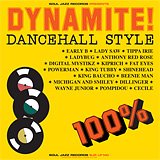
'Dynamite! Dancehall Style' is yet another great Soul Jazz Records compilation.
A few months ago, I discovered the Barefiles website - a treasure trove of Dubstep and Grime mix tracks, brimming with rough but beautiful diamonds mined from Londons pirate radio stations. Just before I went on a short trip to London in august, I downloaded what must be Barefiles' Koh-I-Noor: a mix track by Kode9 from Mary Anne Hobbs' BBC1 radio programme Breezeblock. It was the perfect soundtrack for the London trip - even though it is perfectly possible to love dubstep even if one doesn't live in South London, dubsteps rhythms rhyme with that city's dynamism better than with that of any other city.
My favorite part of that mix track was 'Dem A Bomb We' - delerious dubstep with sharp-tongued lyrics about the bomb attacks on London's public transport, angry yet elegant, bass-heavy but lightfooted, beautiful. The part in which the female singer paraphrased Gloria Gaynor's ' I will survive' was especially intoxicating for me - transgressing a taboo on disco that still lingers from my industrial roots. I had no idea who had made the track, but I loved it.
Thus, I was pleasantly suprised when I found out that 'Dem A Bomb We' was made by none other than Kevin Martin, whose musical career I have followed since 1994 and who has had a very strong influence on the development of my musical taste. Martin has been active in so many genres one couldn't count them on the fingers of two hands: jazz, industrial, dub, dubstep, ambient, hip hop, illbient, Chain Reaction-style techno and so on. He's been a long-time collaborator with Justin Broadrick, another musical hero of mine. Even though 'Dem A Bomb We' is far removed stylistically from Kevin Martins industrial-strength musical assault, I apparently loved his music even if I didn't know and couldn't have guessed that it was made by him.
'Dem A Bomb We' turned out to be the first single taken from the Soul Jazz Records compilation 'Dynamite! Dancehall Style', the umpteenth high-quality compilation of black music put out by that label (I have 7 of them, not counting this cd; some are double cds). It is a somewhat eclectic collection of dubstep, dancehall reggea and ragga tracks from both the UK and Jamaica, tracing the evolution of dance-oriented reggea from King Tubby's 1984 'Fade Out' to the latest South London cuts by the Digital Mystikz. Having received it in the mail today and listening to it for the second time, I can wholeheartedly recommend it, and I certainly hope that Soul Jazz Records will release some more compilations in this vein. Who knows, they could turn out to be the 'Macro Dub Infections' of the naughties!
“As far as I am concerned, I love everything that presents this dimension of mixing, everything mixed blood, from sarcophagi dating from Roman times with faces of splendidly made-up women painted in the most realistic way to Fuegeans wearing European pants found in shipwrecks, not forgetting Alexandrine philosophy and the unmatchable elegance of Harlem negroes along the way” - Michel Leiris.
In the 1990’s, I loved this very dimension of mixing in Mick Harris’s, Kevin Martin’s and Justin Broadrick’s many bands – Scorn, Godflesh, God, Ice, Techno Animal, The Bug, Curse of the Golden Vampire; and in the many compilations these artists made (Macro Dub Infection, Jazz Satellites, Isolationism; and not to forget the Electric Ladyland series), I loved the mixed blood of ‘white’ (grindcore, industrial, ambient) and ‘black’ (jazz, dub, drum & bass, techno) underground musics.
Of course, Kevin Martin and Justin Broadrick are still quite active. Nonetheless, I’d very much like to see more miscegenation among current underground genres such as doom metal, dubstep, black metal and grime.
On one hand, for black metal, syncretism appears as yet to be far off, the genre sadly still being in the grips of racism and the ‘troo’, the ‘ kvlt’ and the ‘elite’. Yet in my minds ear I can already hear black metal’s ice-cold buzzing-bees-in-a-bucket guitars swarming around deep, warm, syrupy dubstep bass.
On the other hand, as far as doom metal is concerned, things seem to be on the move: on internet forums, many have pointed out similarities between doom metal and dubstep, qua slowness and use of sub-bass; both Kode9 and Sunn 0)))’s Stephen O’Malley have devoted blog entries to sound weaponry; and a very nice doom metal/hip hop mashup has appeared on the internet.
So: give me a Blood and Fire vs. Blood Fire Death soundclash, a Burzumic Burial, a Sunn-Skream, a Satanic Dubmaster, a Vex’d Xasthur, a Loefah Leviathan: the stars are right!
'Black in color, with a gaping mouth and projecting teeth and disheveled hair, clad in filthy garments, very smelly, and dwelling in empty, broken-down buildings'
 From Derek Walmsley's interview with Kode9 in The Wire 303: "When dubstep was bogged down in too much stodgy bass, Hyperdub switched to crisp, super-light 8-bit electronics. In an era when dance music is generally self-satisfied and commercially bloated, Hyperdub releases short, sharp tracks like acupuncture darts aimed at the pleasure centers. And the self-titled debut by Burial - The Wire's album of the year in 2006 - was an emotionally overwhelming experience in a decade where sincerity is often seen as a sign of weakness. Meanwhile, Kode9's own music has suggested viable escape routes from the electronic dance continuum formulaic deadlock. When most London producers were bragging about bass weight in 2007, like kid comparing their souped-up cars, "Magnetic City" and "Stung" took graceful spins in a hover speeder. More recently, the slithering synths and Latin-inflected rhythms of "Black Sun" and "2 Far Gone" suggest Herbie Hancock sweating out heavy psychedelics, tie askew and forcing his group out of their comfort zone."
 From Joseph Stannard's interview with Sunn 0))) in The Wire 302: "The walls of O'Malley's Paris appartment stare back, as he plays me [Sunn 0)))'s new album] Monoliths and Dimensions. (...) The final track on Monoliths, "Alice", begins quietly, gradually gathering itself, recalling the gritty, graceful film scores of Ennio Morricone and Bernard Hermann. There are atmospheric echoes of recent Earth, whose guitarist Dylan Carlson appears elsewhere on the album; so far, so lugubrious. Minutes from the end, however, an unexpected shift occurs. The tolling guitars recede and the listener is guided to a space somewhere between ecstatic harp-adorned reveries of the song's subject, Alice Coltrane, and the bittersweet haze of Miles Davis's "In A Silent Way/It's about that time" and "He Loved Him Madly". Into the space vacated by the song's stunning, climactic trombone solo, O'Malley projects a single word: "Priester".