Showing posts with label Roland Barthes. Show all posts

Tuesday, June 02, 2009

Saenredam's Nothingness

"Hanging in the Dutch museums are works by a minor master who may be as deserving of literary renown as Vermeer. Saenredam paints neither faces nor objects, but chiefly vacant church interiors, reduced to the beige and innocuous unction of butterscotch ice cream. These churches, where there is nothing to be seen but expanses of wood and whitewashed plaster, are irremediably unpeopled, and this negation goes much further than the destruction of idols. Never has nothingness been so confident. Saenredam's sugary, stubborn surfaces calmly reject the Italian overpopulation of statues, as well as the horror vacui professed by other Dutch painters. Saenredam is a painter of the absurd; he has achieved a privative state of the subject, more insidious than the dislocations of our contemporaries. To paint so lovingly these meaningless surfaces, and to paint nothing else - that is already a "modern" aesthetic of silence."

Roland Barthes, "The World As Object" (sourced here).

Thursday, March 05, 2009

Black Metal Getting Medieval

I've just finished reading Carolyn Dinshaw's 1999 book Getting Medieval. Sexualities and Communities, Pre- and Postmodern. The book examines and constructs relations between contemporary queer communities on the one hand and medieval dissident figures and groups: prostitutes, heretics, sodomites. I became intrigued about Dinshaw's work through the medieval studies blogs In The Middle and The Medieval Club of New York (to which Nicola Masciandaro is an occasional contributor).

Dinshaw aims for a tactile historiography, focusing on bodies touching each other across many boundaries: those of space and time and text and death, inter alia. Her desire to touch, informed by the work of Roland Barthes, aims to create transhistorical communities consisting of those who are not like others: the queer.

What would such a desire mean for the historiography of that strange dissident community, which has been the subject of many posts of this blog: the Black Metal Inner Circle?

Two of the central episodes of the history of the Black Metal Inner Circle put bodies touching each other center stage: the episode of Dead's suicide and the episode of the murder of Øystein 'Euronymous' Aarseth. Both 'touchings' dramatically took place on the limen of life and death.

The first touching: 'Dead' Per Yngve Ohlin, a young Black Metal musician, aged only 22, kills himself with a shotgun round to the head in a house on Sørumvein Road, Kråkstad, Norway. His still-warm body, dressed in a black jacket and a white "I Love Transylvania" t-shirt, is touched by his fellow band member Øystein 'Euronymous' Aarseth, is touched to be rearranged for aesthetic purposes: photographs are taken to be used on the record sleeve of the 'Dawn of the Black Hearts' album, and (according to Black Metal legend) fragments of Ohlin's skull are collected and forged into talismanic necklaces.

The second touching: Christian 'Varg' Vikernes, former protegé and bosom friend of rings on the door of Aarseth's flat in Oslo. Aarseth, dressed only in his underwear, lets him in. Vikernes stabs Aarseth's half-naked body with a knife, from behind, to the point of excess. Vikernes's accomplice, Snorre 'Blackthorn' Ruch: "We had intended this to happen in the appartment, and fast - no big, dramatic thing with a hundred knife-stabs or something." What had been intended as a cold-blooded murder turned into a disorganized, unrestrained, inordinate performance. According to official reports Aarseth received a total of twenty-three wounds: two to the head, five to the neck, and sixteen to the back. Can the fact that Aarseth is murderously penetrated from behind be said to mean that the murder touches upon sodomy - an act that was exalted by the Satanist Aarseth as 'evil'? Whatever the case may be, in the March 27th 1993 issue of the Metal magazine Kerrang!, Vikernes appeared half-naked in the snow, bragging about his crimes. Vikernes's naked upper body rhymes with that of his victim.

What do these 'touchings' mean to me? Dinshaw's book prompted me to face the corporeal, tactile aspects of my continuing fascination with the drama that unfolded in the Black Metal Inner Circle.

If I were - with Dinshaw - to suppose that this fascination is informed by a desire to form a tactile transhistorical community with that Circle, with a desire to touch the protagonists of that drama, there is one photograph to which I must point.

It is a photograph of Aarseth taken in the legendary Helvete record shop, which functioned as the scene's temenos.

Aarseth is portrayed in a medium shot, from a straight-on angle, on a horizontal level, in an oblique profile. Aarseth himself seems to be posing, but the pose is uneasy. It looks as if he wasn't prepared to be portrayed.
From the point of view of Black Metal iconography, the picture contains only few orthodox motifs. There is no corpse paint, Aarseth is not wearing a theatrical costume. As an object of studious contemplation (Roland Barthes' 'studium'), the only interesting things about this photograph are the record sleeves and a Godflesh poster ('Pure') that can be seen in the background. One of the record sleeves, of Pungent Stench's 1991 album 'Been Caught Buttering', features Joel-Peter Witkin's 'The Kiss', showing two male corpses kissing each other on the mouth. An inverted cross hangs above a door.

Aarseth himself looks tired, he is badly shaven and his long black hair appears to be uncombed.
He is squinting his eyes. Around his waist is a bullet belt. His faded black Mayhem t-shirt is cut-off, exposing his white arms and belly.

The white belly - the belly button specifically - is the element in the photograph which touches me. Roland Barthes: “The second element will break (or punctuate) the studium. This time it is not I who seek it out (as I invest the field of the studium with my sovereign consciousness), it is this element which rises from the scene, shoots out of it like an arrow, and pierces me. A Latin word exists to designate this wound, this prick, this mark made by a pointed instrument: the word suits me all the better in that it also refers to the notion of punctuation, and because the photographs I am speaking of are in effect punctuated, sometimes even speckled with these sensitive point; precisely, these marks, these wounds are so many points. This second element which will disturb the studium I shall therefore call punctum; for punctum is also: sting, speck, cut, little hole - and also a cast of the dice. A photograph’s punctum is that accident which pricks me but also bruises me, is poignant to me.


Post scriptum


Scan of Kerrang! magazine courtesy of Full Moon Productions.

Monday, November 24, 2008

La Taranta (pt. 3)

Ernesto De Martino's fascinating 1961 ethnography of Apulian Tarantism, 'The Land of Remorse: A Study of Southern Italian Tarantism' is strongly influenced by the idealist humanism of Italian philosopher Benedetto Croce.

Because of its optimist, positivist, rational, humanitarian, decent nature, one can read De Martino's ethnography in the way proposed by Roland Barthes in 'The Pleasure of Text': "The more decent, well-spoken, innocent and saccharine a story is told, the easier it is to invert it, the easier it is to blacken it, the easier it is to read it against the grain".

Reading of De Martino's ethnography against the grain is certainly easy- one can destabilize the book's idealism when it is creatively misread in a way informed by Lovecraftian paranoia and the Cthulhu mythos!

Just consider the following quotations from the chapter on the medieval origins of Tarantism:

"First of all, there is the problem of the phenomenon's origins, the period and historical climate in which tarantism came into being, with its own forms, on the ruins of the orgiastic cults and the mystery religions. In this regard, it is impossible for us to trace any useful indication of the symbolism of the taranta in the Phisiologus and medieval bestiaries, or in the prayers, spells and recipes collected by Pradel in Griechische und Süditalienische Gebete, Beschwörungen und Rezepte des Mittelalters. The same must be said for Arab writers. (...) Furthermore, in the De Venenis by Cristoforo Degli Onesti, a Florentine who taught medicine in Padua from 1379 to 1386, there is a chapter which treats De morsu tarantulae. Although this chapter appears in the index of the manuscript preserved in the National Library of Paris, [it] is missing from the text (...)".

Why is the chapter on the bite of the tarantula missing from De Venenis? Did De Martino check all Arab writers - or did he omit to mention that he found some blasphemous indications in the work of the mad one? Why did the authorities really close up the miraculous well at St. Paul's Chapel in Corso Garibaldi in Galatina in July 1959, the well to which those afflicted by Tarantism flocked every year? Doesn't the fact that Tarantism only runs in certain family point towards an Innsmouth-like atavism? And what about the 'Sanpoalari' - Southern Italian snake charmers and traveling healers? To which secrets are they privy? And why doesn't the spider which is held responsible for tarantism correspond to any arachnid of modern zoology? Is there any connection between tarantism and the spider-god Atlach-Nacha? Does the yearly cycle of Tarantism in any way correspond to the astronomical cycle of the planet Cykranosh (or Saturn, as we know it today), the planet from which this demonic deity is said to come? Do the caverns deep beneath Mount Voormithadreth, where the god resides, lead to the Apulian Monte Gargano, or even further south? What about the giant, bloated purple spiders of Leng, which are thought to be the children and servitors of Atlach-Nacha? Wasn't Tarantism mentioned in Unaussprechlichen Kulten by Von Junzt? Or was it Ludwig Prinn's De Vermis Mysteriis?


Post scriptum

Only after writing this post, I read the passages in Reza Negarestani's Cyclonopedia on Hidden Writing.

Wednesday, May 07, 2008

Ofermod - Mystérion Tés Anomias

Many sociological accounts until the nineteeninetees would suggest that people join cults, sects and occult groups out of socio-economic frustration and social isolation; occultists are marginal people subscribing to marginal beliefs. More recent research, such as Tanya Luhrmann's 'Persuasions of the Witch's Craft' suggests otherwise: most paganists are solid, well-functioning middle-class suburbanites, not Lumpenproletariat. Rather than "ruined and adventurous offshoots of the bourgeoisie, (...) vagabonds, discharged soldiers, discharged jailbirds, escaped galley slaves, swindlers, mountebanks, lazzaroni, pickpockets, tricksters, gamblers, maquereaux, brothel-keepers, porters, literati, organ-grinders, ragpickers, knife grinders, tinkers, beggars" (Marx), occultists are secretaries, civil servants, computer workers.

However, that most occultists are middle-class suburbanites leaves open the possibility that some are marginal people. Swedish Black Metal band Ofermod are a case in point.

Guitarist Michayah, the driving force behind Ofermod, is a convicted heroin dealer, and a (former?) addict. Heroin addiction is a virtual guarantee for socio-economic frustration and social isolation: in an interview with Terrorizer magazine Michayah speaks of the 'violence and misery that one has to face each and every day'. What's more, Michayah has been in prison almost without interruption since March 2006, having been convicted for assault, robbery and other violent crimes.

Michayah is also a dedicated occultist, his intellectually elaborate yet violent 'chaos theology' taking inspiration from Qabbalah, Aleister Crowley and Gnosticism. Michayah's occult practice seems to be a relatively socially isolated endeavor, as it takes place outside Wiccan witchcraft communities ('covens') or formalized Western Mysteries fraternities.

As Michayah posits his theological position as fundamental to his music, I will explore it a little further. Unusually for religiously oriented Black Metal, Michaya has rejected Satanism and Evil: "Only Christian exoteric fools can be Satanists". His theology posits Chaos as a supreme and remote deity (the 'Lord of Radiant Darkness'). This deity is 'utter spiritual death' and exists beyond Good and Evil. Good and Evil are concepts of the material world. It is essential to free oneself from this base material world and from bodily existence, which is a prison of flesh. Michayah: "The very creation of the entire cosmos can be related to as an act of pure evil, so from this point of view, its destruction must be considered a blessing. (...) To be human is to be cursed. But there is a way out of this circle of the worms called men, and it is called theurgy and magic. The transformation of the human to the super-human." Here, Michaya's theology is obviously strongly Gnosticist, albeit with a Nietzschean slant.

By rejecting Evil, Michaya has repudiated transgression as a too this-worldly endeavor. Equally, he has rejected Good. Transgression of any symbolic boundary sustains that boundary; thus, transgression supposes a degree, a hypocrisy, which Michaya rejects. By rejecting both transgression and the boundary that is transgressed, Michayah has deprived himself of everything but self-interest.

Indeed, Michayah submits himself rigorously to self-interest. The interviews published on the Ofermod website evince an agressive, overwrought (drug-fostered?) egotism: "Most of the people who listen to Black/Death Metal should go and kill themselves, simply because they are not worthy to dwell in the same dimension as myself.' His tales about drug use, the criminal world and his knowledge of the occult only serve to exaggerate his own importance, power, and notoriety. In an interview with Terrorizer magazine, Michayah promotes the use of heroin (!), not as a way to dissolve the ego but on the contrary to harden it: "It is not only educational about the human nature, but also a process that hardens the individual, with all the violence and misery one has to face each and every day." Heroin is not only highly addictive but also generates a strong tolerance in the user: soon, the drug is used primarily to avoid to prevent the effects of withdrawal, i.e. for future well-being instead of momentary loss of self. Thus, heroin addiction produces economic subservience. Michayah is profoundly servile, a hysterical slave to his self.

For sociologist Emil Durkheim, the sacred world is coterminous with the world of the social. Society does not only - like a divinity - establish moral rules, it has the power to call forth or inhibit conduct, irrespective of any utilitarian calculation of beneficial or harmful results. Furthermore, society has a stimulating and invigorating effect on it's members: in a crowd one becomes capable of exalted emotions and conduct of which one is incapable when left to one's individual resources. Society is to it's members what a god is to the faithful.

Social isolation is in effect the absence of the social. Where the social is absent, it has no power to call forth or inhibit conduct: anomie is the result. Only unrestrained utilitarian calculation remains. In the case of Michayah, this calculation is bolstered by identity politics, by disengagement with social relations, and by a refusal to communicate. Utter spiritual death means the absence of the stimulation, invigoration or exaltation that the social inspires. Michayah has deified his impasse, his social dead end.

Michayah can be likened to Jean Genet - or, to put it more exactly, the philosophical portrait of Jean Genet's painted by Georges Bataille in his 1957 book 'Literature and Evil':

"Genet's will is no longer the furtive will of any man, of any 'sinner' who is satisfied with a minimum of irregularity. It requires a general negation of the taboo, a search for Evil relentlessly pursued till the moment when every barrier has been broken and we reach a state of complete collapse. (...) An unlimited weakness becomes evident; it affects disinterested crime and the basest calculation, open cynicism and treason. No taboo gives Genet the sensation of a taboo anymore and, with numb senses, he finally founders."

So what about the music?

Ofermod's 'Mystérion Tés Anomias' is composed of two parts. The first, Mysterium Iniquitatis, was originally released as a 7" in 1998 by Pounding Metal Productions; the second, Netivah Ha-Chokmah, was recorded in 2004. Both were recorded in the Necromorbus studios and both were released by French Black Metal label Norma Evangelium Diaboli in March 2005 on the cd under review.

The albums starts with a passage of Alfred Schnittke's music, which slowly builds and builds an builds the tension until an eruption takes place, an eruption that is best described as a cold conflagration of Black and Death Metal. The sound is fuller and clearer, less fuzzy than is usual with Black Metal recordings, and the musicianship is technically excellent - as is to be expected from a musician who studies technically highly complex forms of occultism. The 'art brut' character that is associated with some Black Metal bands (Striborg, Dead Reptile Shrine) is far off: rather than damaged and demented, the music is eerie and intelligent. Rather than communicative, the singing (or more accurately: shouting) is self-absorbed, pompous and demonstrative; I am reminded a little of fake-medieval techno-gothic band Will, but thankfully the singing is not as ludicrously bad as John McRae's vocals for that band and does not distract from the music. Though short - a mere 26 minutes - this is an excellent album, that I can wholeheartedly recommend. The excellence of Ofermod's music is reflected by the fact that it has influenced other important Black Metal bands, such as Ondskapt, Watain and Funeral Mist.

Michayah's refusal to communicate, does not mean that his audience perforce cannot communicate with the music he has created - as long as the audience is willing to sever the ties that bind the music to its creator. The destiny of a artistic creation lies not in creator, but in its destination, in its audience. As an audience, we can use Ofermod's music in a way that refuses Michayah's egotistic theology and bathe in the eerie unlight of the music's cold conflagration.


Post scriptum

From Ofermod's website: "In December 2005 the Holy Union of OFERMOD will once again enter Necromorbus Studios. This time to start the recording process of their long-awaited full length debut: "Pentagrammaton". (...) Some titles that will be included on the album are: (...) "A Likeness To Yah". Pentagrammaton would be the first Black Metal album to have a Rastafari song title! ;-)

Here is Stewart Voegtlin's review of Ofermod's album.

Here is a very interesting article on Marx's concept of the 'lumpenproletariat'.

Friday, April 25, 2008

Buried Melodies

Melodies 'buried' beneath chaos, noise, buzz - the funerary metaphor is a staple, if not a cliché of Black Metal reviews:

"Leichenbergen (corps mountains) plods along dissonantly and onevenly with orchestral stabs and bass wails to reveal some deaden melody's buried beneath the chaos (...)" (here)

"Watain build walls of noise with melodies buried deep within (...)" (here)

"(...) there's even some pretty melodies - buried way in the mix, but still there, like the glistening droplets of synth around the beginning of 'Wandering the Wilderness...'., and the quite lovely but also devastatingly morose melody in the title track that Xasthur would kill for." (here)

"Loping mid-tempo buzz over buried angelic choruses, like Morricone's The Mission performed by Graveland." (here)

The 'burial' metaphor points towards a way of listening to Black Metal that is teleological - like an archeologist, the listener excavates the melodies, removing the soil, chaos, noise and buzz until the musical truth is revealed. This way of listening to Black Metal can be likened to watching a strip tease (seeing clothes stripped away, in the hope of the revelation of the sexual organ) or reading a suspense novel (the obfuscations of the plot being stripped away to reveal 'whodunnit'). Listening to Black Metal this way is primarily an intellectual pleasure: one learns to discern, one learns to know, to understand the melodic origin or destiny of the music. The melody would serve as a transcendent signifier, as the source of the whole song, as the source of Black Metal signification.

However, I feel the situation of Black Metal is a little more complicated. After all, Black Metal is a necro(-philiac) genre - the melody is only excavated because it is cold and dead. And how did melody die? It died because it was buried alive. Melody asphyxiated, dehydrated, starved in a tomb of chaos, noise and buzz. Why was it buried alive? Only to dig it up again. For Black Metal, love smells like death.


Post scriptum

Of course, this post is deeply indebted to "The Pleasure of the Text' by Roland Barthes.

Saturday, April 19, 2008

Paysage D'Hiver (pt. 2)

Winter, snow and whiteness are among the richest of metaphors. No doubt an immensely interesting post could be written about Paysage d'Hiver using the work of Mallarmé, Blanchot, Célan. But for this post, I've chosen a more ethnographic approach.

Thus, to investigate the meaning of winter landscapes in Black Metal, I turned to amateur reviews of Paysage D'Hiver's music on the internet, gathering the metaphors which connect music to winter landscape from forums and sites such as Metal-Archives. Below, I've analyzed the most central metaphors, to understand what the listener 'does' with the music.

Imagination
The music of Paysage D'Hiver serves to evoke images of winter landscapes in the listener's minds. One fan writes: "Paysage D'Hiver means landscape of winter apparently and this name aptly describes what you hear." Another fan: "Listening to this makes you portray immense frozen mountains." Yet another fan: "The main concepts of course are winter and darkness, and the music provides a platform to meditate on these concepts. If one can understand this link of what the music means in relation to the concept of PdH, then the music will immediately make more sense. One will come to realize that this particular music is music to think and even dream upon."

Paysage D'Hiver's music can be called a musical equivalent to St. Ignatius De Loyola's Spiritual Exercises. Where the Saint's Exercises makes the believer visualize Hell, Jesus and other symbols of Christianity, Paysage D'Hiver makes the listener visualize winter landscapes. In Paysage D'Hiver as well as in the Exercises, sound (music/prayer) is subservient to sight.

Where Roland Barthes sees the Exercises as an metaphoric and metonymic list of God's attributes, the music of Paysage D'Hiver is a metaphoric ('cold' ambient, metal) and metonymic (environmental sounds) sonic list of the attributes of winter. A fan writes: "Much like Immortal's Blizzard Beasts the music whirls and blasts past you in a scream which sounds a lot like a blizzard. The lack of hooks and breaks as well as the track lengths also mimic a winter storm very well."

Minimalism
Snow reduces the visual variety of a landscape to a minimum, by covering all with a white blanket.

Paysage D'Hiver's music is described by many fan reviewers as "minimalist": "...one of the coldest and darkest minimalist black metal projects yet. It is so minimal that at times a riff repeats for over 10 minutes."; "The music here is minimalistic"; "...this music is all about repetition...". In fact, the music incorporates both the static (long, ambient tones) and the repetitive (riffing with only minimal variations over long periods of time) varieties of musical minimalism.

One reviewer calls Paysage D'Hiver's poor production "minimalist": "The production value is also minimalistic being extremely thin.". Here, minimalism is interpreted as an ascesis of production, as strict self-denial of the joys of high production value as a measure of spiritual discipline.

Paysage D'Hiver's minimalism has a functional aspect with regards to the visualization of winter landscapes. As one fan writes: "To me there's a dualism that is unfounded when experiencing the minimalistic atmosphere that, with the right headphones and approach, can send the listener to a completely frozen and lonely landscape...". Another fan: "[The music] opens up the imagination and paints landscapes of darkness and snow. That is why the repetition and steady droning of the guitars is essential. It is so that there will be no sudden in jolt to ones thoughts." Yet another fan: "Even if there are very few melodies in each song, it's not due to a lack of inspiration from its composer in this case, but more by his will of creating a Hypnotic/Initiatic atmosphere which leads to the harmony/osmose with the nature and Elements, like by shamanic rites." Here, minimalist repetition has a mantra-like function. Wasn't minimalism as a musical style influenced by Indian music, Terry Riley and La Monte Young studying with Pandit Pran Nath?

Purity
"She's pure as the driven snow" is an expression which associates snow with purity, with the absence of any heterological taint, with the absence of anything associated with the body, the desires, passions, etc.

In the context of Black Metal - a necrophiliac and Satanic musical genre - purity may be an unexpected metaphor. On the other hand, any metaphor combining whiteness and purity will evoke disquieting associations with the the racism ('racial purity') so prevalent in NSBM.

But the purity of Paysage D'Hiver is "purity of vision" - or, to put it less kindly, the monomania with which Wintherr pursues his vision of winter. Monocolor white equals monomanic music.

Static noise
"The guitars and vocals white out sounding like fluctuations in malevolent static." Here, static noise is associated with snow. Perhaps the association is brought about by the popular expression for the view on a television screen with no reception: tv snow. Here, nature is not the teacher of art; on the contrary, technology (static) informs nature (snow).
Of course, static noise is also connected to the stasis of minimalism and purity.

Aesthetic danger
In the semiological landscape of Paysage D'Hiver, danger, beauty and nature are closely intertwined. One fan likens the music to "...a completely frozen and lonely landscape where the only conflict [the listeners] face is (...) the fierce beauty known as winter." Another likens the experience of listening to this music to "...being assaulted by the beauty, majesty and ferocity of the winter landscape." The music's harshness is also connected to an aestheticized danger: "The instruments in these heavy passages blend into each other as the droning blast beats and ragged guitar squalls become a massive wall of black noise, conveying the harsh and uncompromising force of a winter storm."

A salient feature of this reception of Paysage D'Hiver's music is that the listener puts himself on the receiving end of nature's violence. In this, I'm reminded of Carol Clover's analysis of horror films, 'Man, women and chain saws'. Like Black Metal, horror films seem to offer sadistic pleasure to their viewers, a pleasure in which violence is directed outside. Clover, however, argues the reverse: that these films are designed to align spectators not with the male tormentor, but with the female tormented--with the suffering, pain, and anguish that the "final girl" endures.

Of course, the intertwining of nature, beauty and danger finds its origin in the philosophical concept of the sublime, which found its eighteenth-century origin in the Swiss Alps, the very area where Paysage D'Hiver's Wintherr lives. Byron:

"Above me are the Alps,
The palaces of Nature, whose vast walls
Have pinnacled in clouds their snowy scalps,
And throned Eternity in icy halls
of cold sublimity, where forms and falls
The avalanche - the thunderbolt of snow!
All that expends the spirit, yet appalls
Gather around these summits."

As Marjorie Hope Nicolson wrote in her 1959 study 'Mountain Gloom, Mountain Glory. The development of the aesthetics of the infinite', to poets of the seventeenth century, and to their predecessors, mountains were not at all beautiful: they were inconvenient, they were seen as repellent warts which disfigured the symmetry of the face of the Earth, they were the symbols of Gods wrath. But in the eighteenth century, under the influence of Romanticism, mountains became to be seen as the cathedrals of nature. Rather than a sensation of formlessness and ugliness, mountains produced "...a delightful Horrour, a terrible Joy (...)" (John Dennis, 1688). Nicolson's thesis is that this change was made possible by the Enlightenment, which gave humankind the illusion of rational control that reduced nature to an object of aesthetic contemplation. No longer were mountains fearful barriers; they now became grand spectacles for secularized religious impulses. The ambiguous sentiment expressed by John Dennis is close to Rudolf Otto's concept of the numenous. For Otto, the Holy is a mysterium tremendum and fascinosum: a mystery that simultaneously fascinates (attracts) and frightens (repels).

The reception of Paysage D'Hiver's music is informed by the concept of the sublime - an alpine Romantic Agony. In a sense, this is a pity. Black Metal is a "wart, went, blister, impostume" upon the otherwise fair face of music. Paysage D'Hiver could have been received as a perverse postmodern reincarnation of the pre-Romantic view of mountains as fearful, grim and ugly.

Conclusion
The music of Paysage D'Hiver is used as a monomanic, minimalist musical mantra. This mantra is supposed to help the listener to visualize Alpine winter landscapes, and to experience this landscape as sublime, an aesthetic emotion of simultaneous attraction and fear, an emotion which finds its origin in Romanticism. Listening to Paysage D'Hiver is a phantasmatic practice.
How this practice is connected to other elements of the listener's lives (social, economic, psychological, political etc.) falls outside of the scope of this post.

I think the fan reviews serve as 'instructions for use' of the music, a ' how to' guide to the phantasmatic practice, detailing for the benefit of the listener what do with this Black Metal. They specify a preferred technique or procedure designed to direct the experience of the music. That there is a preferred technique or procedure implies that there may be other, forgotten or expelled uses of Paysage D'Hiver's music. I myself, however, still enjoy listening to Paysage d'Hiver in the orthodox way.

Thursday, April 17, 2008

Paysage D'Hiver (pt. 1)

No such thing as a "zero degree of winter" is possible. An objective, neutral, transparent, naked winter is impossible. No winter can be experienced without pathos, without color.

This is not only true for literary representations of winter, but also for musical representations of the coldest season. Even such a starkly minimal album as "Un peu de neige salie" by Bernhard Günter is still stained with meaning.

Winter landscapes are a symbol of Black Metal. They are one of the most important strands of Black Metal's cultural 'web of significance' (Geertz). Winter landscapes (snow) are to Black Metal what tropical landscapes (palm trees) are to Exotica. What is the context of winter in Black Metal? To which other signs is winter connected? What is the meaning of winter?

To answer these questions, I turn to Paysage D'Hiver, a Swiss Black Metal band. Paysage D'Hiver is a solo project; the man behind the moniker is thirty-year old Wintherr. Strongly influenced by Burzum, Paysage D'Hiver integrates Ambient, environment recordings (howling winds and wolves) and Black Metal. As evinced by the name of the band and the musician, winter and wintry landscapes are the band's central theme.

*

*

Wednesday, December 12, 2007

Dead Raven Choir - My Firstborn Will Surely Be Blind (pt. 2)

That Polish musician Smolken creates corroded Black Metal cover versions of Folk songs - either traditional songs or songs of 'invented tradition' - stands to reason.

After all, the Black Metal has used elements of Folk since the former genre's infancy: just think of Ulver's 1995 album "Bergtatt", which incorporated acoustic folk guitar playing and frilly blouses. And, judging from mp3 blogs such as "Blodvargr", Black Metal now has such unlikely bedfellows as 'alpine folk', 'apocalyptic folk', 'neofolk' and 'nordic folk'. European Folk is one of the strands of Black Metal's 'spider's web of significance'.

And as for covering American folk songs by Fairport Convention's Richard Thompson and Townes Van Zandt - I see that as a return to the origins of Black Metal - isn't traditional American country music one of the formative influences on Rock, which eventually transformed into Black Metal, amongst others?

So I repeat - that Dead Raven Choir fashions an aesthetic unity out of the two genres is not in itself surprising.

But playing a Black Metal cover of one of the classics of the Cole Porter songbook - "It's All Right With Me" - that is odd! Cole Porter, that means: show tunes, musical comedies, sophistication, socialites, homosexuality and Broadway. Few musics could be more at odds with Black Metal than the Cole Porter songbook.

Many a reviewer has expressed the suspicion that Smolken is lampooning the songs that he covers in his unique fashion. In a review of Wolfmangler's "Cooking With Wolves" in Wire 284 Edwin Pouncey writes: "There is a grim determination at work here that makes it hard to tell if Smolken despises or secretly adores his chosen victims - or whether this is all some elaborate jape to raise the hackles of those fans who might feel 20th century Broadway classics and the work of the author GK Chesterton (to name two influences) have no place in the underworld of Black Metal". Sam Davies writes about "My Firstborn Will Surely Be Blind" in Wire 285: "There's something very deadpan about Dead Raven Choir. They scratch away at the extreme limits of scorched-earth harshness with enough determination for any Metal fan, but at the same time hold out the possibility of a very subtle send-up. Its trebly tinniness subverts the normal smothering sludge of the genre, and in its pillaging of folk forms seems to [be] deliberately toying with fey wispiness".

In "The Pleasure Of The Text" Roland Barthes writes that there is a break or fissure in the writings of the Marquis De Sade. On the one side of that break is a good, moral text which faithfully copies a canonical model; and on the other side is a empty, mobile text which subverts the canonical text.

The same break can be found in Dead Raven Choir's music. For Pouncey, Black Metal is the text which subverts 20th century Broadway classics; for Davies, trebly tinniness, folk forms and their fey wispiness seem to subvert Black Metal.

That leads me to conclude that, while the break still exists in Dead Raven Choir's music, the question which side is which has become indeterminable. Both Black Metal and 20th century Broadway classics function as canonical text; both Black Metal and 20th century are a subversive text which satirizes the canonical text. Could it be said that Dead Raven Choir is hyper-Sadean music?

The information about Dead Raven Choir on the bands MySpace page seems to suggest that Smolken makes his music quite in earnest: "DEAD RAVEN CHOIR is a horrid blight upon black metal and does great damage to credible black metal artists everywhere. Or perhaps it's keeping black metal alive and interesting. DEAD RAVEN CHOIR doesn't care which it is, just plays black metal covers of country and folk songs".

What if we interpret the cover version of Cole Porter's "It's All Right With Me" just as earnestly?

The performer of the song's lyrics plays the role of a jilted lover who seeks forgetfulness in someone else's arms, knowing very well the wrongness of his actions. Loneliness and a sense of being-out-of-place pervade the song. Cole Porter himself - a homosexual in an age in which such a sexual orientation was tolerated at best - suffered from severe depressions: Wikipedia states that he was one of the first people who experienced electric shock therapy. Furthermore, a riding accident crushed his legs and left him in chronic pain, largely crippled; in the end, the legs had to be amputated.

For me, Dead Raven Choir's cover brings out the depressive aspect of "It's All Right With Me", an aspect which remains latent in most it's performances. The sombre, distorted and stunted sound of Dead Raven Choir's unique and inspiring brand of Black Metal is in tune with these hidden currents in one of Cole Porter's greatest hits.

To conclude this post, here are Ella Fitzgerald and Nat King Cole performing Cole Porter's "It's All Right With Me":


Post Scriptum

I really shouldn't write a second post on Dead Raven Choir's "My Firstborn Will Surely Be Blind". After all, Wolfmangler's PKlima quoted a my review of that band's album "Dwelling In A Dead Raven For The Glory Of Crucified Wolves" as an example of 'extremely bad poetry'. But then again, I'm a second-rate mystic, a parasite of the sublime, a plagiarist of ecstasy - what to expect but a debacle when it comes to poetry?

Tuesday, December 04, 2007

Wolves In The Throne Room - Two Hunters (pt.2)

In an interview (here), Wolves In The Throne Room (WITTR) states that the title of their recent album "Two Hunters" was inspired by the cave-bear cults of prehistoric times. "That man, through his intellect and cunning, was able to defeat such a fearsome foe represents a powerful psychic turning point, for better or worse. So the two hunters are bear and man".

That there has been such a thing as a bear cult in prehistoric times is now very much in doubt among paleo-anthropologists. But that is insufficient as a critique of WITTR's concept, so an attempt to write a post about the current scientific insights with regards to the bear cult was quickly abandoned.

I was tempted to write a demystification of "the cult of prehistoric man" in the style of Roland Barthes' "Mythologies" instead. That post, if it had been written, would have been a denunciation of the inverted teleology of portrayals of prehistoric man, a genre in itself, in which the life of prehistoric man is presented as containing within itself the 'historical process as a whole'. The post would have proposed that the "prehistoric cult" genre in a sense postulates that history had already ended before it began and that, paradoxically, these historical fictions deprive man of History. Telling in this respect is that "the cult of prehistoric man" is never in the plural, always in the singular - or so the post would have put forward, if it had been written.

It would have been great fun writing such an post, but I don't have the stomach for the necessary research: I'd hate having to read the entire "Clan Of The Cave Bear" cycle, I don't even want to see the movie. And neither do I have an appetite to watch "The Quest For Fire".

Also, "Mythologies" is perhaps the most irritating book Roland Barthes has written. There is something self-contented about it's denunciations of bourgeois culture, and something hypocritical too. What's worse, is that his enmity of the bourgeois dulls the sharpness of his analysis. Furthermore, as an anthropologist I am taken aback by the very negative connotations 'mythology' has for Barthes.

So instead of the demystification of "the cult of prehistoric man", I'll leave you with an YouTube video of WITTR performing "Behold The Vastness And Sorrow" from the "Two Hunters" album. The performance took place on October 2nd 2007 in Slim's in San Francisco, California.


Post scriptum

Here is a WITTR review by Erik Davis over at Slate magazine, which arrives at the same conclusions as the previous post.

Monday, November 26, 2007

Anti-spiritual exercise

I

"St. Ignatius of Loyola certainly used the imagination in a magical fashion as preparation for personal prayer" - Gareth Knight "A history of white magic" (1978).

II

Ignatius De Loyola's fifth exercise is a meditation on Hell. It contains in it, after the Preparatory Prayer and two Preludes, five Points and one Colloquy. Here I omit the Preparatory Prayer, Preludes and Colloquy.

"First Point. The first Point will be to see with the sight of the imagination the great fires, and the souls as in bodies of fire.

Second Point. The second, to hear with the ears wailings, howlings, cries, blasphemies against Christ our Lord and against all His Saints.

Third Point. The third, to smell with the smell smoke, sulphur, dregs and putrid things.

Fourth Point. The fourth, to taste with the taste bitter things, like tears, sadness and the worm of conscience.

Fifth Point. The fifth, to touch with the touch; that is to say, how the fires touch and burn the souls."

III

In 'The Pleasure of Text', Roland Barthes wrote a text I've quoted a few times before in this blog: "The more decent, well-spoken, innocent and saccharine a story is told, the easier it is to invert it, the easier it is to blacken it, the easier it is to read it against the grain". The same goes for this part of De Loyola's exercises: they are easy to subvert, easy to use for unintended purposes. The fifth exercise can be used to find delight in imagining the sights, sounds, smells, tastes and textures of Hell - that is: for black magical purposes.

Saturday, September 29, 2007

Secos E Molhados

As an anonymous commentator to yesterdays post pointed out, Arthur "I Am The God Of Hellfire" Brown is a possible antecedent to "Secos E Molhados" - and of course, to KISS. I deliberately avoided mentioning more likely forerunners of Black Metal's corpse-paint than "Secos E Molhados": Arthur Brown, KISS, Alice Cooper, the Misfits, King Diamond. After all, reading Black Metal against the grain is much more fun!

In 'The Pleasure of Text', Roland Barthes wrote: "The more decent, well-spoken, innocent and saccharine a story is told, the easier it is to invert it, the easier it is to blacken it, the easier it is to read it against the grain". The same goes the other way around: the more indecent, offensive, evil and foul-tasting a story is told, the easier it is to invert it, the easier it is to white-wash it. Thus, it is easy to invert the stories Black Metal tells - and it is fun too!

To read Secos E Molhados's influence into Black Metal's discourse is to inject a little bit of sensual, vitalistic, tropical, mixed-descent queerness into Black Metal's necro, frostbitten, all-too-often racist and homophobic veins and thereby drug the genre with some sweet poison.

Here is a little more of that poison... Enjoy!


Sunday, July 22, 2007

MZ. 412 - Burning The Temple Of God

"It is better to devastate a church than to close it down".

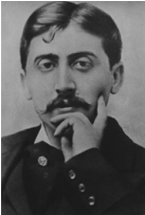
Marcel Proust, "La Mort des cathedrales" ~ Le Figaro, August 16th 1904
I

The magnum opus of Marcel Proust, "Á La Recherche Du Temps Perdu" begins with an image of a church - that of Combray. Proust wanted to construct his oeuvre like a cathedral; and this he intended to show by calling parts of it "Apse", "Window" and "Narthex". He thus likened the work of a writer to a architect, organizing the least parts of the text into an interdependent whole. Both Proust's text and the cathedral are the products of a synthetic spirit, binding together diverse domains of knowledge into a coherent edifice. Panofsky: "The classical cathedral, in its imagery, seeks to embody the totality of Christian knowledge, theological, natural, and historical, by putting everything in its place and by suppressing whatever no longer found a place". For Proust, the cathedrals of France were not only the most beautiful monuments of French art, but also the only works of art which still lived a life of completeness ("...leur vie intégrale...").

However, in 1904, French Socialist parliamentarian Aristide Briand drafted legislation concerning the strict separation of church and state, which was informed by strong anti-clerical sentiments. Briand's legislation declared all religious buildings property of the state and local governments. This threatened to close down many churches, turning them into casinos, banks, museums or conference centres.

This offended Proust's aesthetic ideals so strongly, that he preferred the destruction of the churches over their submission to strictly utilitarian ends. Rather than making the artistic heritage of religion into a tool for production, rather than subordinating churches to utility, churches should be devastated, sacrificed to nothingness, torched.


II

On June 6th 1992, Fantoft Stavkirke, a medieval wooden church near Bergen, Norway, was torched. It burned to the ground.

The church, of the type known as "stave churches", was built around 1150. Between 1100 and 1300 some 1,000 stave churches were built in Norway. Today only 28 remain. The stave churches were built as palisade constructions; thus, their architecture is based on that of fortifications. Their rich ornamentation mixes Christian design with Viking motifs, interweaving theological, natural, and historical imagery into a synthetic whole. The oldest stave church, which is very well preserved, is on UNESCO’s World Heritage List of most valuable cultural memorials in the world.

Why? Why was this stout and beautiful place of worship burned to the ground? Why did other churches follow? Why Holmenkollen Chapel, the church King Harald V and the royal family attended? Why Skjold Church in Vindafjord? Why Åsane Church in Bergen? Why many others?

We will never know. That it is well known who was responsible for the destruction of these cultural treasures - Count Grishnack, Samoth and other Norwegian teenage Black Metal adepts - does not help us any further. In literature, "the author is dead". The same goes for the arsonists: they are dead too. Not in the literal sense, of course. They are dead in the sense that we will never be able to reconstruct the meaning that the crime had for the perpetrators at the time it was committed. This meaning is hidden behind time's curtain.

The motives Varg Vikernes ('Count Grishnack'), acquitted but in all probability responsible for the arson of Fantoft Stavkirke, put forward, illustrate this point. In an interview with Michael Moynihan for the controversial book "Lords Of Chaos" he stated his (hypothetical) motive as follows, without admitting that he was guilty:

"I am not going to say that I burnt any churches. But let me put it this way: There was one person who started it. I was not found guilty of burning the Fantoft stave church, but anyways, that was what triggered the whole thing. That was the 6th of June and everyone linked it to Satanism. (...) What everyone overlooked was that on the 6th June, year 793, in Lindesfarne in Britain was the site of the first known Viking raid in history, with Vikings from Hordaland, which is my county." He also stated "They [the Christians] desecrated our graves, our burial mounds, so it's revenge". In another text: "For each devastated graveyard, one heathen grave is avenged, for each ten churches burnt to ashes, one heathen Hof is avenged, for each ten priests or Freemasons assassinated, one heathen is avenged".

Vikernes's statements do not hold up to scrutiny. It is not only that the Lindisfarne Viking raid did not occur on the 6th of June, but on the 8th. Furthermore, Fantoft Stavkirke had been moved from it's original location in 1883, so it did not anymore "occupy" the place on a heathen Hof. A more fundamental issue with the statements is that in June 1992, Vikernes had not yet "converted" to the Odinist fascism he is currently preaching. Only after being ostracized from the black metal community, Vikernes announced that he was no longer a Black Metal Satanist, but rather a Odinist fascist. In the statements on the Fantoft burning, he is inscribing a meaning into it that it could not have had at the time.

The burning churches are a text which “...consists of multiple writings, issuing from several cultures and entering into dialogue with each other, into parody, into contestation" (Barthes).

So what is there to do but to give meaning to the crime ourselves, as the audience of the fires? After all: "The unity of a text is not in its origin, it is in its destination” (Barthes again).

As a spectator of the fires, seeing them from the perspective of this blog's concerns, I'd like to turn to Georges Bataille's essay in "La Litterature Et Le Mal' on Jules Michelet's 'La Sorcière' to see if that essay can illuminate the path to that destination - the essay as torch light, as a madman's lantern in the bright morning hours.

In the essay, Bataille posits that the popular development of the Black Mass at the end of the Middle Ages may have corresponded to the decline of the Church. In those time, the intense sacrality of the sacrifice of Jesus on the cross was diminished as the Church only served the most conservative cares - like work and the maintenance of life. The Church became too mundane - not awe-inspiring, not frightening enough to be perceived as sacred. The popularity of Black Sabbath points towards an attempt to regain this lost intensity of the sacred. For Christianity, not only God was sacred. Satan too belonged to the world of the sacred, embodying the negative, left handed or transgressive elements of sacrality. More than being merely parasitic on Christianity, Satanism audaciously went "one step beyond", by sacrificing the sacrifice of Jesus. The Satanic sacrifice consists in establishing a means of communication between a Satanic sacred world and the profane world through the mediation of a victim, that is of a thing that in the course of the ceremony is destroyed. In this case, a concept - the sacrifice of Jesus - is destroyed, sacrificed by means of defilement.

So how was the situation in Norway in the early nineteen nineties?

Norway had a State religion; paragraph 2 of the Norwegian Constitution says that “the Lutheran-Evangelical faith is the religion of the state”. Nearly 83% of Norwegians are formally members of the State Church. The Church is closely intertwined with the political life of Norway. Prof. Stensvold: "Throughout the 20th century, the political parties in power have, without exception, used the state church as a political tool and used it as a reservoir and transmitter of a set of (Norwegian) ideals, values and worldview. So far, this has been a surprisingly fertile collaboration for both. Church leaders have willingly supported state legislation". The political life of Norway after the second world war was dominated by social democracy. The Norwegian Labour Party had been part of the Norwegian government almost continuously since 1927. Social democracy's biggest success was the creation of the welfare state, which provides comfort and material security for its citizens. Thus, welfare and religion were brought together by the Norwegian State.

So perhaps the Norwegian State Church became too committed to a life of comfort, impoverishing the sense of the sacred, making the sacred anaemic, unable to inspire enthusiasm, ecstasy. What Proust feared would be the result of Briand's legislation, happened in Norway: churches were submitted to strictly utilitarian ends, becoming a branch office of the welfare state, somewhat like a State bank, a museum, a government conference centre. The result? Norway is a society with one of the highest scores on the secularization scale, Norwegian normative Protestantism is in crisis, and priests have lost their former authority.

And like Bataille's medieval peasantry, the youth of Norway, which was disenchanted by the Church, turned to Satan to experience something awe-inspiring in celebrating the Eternal Exile's feast: the Black Mass. And like Marcel Proust, they preferred torched churches to churches whose "...life of completeness..." had drained away. In a sense, setting fire to the Fantoft Stavkirke, the Holmenkollen Chapel, the Skjold Church and the Åsane Church represented a defilement, a malefic sacrifice of the sacrificed God.


III

The burning of churches had a galvanizing impact on the early-nineties metal scene. The holocaust (in the original sense of the word) of these places of worship gave rise to enormous media attention - see the "Satan Rir Media" post - and conferred a charismatic aura on the Black Metal genre. Through the attention of the mass media, the genre exerted a tremendous fascination on Metal musicians, and many started to play in the style pioneered by Mayhem, Burzum, Satyricon and Emperor. Indirectly, the church burnings brought about a renewal and rejuvenation of Metal. And not only Metal was affected by the crimes of the Black Metal inner circle - the force of it's attraction extended to other musical genres as well, more specifically to electronic music genres. "Black Ambient" and "Black Industrial" came into being.

And this finally brings me to the intended subject of this post: MZ. 412's album "Burning The Temple Of God".

The Swede Henrik "Nordvargr" Björkk (often credited as Kremator - another fire reference) created Maschinenzimmer 412 in 1989. The band changed its name to MZ.412 with the 1995 release of "Burning The Temple Of God"; and it also changed it's image to one of black leather, long hair and corpse paint. Not only did the record's name refer to the church burnings, it's cover art featured a photograph of Fantoft Stavkirk in flames. The album is regarded as the very first "Black Industrial" album, organizing Industrial Noise, Ritual Ambient and Black Metal into a coherent whole. It was put out on the Cold Meat Industry record label, which specializes in Industrial Ambient from Scandinavia.

Putting the burning of a Christian temples center stage, focusing on strategies against ecclesiastical architecture, raises certain expectations about the music: one is led to expect radically destructured music, disjointed and charred compositions, fissures of orchestration, scorched arrangements, incongruities, interruptions, and breaks.

Nothing could be further from the truth: "Burning The Temple Of God" contains highly structured electronic music. Even if the sounds are harsh, abrasive, noisy, they are strictly sequenced. Sequencers were the software with which electronic music was made in the mid-nineteennineties; and a sequence is defined in the Oxford Dictionary as ‘the following of one thing after another; a set of things belonging next to each other in a particular order’; the Industrial, Black Metal and Ambient sounds are organized in relationship to each other according to a constant measure. The musical structures are decorated with samples from horror films, which present a panoply of Satanic occultism: the sounds of ritual magick, daemonic possession, exorcism and witchcraft trials.

MZ. 412's music on this album is architectural, even monumental in nature. It is not so much a cathedral in flames as an inverted cathedral, inverted as the Satanic cross; it is not so much a burnt Mass as a Black Mass. To paraphrase Coil's Jhonn Balance: it is a Black Temple for a Black Pope in Black Rome. Evil, majestic, intimidating.

So is MZ. 412's music a closed system? Is whatever no longer finds a place suppressed? No. A specific sample, placed at the beginning of the sixth track called "Submit And Obey", is an opening which provides some fresh air, an escape route from the Satanic edifice. In the sample, a young woman with an English accent and an incredulous, sarcastic tone speaks the following words:

"I told them we eat babies and drink piss. I told them we watch corpses being raped by dogs and shit on the host. I told them a goat with a prick of hot iron comes out of the trees and will all kiss its rump by the light of living children buried in excrement up to their necks with their heads on fire. And they believe it! Every word! They cross themselves with every new abomination and thank the Lord for bringing this poor monster into the light of His redemption".

Though scornful of Christianity, these sentences also point to the fact that the Satanic crimes of the Black Metal inner circle were the last word. "The mythical man is dead, leaving us his final message - a black laugh".


IV

Burning churches is a thing of the past; a crime which now can only have a impoverished and nostalgic meaning. Georges Bataille in 'Literature And Evil': "I do not believe this type of provocation will ever lose its power of seduction, but the effect of seduction is subordinated to the interest of a purely external success, to preference for a deception which can be immediately appreciated. The servility of this type of quest for success is the same in the author and the reader. Each one, author and reader, avoids the pangs, the annihilation of sovereign communication. They both limit themselves to the prestige of success".


Post scriptum

The first to paragraphs of this post are heavily indebted to Denis Hollier's "Against Architecture. The Writings Of Georges Bataille" - a book with a burning cathedral on it's cover, the Cathedral of Reims in flames after being bombarded by the German armed forces on September 19th, 1914.

Interviews with Nordvargr can be found here and here and here.
An interview with MZ. 412 member Drakhon can be found here.

A beautiful post on churches, pilgrimages and apocalypse, can be found on the Ecclesiastical Proust Archive blog (link).

Apparently, the Fantoft church, which was torched by Varg Vikernes but rebuilt, has become a place of pilgrimage for Black Metal adepts, much to the dismay of the churchgoers (link).

An excellent interview from the Observer with Mayhem's Necro Butcher, penned by Chris Campion, provides much information about the Dream Time of Scandinavian Black Metal (link).

Another long piece on Norwegian Black Metal (link).

Here is a link to the Unholy Black Cult website, a web museum for Black Metal.

Monday, April 09, 2007

Abruptum - Post Scriptum

On a somewhat overcast second Easter day, listening to Bach's "St. John's Passion" and "St. Matthew's Passion" and to Abruptum's "Evil Genius" (all works of agony and suffering), I wrote a post scriptum to yesterday's post on the latter album. If you haven't read yesterday's post yet, I advise you to read that first.

Genius?
It is ironic that music (stubbornly, I keep using that word) which sounds so retarded should bear the title "Evil Genius" - there are light years between the dark and dank grotto which Abruptum would surely inhabit and the high-tech marvels of the lairs of evil geniuses like dr. Fu Manchu and Ernst Stavros Blofeld. Abruptum sounds like a caveman, not like Brainiac!
But perhaps the word 'Genius' should be understood in it's original meaning of 'tutelary spirit' - animistic deities from Roman mythology, spirits which guarded over individuals, regions, families, households and cities - in short, over social communities. And of what community is Abruptum's "Evil Genius" the tutelary spirit? Of the band Abruptum (in a anthropological sense, a band is without doubt a community)? Of the community of early nineties Scandinavian Black Metal musicians? Of the (imagined) community of Black Metal fans? We cannot know without interviewing Abruptum, we cannot know without anthropological fieldwork. But surely it is a wrathful spirit, one that will blight the community if it is not properly placated. It is an Evil Genius, after all.

Abyss
As discussed in the previous post, Abruptum's soundtracks are a recursive audial image, creating a double mirror effect which is intended to act upon the listener. "And when you look for a long time into an abyss, the abyss also looks into you" (Nietzsche in 'Beyond Good And Evil'). To make the abyss look back into him, was exactly what IT desired his music to do.

Dark mirror
Abruptum's soundtracks functioned as a mirror, as a tool which served to enable IT to see introspectively deeper into his inner being, to reach further along the dark road to 'utter hell'. As such, the cd is a scrying device, a tool for divination, used to seek out signposts along the road which leads to his darkest recesses. The cd can be likened to John Dee's famous obsidian scrying mirror, which he used to call forth his spirits.
IT: "With Abruptum I have attempted to conjure up and beckon my wrathful demons, befriend them and compose them to an utterly natural element of myself".
In this sense, IT is one of those religious specialists known as diviners or shamans, a ritual technician of ecstasy, who uses his ecstatic audio material for sorcerous purposes, who uses the external power of magical rites and paraphernalia to consciously do evil.

Ear
As Roland Barthes points out in "Sade, Fourier, Loyola" modernity changed the hierarchy between sound and image, priviliging the latter over the former. 'Hearing is believing' became 'seeing is believing'. Before modernity, hearing came first; believing meant listening to the word of God: auditum verbi Dei, id est fides.
Abruptum's scrying method uses the ear, not the eye. Sound, not image, points the way towards the essence of evil. In this sense too, Abruptum is premodern.

Links
Here is a link to an interesting article (Word-document) on Bataille and medieval mysticism, an article which provided some of the inspiration for the post.
Here is a link to an 1994 interview with IT.
Here is a YouTube link to a Dr. Who (!) video with Abruptum music from "Evil Genius".

Tuesday, January 16, 2007

Open The Dark

In 'The Pleasure of Text', Roland Barthes wrote: "The more decent, well-spoken, innocent and saccharine a story is told, the easier it is to invert it, the easier it is to blacken it, the easier it is to read it against the grain".

Of course, this is the reason why many of the playlists I post are inversions of the titles of tracks of Boards of Canada - their most recent cd, "The Campfire Headphase", turning away from the haunting, Coil-like soundscapes of the "Geogaddi" album and turning towards "decent, well-spoken, innocent and saccharine" electronica.

Thus, the title of the following playlist, "Open The Dark", is an inversion of Boards of Canada's "Open The Light".

1. Chris Watson - "Low Pressure. Glen Cannich, Inverness-Shire, Scotland" from the "Stepping Into The Dark" cd;

2. Svarte Greiner - "Final Sleep" from the "Knive" cd;

3. Coil - "At The Heart Of It All" from the "Scatology" cd (which must be one of the most Bataillean cd's ever made);

4. Dead Raven Choir - "October Tragedy" from the "Death To Dead Wolves" cd (download it from DRC's site here);

5. Burzum - "Hvis Lyset Tar Oss" from the cd with the same title;

6. Leviathan - "The Fourth Blind Wound" from the split with Sapthuran (download it from Southern Lord's website here);

7. Coil - "Ubu Noir" also from the "Scatology" cd;

8. Art Ensemble Of Chicago - "Thème Amour Universel" from the "Les Stances A Sophie" cd;

9. Ennio Morricone - "Fumeria D'Oppio" from the wonderful "Crime And Dissonance" compilation cd (originally part of the sound track for the 1980 film La Storia Vera Della Signora Della Camelie);

10. Goblin - "Sighs" from the utterly classic "Suspiria OST" (IMDB link here);

11. Xasthur - "Nocturnal Poisoning" from the cd with the same title;

and finally

12. William Basinski - "Shortwavemusic" from the Raster-Noton compilation cd "Archiv1".